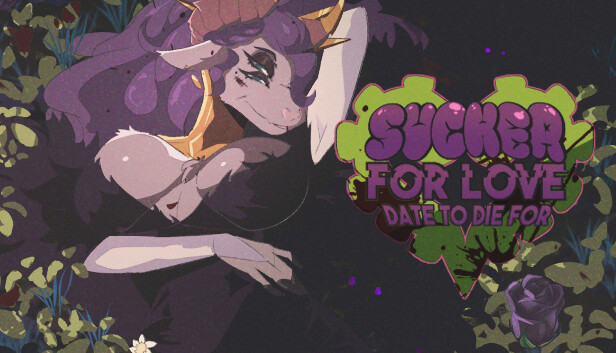
Dating sims live or die on how much you’re allowed to actually know the person you’re falling for, and horror games live or die on how much you’re kept in the dark. Very few games manage to serve both masters at once without one genre eating the other. A letter that looks like it came from her dead parents is what pulls Stardust back to her childhood home in Sacramen-Cho at the start of Sucker for Love: Date to Die For, Akabaka’s follow-up to the cult favorite Sucker for Love: First Date. She’s asexual, not driven by romance the way this genre usually assumes its protagonists are, and what she actually wants is simply to get out of town alive once she realizes everyone she knew there is gone and cultists are closing in.
Trapped and armed with nothing but a cultist’s spellbook, Stardust finds instructions for summoning something called the Black Goat of the Woods and does it almost out of desperation, which is how Rhok’zan ends up entering her life. Helping Rhok’zan fight back against the cult means performing rituals built from items scavenged around Stardust’s own family home, used in different combinations depending on the specific chapter and its specific threat, a survival mechanic that gives the four chapters more to actually do than just reading through story beats.
That structure loops back on itself too. Stardust keeps returning to the same stretch of woods to help Rhok’zan, and a different cultist antagonist, a hot-headed one named Buck chief among them, takes center stage in each of the four chapters depending on who actually survives the previous loop. It’s a clean way to keep the game’s Lovecraftian influences, drawn explicitly from stories like The Dunwich Horror and The Shadow over Innsmouth, feeling different chapter to chapter instead of repeating the same beats with new wallpaper. Each chapter also carries two possible endings, and reaching the specific one flagged as the true ending is what actually unlocks the next loop.
The real interest here sits with the cultists and the ordinary, broken people orbiting Rhok’zan rather than with Rhok’zan’s own cosmic nature, and that choice gives the writing somewhere real to go instead of just gesturing at unknowable horror the way this genre usually settles for. Watching what people are willing to do, and who they’re willing to hurt, in service of something they don’t actually understand stuck with me more than any of the game’s jump scares did.
Rhok’zan herself is the whole show, and having just one dateable entity this time instead of the three First Date offered could have made the game feel thinner for it. The opposite happens. Concentrating the writing on a single relationship gives her room to develop that First Date’s split attention across three separate monsters couldn’t match, and by the end she reads as a properly realized character rather than a horror comedy bit stretched across a full runtime. The narrower scope turns out to be a real strength rather than a limitation.
Presentation marks a clear step up from the first game too. The hand drawn, 90s anime inspired art style carries real nostalgic charm, and 360 degree explorable environments, presented in a first person adventure format rather than static VN backgrounds, give Stardust’s childhood home and the surrounding woods an actual sense of place that most visual novels never bother building. It’s an ambitious technical choice for what’s still fundamentally a small, solo developer project, and it pays off in how much more immersive the exploration segments feel next to typical point and click VN navigation.
The tonal balancing act between horror and comedy remains the series’ signature move, and Date to Die For threads that needle just as well as its predecessor, funny character writing sitting comfortably alongside real dread and, in the back half specifically, real heartache I wasn’t expecting from a game this openly silly about a goat woman. A returning figure from First Date, an eccentric, theatrical woman who reads as this world’s take on the King in Yellow, shows up here too, and the moment the two games visibly connect landed for me even without every detail of the first game fresh in memory.
The whole thing runs short, somewhere around five hours to see nearly every ending across all four chapters, and there’s no cloud save support, which stung a little on a game clearly built for exactly the kind of session based Steam Deck play that gap makes harder. Neither complaint undid how much I enjoyed the time I did spend with it, but they’re real gaps for a fifteen dollar release.
Verdict
Sucker for Love: Date to Die For takes the central gimmick of its predecessor, that you can fall for a Lovecraftian horror and mean it, and refines it into something more focused and emotionally resonant by narrowing its cast down to a single, richly developed relationship. The time loop structure keeps its four chapters feeling distinct, the hand drawn first person exploration is a real, ambitious touch for an indie release, and Rhok’zan proves that less can be more when the writing commits fully to one character. A short runtime and the lack of cloud saves are real, worth-knowing gaps, but new players will still get plenty out of this on its own, and playing First Date beforehand only rounds out the series’ running gags and tone further.