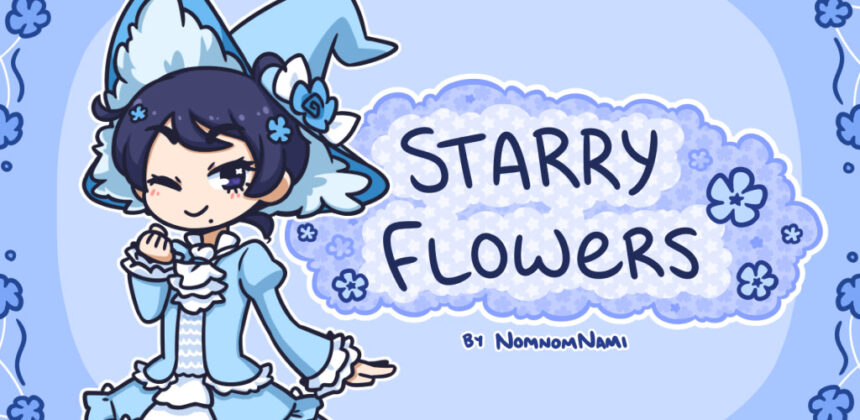
Periwinkle has already figured out the kind of romantic life he wants when Starry Flowers begins. He’s a perfume-making witch who enjoys dressing up, going to parties, and dating without looking for anything particularly serious. Then he meets Pastille at a candy shop, asks him out, and discovers that maintaining that comfortable distance becomes considerably harder when the person across the table is someone he actually wants to keep seeing.
The arrangement between them is deliberately casual at first, and Starry Flowers gets much of its momentum from watching the limits of that arrangement become increasingly inadequate. Neither character needs an elaborate external conflict to keep the story moving. NomnomNami instead gives them dates, conversations, awkward admissions, physical attraction, and enough time together for the distinction between enjoying someone’s company and becoming emotionally invested in them to start collapsing. The official description calls it an “extremely sweet slow burn romance,” which is about as concise a summary of its priorities as I could give.
Pastille also brings an unusual history into the relationship. He originates from NomnomNami’s earlier Syrup and the Ultimate Sweet, where he is connected directly to Syrup and the magical candy-making world established there. Starry Flowers therefore isn’t introducing an entirely isolated cast or setting. It belongs to a larger collection of interconnected NomnomNami stories, and familiarity with those games adds context to returning characters and references. I never found that history necessary for understanding the central romance, though. Periwinkle and Pastille’s relationship is given enough room here to work as its own story rather than requiring the earlier games as homework.
That independence is important because Starry Flowers is remarkably focused. NomnomNami lists the script at approximately 27,000 words and estimates around two hours to finish it. There isn’t enough space for the story to wander through a huge supporting cast, multiple elaborate subplots, or complicated route structures, so most of that time remains concentrated on the developing relationship between its two leads.
The result feels closer to spending a concentrated stretch of time with a couple than navigating a conventional dating simulator. Periwinkle isn’t choosing between several possible partners, and I wasn’t constantly watching an affection meter to make sure I’d selected the mathematically correct response. The pleasure comes from seeing two already-attracted people gradually discover that the emotional boundaries they established are considerably less stable than either initially assumed.
Periwinkle carries much of the story’s personality through his presentation alone. Fashion isn’t treated as an incidental part of his character design. Starry Flowers includes a dedicated dress-up feature that allows players to choose from numerous accessories and style him for his dates with Pastille. It’s a small mechanic, but one unusually well matched to the protagonist rather than added simply to give the player something interactive to do. NomnomNami specifically advertises the feature around making Periwinkle look cute for those dates, and that’s essentially its entire purpose.
I liked that simplicity. There is no need to pretend choosing an accessory will radically alter the course of the relationship. Instead, the feature lets me participate in something Periwinkle himself cares about. His appearance becomes another expression of the anticipation surrounding a date, and deciding what he should wear gave me a tiny amount of ownership over scenes whose narrative direction otherwise belongs firmly to the author.
The artwork supports that approach beautifully. NomnomNami handled the story, art, and music personally, giving Starry Flowers an unusually unified creative identity. The same pastel-heavy, hand-drawn sensibility runs through the characters, environments, interface, and romantic illustrations, so nothing looks as though it wandered in from a different production. The visual softness is particularly appropriate for a story that spends far more time creating warmth between its protagonists than manufacturing dramatic threats around them.
That doesn’t mean the romance is completely frictionless. The central problem is simply more intimate than spectacular: Periwinkle’s established approach to dating stops matching what he feels. Starry Flowers doesn’t need a villain to create tension when the original agreement between its protagonists is already becoming increasingly difficult to maintain.
Pastille works especially well opposite him because their personalities don’t make the relationship feel like two versions of the same character flirting with each other. His connection to the magical candy world also gives him a history beyond simply being “Periwinkle’s love interest.” Returning players can recognise that wider context, while newcomers are given the information necessary to understand who matters in this particular story.
The game is also more mature about their attraction than its extremely cute presentation might initially suggest. NomnomNami explicitly recommends it for players aged sixteen and older because the two adult protagonists have a sexual relationship and the script contains sexual themes and strong language, although intimate scenes fade out rather than showing explicit sexual activity. That distinction matters because describing Starry Flowers simply as wholesome risks misrepresenting part of what the relationship actually is. Periwinkle and Pastille aren’t written as an abstractly innocent couple who happen to hold hands occasionally; physical attraction is part of their relationship alongside the emotional attachment developing between them.
What surprised me more was how comfortably the game lets those different sides coexist. The cute artwork isn’t contradicted by two adults being attracted to one another, and the romantic sincerity isn’t undermined by acknowledging that attraction. Both simply belong to the same relationship. That makes Periwinkle’s growing attachment more convincing because the story doesn’t need to transform an initially casual connection into something completely different before treating it as meaningful.
Music remains similarly personal to the project. NomnomNami composed the game’s music, while the ending theme, “Pretty in Pink,” is credited to Marlene Bellissimo. Having the developer responsible for the script, visuals, and regular score gives the production a consistency that is easy to take for granted in something this small. The ending song provides one of the few moments where another credited creator steps into that otherwise largely solo production.
Finishing the main story also opens a bonus gallery containing additional scenes. It’s a sensible reward for a game whose primary appeal is spending more time around these characters rather than mastering a complicated system. The official feature list specifically advertises those extra scenes alongside the dress-up component, word count, and slow-burn romance.
Starry Flowers originally appeared in 2021 and remained available through itch.io as a name-your-own-price download for Windows, macOS, Linux, and later Android. NomnomNami continued updating it after release rather than abandoning the original build; itch.io records later PC, Mac, and Android updates. A free Steam edition followed on June 30, 2026 for Windows, macOS, and Linux, introducing the game to a storefront audience five years after its original debut.
That Steam release has also provided a fresh indication of how the story has aged with players. At the time I checked, Steam classified its user reviews as Very Positive, with roughly 98 percent positive feedback. That’s still a relatively small sample rather than evidence of some enormous critical consensus, but it does show that a free romance originally released years earlier has found an enthusiastic new audience after reaching Steam.
The two-hour scale ultimately works in its favour. Periwinkle doesn’t need an enormous character transformation for the romance to feel complete, and Pastille doesn’t need dozens of hours of backstory before his importance becomes believable. Their story is built around a much smaller shift: two people establishing one kind of relationship and gradually confronting the possibility that what they’re building no longer fits the description they gave it at the beginning.
Verdict
Starry Flowers knows exactly how small a story it needs to tell. Periwinkle and Pastille aren’t trying to save a magical kingdom or overcome an elaborate external threat; they’re trying to navigate a relationship whose supposedly casual boundaries become harder to believe the longer they spend together. Keeping the narrative concentrated on that change allows 27,000 words to feel appropriately focused rather than slight. NomnomNami’s control over the writing, artwork, and music gives the game a cohesive identity, while Periwinkle’s dress-up system is a rare bit of visual-novel interactivity that actually tells me something about the protagonist using it. The bonus gallery extends the experience without bloating the main story, and connections to earlier NomnomNami games remain rewards for returning players rather than barriers for newcomers.