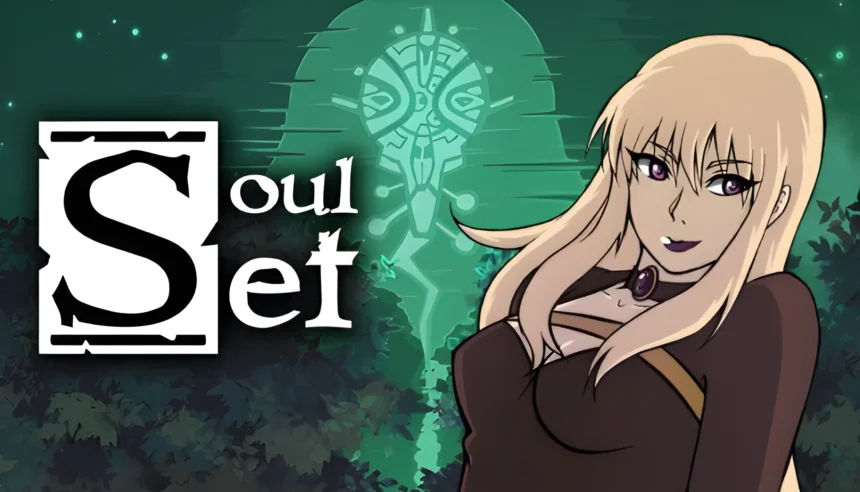
Amnesia mysteries usually begin by taking information away. The more interesting ones eventually make me question whether getting that information back is actually going to make anyone safer. A locked mansion full of people who cannot explain how they arrived there gives plenty of room for suspicion, but the real danger starts when those missing pieces begin returning in the wrong order. SoulSet traps Mariko Blairnot inside an eerie mansion with five other people who claim to have no memory of their past. Mariko is not completely blank herself. She retains scattered memories connected to her mother’s death, a mysterious stranger, and Isshin, the dragon who had been her closest companion, but neither that stranger nor Isshin is anywhere inside the mansion. Everyone is left trying to recover enough of the past to understand why they have been brought together and whether the people helping with that investigation can actually be trusted.
The fantasy world surrounding that mystery is broader than the mansion initially suggests. Magic is commonplace, spirits move among the living, dragons exist despite being rare, and souls carry possibilities that go well beyond ordinary life and death. NoBreadStudio does not dump all of that mythology into the opening at once. The mansion provides a smaller problem to hold onto while the stranger parts of the setting gradually become relevant to the people trapped inside it.
Mariko helps enormously because she does not behave like someone waiting for the rest of the cast to decide what kind of protagonist she should be. She can be assertive, teasing, flirtatious, and direct about what she wants, and that made conversations feel like something she was actively steering rather than merely surviving. Even when the mystery limits what she knows, it rarely strips away her personality.
That becomes particularly useful once the game asks her to choose someone to work with during an attempt to recover the group’s memories. The route system grows naturally out of that decision. Yvonne, Shira, Apris, Shirr, Marco, and Feathor all lead the mystery through different material, Apris has an additional alternate path, and another pursuable route remains hidden until the game’s structure begins opening further.
Romance exists across those routes, but SoulSet does not require it to reach the larger conclusion. Every romance scene is optional, including on the path toward the True Ending. I appreciated what that does for Mariko’s relationships because pursuing someone can remain a choice rather than the price of accessing the mystery. The mansion still has an answer even if attraction is not the reason I am following a particular character.
No individual route provides that answer on its own. SoulSet is deliberately constructed as a multi-route mystery, with information distributed across different paths so that the full sequence of events only becomes understandable after working through them. That makes repetition part of the design problem. Returning to familiar circumstances is unavoidable, but the route structure keeps changing which information matters and what an earlier scene can mean once another piece of context has been found.
The game also builds progression around clues rather than expecting memory alone to carry everything. Its Clue Chart tracks discoveries collected across routes, and later endings can depend on information found elsewhere. Patch 1.2 even altered the post-ending flow so completed routes return closer to the point where meaningful divergence begins instead of forcing every replay back through the entire opening. That is a small quality-of-life decision, but an important one in a story designed around seeing multiple outcomes.
Those outcomes are not all gentle detours. SoulSet has more than twenty possible endings, and several of the bad ones commit to consequences harsh enough that failure never felt like a harmless prompt to reload. That surprised me. Mystery visual novels can sometimes make a bad ending feel disposable once it becomes obvious that it exists only to redirect the player toward the correct branch. Here, some failures carry enough violence and finality that choosing badly still feels meaningful.
The broader content fits that willingness to let things go wrong. SoulSet includes blood, violence, disturbing material, strong language, alcohol use, partial nudity, and implied sexual content. The sexual material remains non-graphic and every depicted character is an adult, while the mystery itself is perfectly capable of creating discomfort without depending on explicit material to do it.
What makes those darker endings effective is that the cast has enough definition for losing someone to matter. Yvonne, Shira, Apris, Shirr, Marco, and Feathor are not simply six differently colored doors leading toward the same revelation. Each route changes which relationships and pieces of history come forward, and the alternate Apris path is another reminder that even choosing the same person does not necessarily mean there is only one useful perspective on them.
Mariko’s confidence gives those interactions an unusual energy for a romance-heavy visual novel. She is often capable of initiating rather than waiting, which changes the tone of attraction considerably. The mansion may control where everyone can go, but Mariko is rarely passive about the emotional distance between herself and another character. That helped keep the romance from feeling like something layered onto the mystery after the important decisions had already been made.
The presentation is more uneven. NoBreadStudio’s three-person team divided the work across writing, programming, character sprites, backgrounds, icons, and event artwork, giving the finished game eighteen backgrounds, more than thirty character sprites with alternate outfits, and galleries for CGs, backgrounds, and endings. Character sprites handle most of the conversational work, while CG illustrations appear more selectively.
That selectiveness sometimes left major emotional moments feeling visually thinner than the writing around them deserved. The text could arrive at something genuinely ugly or revealing while the presentation still depended heavily on familiar sprites and backgrounds. SoulSet does have event CG artwork, so it is not visually limited to portraits alone, but those larger illustrations are not constant enough to carry every scene that might have benefited from one.
The backgrounds do more for the mystery than simple room identification. Arcane details keep the mansion connected to the fantasy setting even when the story spends long stretches indoors, and the differences between rooms help the route-heavy structure avoid feeling as if every revelation happens against one interchangeable wall. The visual variety is modest compared with a much larger production, but it gives the mansion enough identity to function as part of the mystery rather than merely its container.
There is no voice acting, which leaves every conversation dependent on text, sprites, music, and sound. That puts considerable pressure on the dialogue because there is no performance to reshape a flat line or add emotion the sentence itself does not contain. Mariko’s stronger personality helps here. Her conversations already have a clear rhythm on the page, so she does not need a voiced performance to establish who is taking control of an exchange.
The audio works alongside a story that frequently shifts between suspicion, romance, fantasy, and outright danger. SoulSet needs those changes because the mansion cannot remain ominous at exactly the same intensity for more than 100,000 words. Quiet character scenes and dangerous discoveries occupy the same overall mystery, and the soundscape helps separate those moods without changing the game’s basic presentation.
The scale is considerable for a debut made by three people. SoulSet contains more than 100,000 words and estimates roughly ten to fifteen hours for the larger experience, with the actual amount depending heavily on how many paths and endings are pursued. NoBreadStudio released the full game on December 17, 2016 for Windows, macOS, and Linux, with the studio handling both development and publishing.
That small-team origin is more interesting to me because of how deliberately the routes depend on one another. Building six obvious character paths, an alternate branch, a hidden route, more than twenty endings, and a mystery that expects information to travel between them creates plenty of opportunities for one route to accidentally invalidate another. SoulSet instead treats incomplete knowledge as part of the structure. An ending can be correct for what Mariko currently understands without being the end of what the player needs to learn.
The studio later moved on to Blankspace and The Elevator Game with Catgirls, both of which continue NoBreadStudio’s interest in confined spaces, mystery, and characters trying to understand situations with incomplete information. SoulSet is the first finished expression of that interest, and its ambitions are already larger than its mansion setting initially makes them look.
For me, the most convincing proof of that ambition was still the bad endings. The full mystery naturally provides the larger reason to explore every route, but failure having consequences gave those branches weight before I knew where the True Ending was leading. A route was not valuable only because it supplied another clue for an eventual solution. Sometimes it showed exactly how badly events could go when Mariko understood the wrong thing, trusted the wrong person, or simply did not yet have enough of the picture.
That makes SoulSet’s amnesia premise more useful than a convenient excuse to hide exposition. Nobody begins with the information needed to interpret the mansion correctly, and neither does the player. The game keeps changing the value of what I already know until recovering the past becomes less about finding one lost memory and more about understanding which pieces belong together.
Verdict
SoulSet earns its multi-route structure by making incomplete knowledge the central problem rather than using six character paths as separate versions of the same romance. Mariko’s assertiveness gives her relationships much more agency than I expected from the setup, while Yvonne, Shira, Apris, Shirr, Marco, Feathor, and the hidden path each contribute pieces to a mystery that only becomes complete after sustained exploration. The visual presentation occasionally feels thinner than the writing, particularly when a major scene has to rely heavily on familiar sprites, but the more than twenty endings give the choices real room to fail. Several bad endings hit much harder than I expected, and that willingness to let mistakes end gruesomely made uncovering the mansion’s larger truth feel consequential rather than procedural.