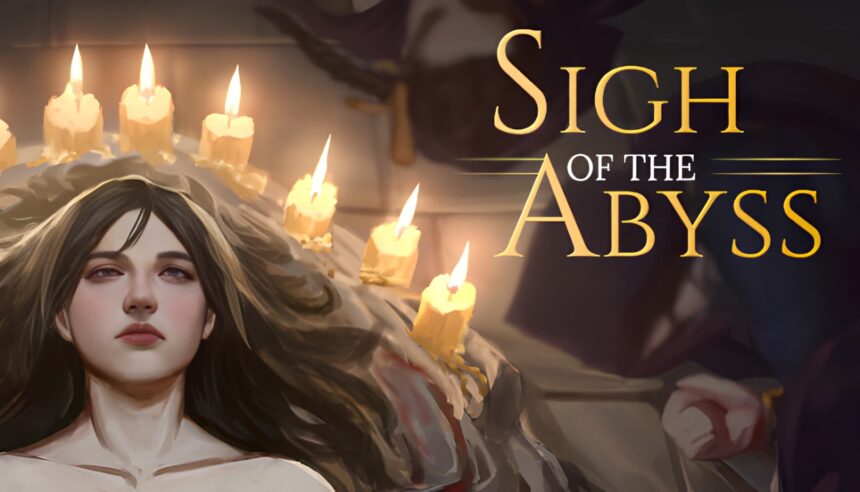
The Envoy spends much of Sigh of the Abyss surrounded by people who want to know who she is, while she survives by insisting that she does not know herself. That answer is convenient because it is also partly true. She wakes after a bloody ritual with no ordinary life to return to, mortal in appearance but carrying the power of the Abyss and the voices of the people whose deaths made her possible. The problem is that fragments of identity still matter, especially around people who might recognize traces of whoever existed before the ritual. What got to me was how often claiming amnesia felt less like exposition and more like self-defense, a way to survive conversations where telling the wrong truth could make everything worse.
Carolise gives her plenty of reasons to keep lying. The Renaissance-inspired port city is beautiful enough to sell itself as prosperous, with Mediterranean warmth, trading wealth, and streets that suggest a place expanding faster than its walls can contain. That beauty exists beside poverty so severe that the contrast becomes political rather than decorative. Beggars watch commerce flourish, nobles benefit from systems the poor keep running, and the whispers guiding the Envoy constantly direct her attention toward the imbalance between people who toil and people who feast. Her creation is supernatural, but the problems she walks into are very human.
That makes the Abyss more interesting than a simple source of forbidden magic. The dead who sacrificed themselves for the Envoy remain present as voices, giving her power while also imposing a kind of inherited obligation. She can use that power to change Carolise, but there is no neutral way to spend it. Saving one person can condemn another, allowing an institution to survive can preserve the suffering built into it, and tearing something down does not guarantee that whatever replaces it will be better. The Envoy begins as a created being with no established place in society and quickly becomes someone capable of deciding what sort of society deserves to survive.
The four-humor personality system keeps that power from belonging to one fixed heroine. Sanguine responses lean carefree and passionate, phlegmatic ones reflective and measured, melancholic choices anxious and fearful, and choleric options impulsive and aggressive. These are not simply four labels chosen from a character-creation screen and forgotten. Dialogue repeatedly lets the Envoy accumulate a personality through the way she responds, so the same political problem can feel very different depending on whether I push her toward patience, fear, humor, or anger.
I liked that none of those directions automatically reads as the correct personality. A choleric answer can cut through evasiveness or create an unnecessary enemy. Melancholic caution can protect the Envoy in one conversation and make her retreat from something important in another. Sanguine confidence can diffuse tension but also feel careless, while phlegmatic reflection can become frustrating when immediate action is needed. The system works because temperament changes how she approaches choices without reducing every decision to a visible good-versus-evil meter.
Her Abyssal gift is equally flexible. One path emphasizes supernatural strength and resilience, turning the Envoy into someone capable of surviving damage and performing feats beyond ordinary humans. Shadow magic opens a different approach built around perception, scrying, movement through darkness, and other less direct uses of power. Dominatio is the ugliest option, allowing her to reach into other minds and bend or break another person’s will. Choosing between those abilities changes more than flavor because particular situations can become easier, harder, or morally different depending on what the Envoy is capable of doing.
Dominatio especially made the wider politics harder to treat abstractly. Carolise already contains systems where one group controls another, and giving the protagonist literal mind control means I can reproduce that same logic in miniature whenever coercion becomes convenient. It is difficult to condemn a city built on exploitation while casually forcing an individual to obey. Sigh of the Abyss does not remove the option just to keep the heroine morally clean. It lets the contradiction sit there.
The mages make that contradiction even sharper. Marané and Ascanio possess tremendous magical value to Carolise while living under restrictions that turn privilege into another kind of imprisonment. The Halls are luxurious, but luxury does not make confinement freedom. Their magic belongs to a system that wants its benefits without allowing the people wielding it to live ordinary lives. The Envoy’s existence is destabilizing because she carries Abyssal power outside the structures that normally regulate it.
Ascanio embodies that history more than anyone else. He looks young, but his relationship to time and power gives him a perspective far removed from the Envoy’s brief existence. Conversations with him therefore have a different texture from the more immediate relationships elsewhere in the cast. He understands the institutions surrounding Carolise from inside them, and his long association with the mages makes it impossible to separate him cleanly from the system that confines them.
Alpheon offers almost the opposite energy. He seeks pleasure and irresponsibility, avoiding the weight that other characters seem determined to carry. That can make him look shallow beside people talking about oppression, bloodlines, and revolution, but the avoidance itself becomes part of what defines him. His connection with the Envoy feels closer to two people trying to decide how much seriousness they are willing to let into their lives, even when the world keeps making that choice for them.
Malec brings another form of inheritance into the cast through the blood-stained legacy he has been handed. Sylas survives from a much less protected position, without a secure home and willing to turn to crime when survival demands it. Marané’s status as a mage places her directly inside the same gilded confinement shaping Ascanio. These relationships matter because the Envoy can befriend them, romance them, alienate them, or become their rival depending on how she behaves. Romance is optional rather than treated as the mandatory reward for completing somebody’s story.
The game supports five romance interests in total, with Sylas and Marané as the two women and Alpheon, Malec, and Ascanio as the three men. Romantic preferences can be set so that only the kinds of relationships the player actually wants will be initiated. I appreciated that because it keeps friendship from feeling like failed romance. Someone can matter deeply to the Envoy without the game constantly suggesting that emotional closeness must eventually become sexual or romantic.
Atri sits outside that romance roster but still contributes to the wider network around the Envoy. That distinction is useful because Carolise needs people whose relevance does not depend on attraction. The stronger political scenes come from the feeling that the protagonist is forming an actual web of allies, rivals, obligations, and enemies rather than collecting partners one route at a time.
The narrative stretches across more than ten chapters and gives those relationships enough room to collide with the larger fate of the city. Choices can determine who survives, who becomes an enemy, which factions gain power, and what Carolise looks like by the end. The conclusions are expansive enough that the final state of the city feels connected to accumulated decisions rather than one obvious last-minute branch.
That scale also prevents the Envoy’s amnesia from functioning as a permanent excuse for withholding characterization. She begins as a blank enough figure that the humor choices and abilities can meaningfully shape her, but the game steadily gives her a history through the people and institutions around her. The more she learns, the harder it becomes to treat identity as something that existed only before the opening ritual. Who she becomes after waking matters just as much.
The codex helps with the amount of world-building surrounding that process. Carolise has social classes, magical restrictions, political factions, religious and supernatural history, and enough terminology that forcing every explanation into dialogue would have made conversations painfully artificial. The codex lets the story move while still giving me somewhere to check the larger context when a name or institution becomes important again.
Visually, the city leans into sunlit Mediterranean inspiration rather than defaulting to gloomy dark-fantasy gray. Warm stone, coastal light, ornate interiors, and saturated outdoor scenes make Carolise appealing enough that its cruelty feels more deliberate. This is not a dying kingdom where everyone can see collapse coming. It is a prosperous-looking place whose beauty depends partly on deciding whose suffering remains out of sight.
The character art follows the same contrast. The cast is attractive and richly costumed enough to fit the romantic side of the game, but the presentation does not soften the blood, coercion, poverty, and political violence surrounding them. Dark fantasy works better here because darkness is allowed to exist in daylight. Carolise does not need endless rain or ruined castles to feel cruel.
Selected scenes are fully voiced rather than the entire script. Maisy Kay voices the Envoy, with Allen Chan as Ascanio, Thomas G. Burt as Alpheon, Jason Daryl-Hall as Malec, Whitney Holland as Sylas, Savy Des-Etages as Marané, Emaline Tuck as Atri, and Aurum Branham as the Abyss. Partial voicing suits the scale because major emotional scenes gain the extra performance without requiring every line across a heavily branching story to be recorded.
The Abyss benefits most from having a voice. Its presence already exists somewhere between guide, creator, creditor, and threat, so hearing it during selected moments makes the relationship feel more immediate than text alone could. The Envoy may wield its power, but the voice is a reminder that the power did not originate with her.
The soundtrack takes a similarly setting-conscious approach, using original music designed to carry some historical character rather than simply layering generic fantasy orchestration over the city. The score supports both the Renaissance inspiration and the darker supernatural material without making them feel like two unrelated settings occupying the same game. Quieter relationship scenes remain warm enough that Carolise can feel livable even when I know what sits underneath its beauty.
Sigh of the Abyss was developed by Rascal Devworks over roughly three years before releasing in October 2024 for PC, with the game also available through itch.io. Shadow Bonds came first in April 2022 as a free standalone introduction to the setting and cast. That earlier release is non-canonical to the finished story, which means it works better as a sample of the world and relationship systems than as required prologue reading.
The full game’s scale makes the solo-development origin especially striking. The personality system, three categories of Abyssal power, five optional romances, branching political outcomes, codex, voice cast, hand-painted presentation, and multiple detailed endings all have to coexist without making the project feel like a collection of unrelated ambitions. Not every strand carries identical weight, but the systems generally reinforce the same central question: what does someone created through sacrifice owe the people whose world she now has the power to change?
For me, the quieter version of that question remained more affecting than the largest political decision. The Envoy repeatedly enters conversations knowing that honesty about herself could be dangerous, while the people around her offer friendship, suspicion, attraction, or recognition without understanding exactly what she is withholding. Saying she remembers nothing protects her, but it also creates distance from anyone trying to know her.
That made even warm relationships feel slightly fragile. The Envoy may be able to decide the fate of Carolise, but she cannot simply hand someone the truth and assume they will still see the same person afterward. Her power comes from dead strangers. Her body carries a history she barely understands. Her personality is still being assembled through every choice. Sigh of the Abyss is strongest when all of that political and supernatural machinery narrows back down to one uncomfortable problem: being loved while never feeling completely certain which version of you the other person thinks they know.
Verdict
Sigh of the Abyss turns a familiar chosen-one premise into something genuinely textured, letting a customizable protagonist and real political stakes carry a dark fantasy romance well past its Renaissance-city dressing. Ascanio’s centuries of perspective against Alpheon’s closer-to-home familiarity gives the romance options real range, and the mages’ gilded captivity gives Carolise’s inequality actual teeth. It’s an ambitious, visually confident solo project that earns the three years it clearly took to build.