The first thing Seers Isle teaches me is not who to trust, but how quickly I start assigning importance to the wrong person. A group of shaman apprentices arrives together, each carrying enough history and personality to look like a plausible lead, and the story is perfectly happy to let those assumptions settle in. I picked favorites almost immediately. I started reading certain choices as though they belonged primarily to Rowan or Jennyver, then gradually realized the island had been framing the entire journey from a perspective I had not understood yet. That shift is what makes the ensemble structure work for me. The cast is not simply large. The game uses that size to hide where its real center of gravity sits.
Seers Isle begins with the apprentices landing on a sacred island where they are supposed to complete an initiation into magic and meet mysterious spirit-guides called the Seers. Before they have even fully settled into the journey, a horned woman begins appearing in their dreams, and the island’s silent, masked inhabitants make it increasingly obvious that the trial is not taking place in an empty wilderness. Nova-box keeps the setup simple enough that the mystery can grow out of the group rather than out of dense lore. There is no need for pages of terminology before something feels wrong. The unease comes from being watched, guided, and tested by forces nobody in the group fully understands.
Rowan and Jennyver gave that mystery its strongest human weight for me. Rowan carries guilt from childhood over the death of a clan chief’s son during a bear attack, a memory the story releases gradually instead of turning into immediate exposition. Jennyver’s grief is different but no less defining, rooted in the loss of her husband and daughter to a plague that devastated her village. The game keeps moving between perspectives without making either woman’s pain feel like a variation of the other’s. That matters because an ensemble can become shapeless when every tragic backstory is written to produce the same emotional note. Here, guilt and grief create different kinds of hesitation, different reactions to the island, and different reasons to either trust or resist the people around them.
The wider cast gives those differences room to collide. Eight major characters share the story, and their relationships change depending on the decisions made along the way. Choices do more than redirect isolated scenes. They influence personality, mood, affinity, and which story paths become available, eventually leading toward multiple endings and different romantic or emotional connections. I liked how quickly the group dynamic stopped feeling fixed. A decision that strengthens one relationship can quietly weaken another, and the effect becomes more noticeable on repeat runs once I already know where particular tensions are heading.
That replay structure is essential because a single playthrough only shows part of what Nova-box built. My first run took close to two hours, and I could already tell by the end that too many questions and character threads remained untouched for one path to be treated as complete. Holding the space bar to skip previously seen dialogue made returning much less tedious, especially once I started deliberately chasing different relationships and outcomes. The limitation is that there is no flowchart or branch map for rewinding directly to earlier choices. If I wanted to change a decision, I had to replay toward it rather than jumping backward through the structure.
Normally that would bother me more, but Seers Isle gives repetition a thematic purpose once some of its endings begin feeding knowledge back into later attempts. I will not explain the mechanism because it is tied too closely to who the story is really following, but reaching an ending that allowed what I had learned to matter on another run changed how I approached the entire replay loop. Going back stopped feeling like ordinary completionism. I was not simply checking alternate scenes. I was bringing information into another attempt at the same journey, which makes repetition feel like part of the narrative rather than an external demand for more playtime.
That is also where the hidden center of the ensemble begins to reveal itself. Someone outside the obvious apprentice structure turns out to matter far more than the opening suggests, and once that becomes clear, earlier scenes take on a different shape. Conversations I had treated as straightforward character moments suddenly felt connected to something larger. The horned woman in the dreams, the Seers, the trial itself, and the relationships among the apprentices all become harder to separate from the question of who has really been guiding the journey. The reveal worked for me because it did not invalidate the cast I had already invested in. It recontextualized why their experiences mattered.
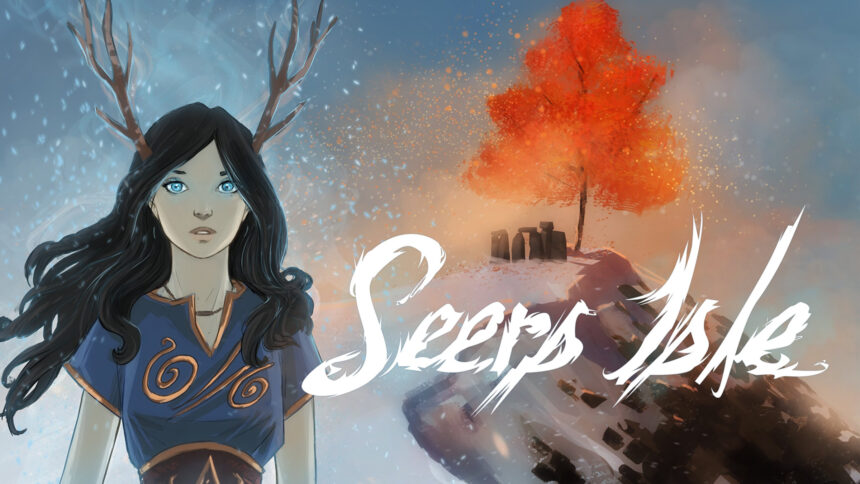
The comic-book presentation helps that recontextualization enormously. More than six hundred hand-drawn illustrations were created for the game, drawing heavily from Franco-Belge comic traditions rather than the standard visual novel arrangement of fixed sprites standing over repeated backgrounds. Dialogue shifts around panels, scenes change framing regularly, and characters are redrawn into different compositions often enough that the story feels directed rather than merely displayed. I found myself slowing down to look at particular images before moving on because the composition itself was doing part of the storytelling.
That density of artwork gives the island a physical identity beyond a list of backgrounds. Forests, shores, dream spaces, interiors, and stranger supernatural locations can be framed specifically for the moment rather than forced to reuse one perspective because the game only owns a handful of assets. It also helps the ensemble. When eight major characters are competing for attention, visual staging can tell me who matters in a scene before the dialogue does. The result feels closer to reading an interactive European graphic novel than watching a conventional sprite-based visual novel.
The soundtrack is just as adaptive. Nova-box built the music to shift with the choices and emotional tone of individual scenes, and the official soundtrack runs for more than ninety minutes. That flexibility matters in a story moving constantly between wonder, tension, intimacy, grief, and dread. I caught myself humming one of the early forest themes long after that scene had ended, which was a good sign that the music had become associated with the place rather than simply functioning as background texture. The score gives the island continuity even as perspectives and relationships keep changing.
There is no full voice acting carrying those performances, so the writing, panel composition, facial expressions, and music have to establish each character’s tone on their own. I never found the silence a problem because the presentation is already so visually active. Speech appears more like part of a comic layout than like subtitles waiting for an actor, and the lack of voices leaves space for the soundtrack and artwork to control pacing. In a more static visual novel I might have felt the absence more strongly. Here, the game already has another way of making scenes feel alive.
The weakness of the ensemble is exactly what I would expect from trying to give eight people meaningful arcs inside a comparatively short narrative. Rowan and Jennyver receive enough emotional room that their histories become genuinely affecting, while some of the others can feel as though I understand the outline of their problems more clearly than the full person behind them. Repeat playthroughs help, since different paths shift attention around the group, but the imbalance never disappears completely. A cast this large creates more combinations than a two-hour route can explore evenly.
That unevenness is easier to forgive because the game is clearly designed around seeing different slices of those characters rather than consuming every arc in one run. Choices determine which relationships deepen and which parts of the ensemble receive more attention, so incompleteness becomes part of the intended experience. Still, there were moments when I wanted another scene with someone just as the plot moved away from them. The game gains mystery from withholding information, but sometimes the same economy leaves a character underdeveloped rather than intriguingly obscure.
Nova-box released Seers Isle in September 2018 for Windows, macOS, and Linux before later bringing it to Nintendo Switch. The Bordeaux-based studio had already established its interest in heavily illustrated interactive fiction through Along the Edge and later continued that approach with Across the Grooves. Seers Isle feels like a particularly confident version of that philosophy because the branching is not just there to advertise multiple endings. Personality, relationships, perspective, and even how the story frames its central mystery can shift based on the route taken.
That is why the absence of a branch map feels like a genuine inconvenience rather than a fatal flaw. I wanted to replay because the structure gave me reasons to replay. The second and third runs were not attempts to repair an unsatisfying first ending so much as attempts to understand what the first run had deliberately left outside my view. Once the game showed me that information from one ending could matter to another attempt, it had already justified asking me to return.
What stayed with me most was the way perspective changes the meaning of the island. On the first pass, the story felt like an initiation journey involving several apprentices carrying private wounds. Later, those same events began to read as pieces of somebody else’s much larger problem. Rowan’s guilt and Jennyver’s grief still mattered, but they existed inside a structure I had not recognized the first time. That is the kind of replay value I care about more than collecting alternate dialogue for its own sake. The story itself becomes different because I understand who is looking at it.
Verdict
Seers Isle earns its replay structure by making later knowledge change how the first journey reads. The eight-character ensemble gives the island enough competing personalities and histories to hide where the story’s real center actually lies, while Rowan’s guilt and Jennyver’s grief provide the strongest emotional anchors along the way. Not every member of the cast gets equal room to develop, and the lack of a flowchart means exploring alternate choices requires more replaying than I would have preferred, but the ability to carry what I learned from certain endings into another attempt made that repetition feel narratively worthwhile. More than six hundred hand-drawn illustrations give the game a striking Franco-Belge comic identity, and the adaptive soundtrack makes the island feel as carefully authored in sound as it is on the page. What impressed me most was how effectively Seers Isle let me believe I understood whose story I was following, then made earlier scenes mean something different once I realized I did not.