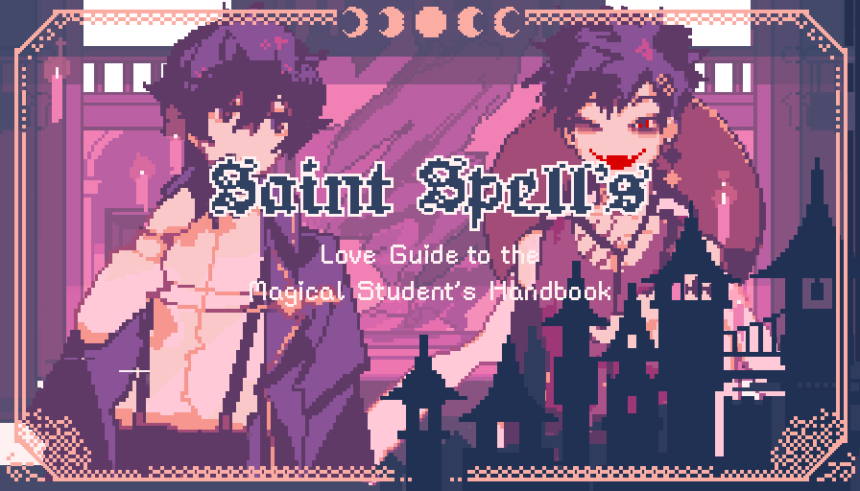
Twenty-nine people is almost an absurd number for a dating sim to ask me to care about. Saint Spell’s Love Guide to the Magical Student’s Spellbook does it anyway, filling its magical conservatory with witches, anima, Seraphims, Fiendish, Clockhearts, and enough different personalities that my first problem wasn’t deciding who to pursue. It was remembering everyone I’d already met. That scale ended up being a large part of the appeal for me. Saint Spell isn’t built around arriving at school and immediately being handed a small, obvious group of romance routes. Its first week throws 29 magical students into the mix and lets me decide who deserves my attention. Some characters interested me immediately, others took longer, and having that much choice gave the school the crowded feeling I wanted from the setting.
The fantasy variety helps enormously. Witches are only one part of Saint Spell’s student population, sitting alongside anima, angelic Seraphims, Fiendish, and Clockhearts. That kept the magical-school premise from feeling like another collection of ordinary students who happen to cast spells. The different character concepts give the conservatory a stranger personality than I expected from its cheerful presentation.
What I actually do there is considerably simpler. I can practice spells, brew a love potion, spend time meeting people, or decide to slack off instead. There are 571 menus across the finished game, so choices appear constantly rather than being reserved for occasional major route decisions. I liked having something to decide regularly because it made the week feel like mine even when the individual activities themselves were straightforward.
The sheer amount of writing behind those choices surprised me most. The current release contains 15,645 dialogue blocks and 173,962 words, along with 159 images and 36 screens. For something created by such a small team, that’s a substantial amount of material to spread across a single school and its enormous cast. That size creates the game’s most obvious tradeoff too. With 29 students competing for attention, I never expected every relationship to receive the concentrated development of a visual novel built around three or four leads. Some characters naturally grabbed me more quickly than others, and the experience became less about seeing absolutely everything in one run and more about deciding whose company I actually wanted to seek out.
I think that approach suits Saint Spell better. The cast works as a collection of possibilities rather than a checklist I felt obligated to complete. On one playthrough I could spend time with characters I had immediately gravitated toward; another gave me an excuse to investigate someone I’d barely considered before. The large roster therefore becomes part of the replay structure rather than simply an impressive number on the game’s description.
The developers continued expanding that structure after the initial Valentine’s release. Version 1.0 added completed routes for Bugbear and Luca, a background gallery, another ending involving Eleni and Siri, additional CGs, and expanded dialogue for several characters. That development history helped explain why the finished game feels packed with small branches and character-specific material rather than organized around one enormous central narrative.
Visually, the pixel-art presentation keeps all of that fantasy material surprisingly cohesive. With so many different supernatural character concepts sharing the same school, a more elaborate visual approach could easily have become cluttered. Instead, the 2D pixel-art style gives Saint Spell an immediately recognizable identity while leaving the stranger species and character designs to provide most of the variety.
The project itself is credited to jiefinch and rence, with bennabun responsible for the world setting and lore. That division makes sense once the scale becomes apparent. Saint Spell feels less like a dating sim constructed around one predetermined romantic storyline and more like an established fantasy setting that happens to let me spend a week deciding which corners of it, and which people inside it, interest me most.
I won’t pretend all 29 students affected me equally, because a cast this large practically guarantees favorites. That imbalance became part of the fun rather than a problem I needed the game to solve. Every new introduction carried the possibility that someone I initially regarded as another face in the conservatory would become the person whose scenes I started actively looking for.
Verdict
Saint Spell’s Love Guide to the Magical Student’s Spellbook wins me over through abundance. Twenty-nine students, 571 menus, and more than 173,000 words give its magical conservatory enough possibilities that one week can unfold very differently depending on who catches my attention. Not every member of such a huge cast can command equal investment, but I preferred having too many potential relationships to explore over being pushed toward a tiny predetermined group. Witches, anima, Seraphims, Fiendish, Clockhearts, spell practice, love potions, and the freedom to simply slack off give Saint Spell the playful identity it needs to support that scale. It is messy by design, enormously ambitious for its team size, and at its best when I stop worrying about seeing everything and simply follow whichever strange student interests me next.