A sequel earns its existence when something that once looked like background decoration suddenly becomes impossible to ignore. Sage Fusion – Chapter 2: Children of Deceit does that repeatedly. The first chapter spent so much time explaining Capistad, the Zeian Church, the Galactic Union, Tarrant, artificial intelligence, and the package Marlon Ziglar had been hired to deliver that the larger conspiracy sometimes felt as though it were waiting behind the actual game. Here, those same pieces stop waiting. Threads that once looked like setting detail begin colliding with one another almost immediately, and the result made the first game’s slower groundwork feel much more deliberate in hindsight.
Marlon remains the wealthy freelance merchant caught in the middle of forces he never intended to confront, with Alvonse Brin beside him as his bodyguard. Their latest delivery to Capistad should be another job, but problems surrounding Marlon’s ship and his client Heinlein pull them back into the same conflict between political power, religion, and secrecy that the previous chapter only began exposing. The important difference is momentum. Children of Deceit no longer needs to stop and teach me what this galaxy looks like before it can threaten the people living in it. Events begin moving almost immediately, and the sequel is roughly twice as long as its predecessor, giving that faster opening somewhere substantial to go instead of burning through all of its energy in the first hour.
That extra space pays off most clearly with characters who previously felt as though they were carrying information the first chapter was not ready to reveal. Alvonse’s anger becomes one of the clearest examples. He spends much of the story carrying a fury that initially looks difficult to explain from the outside, while a mysterious girl observes him from a distance for reasons the narrative deliberately withholds. The more I learned, the less his behavior felt like a bodyguard simply becoming more aggressive because the sequel needed additional drama. His anger belongs to history that the first game had only begun exposing, and uncovering that history gives his presence beside Marlon a different weight.
Vientiane Blaise benefits even more from finally getting the space to explain who she was before the conspiracy reached its current shape. Her role as a Tarrant Spy already made her useful to the first chapter, but Children of Deceit fills in how she arrived there and gives context to choices that previously had to stand on their own. That backstory reframed how I remembered her earlier appearances rather than simply adding trivia to them. The best sequel revelations work that way. They do not just move a character forward. They alter the meaning of material the audience has already seen.
New players are not completely abandoned while all of this prior material is paying off. Rather than opening with a long summary of Chapter 1, the story brings earlier events back through flashbacks when they become relevant to what is happening now. That lets returning players recover details without sitting through a formal recap and gives newcomers enough context to understand why a particular package, person, or political relationship matters at the moment it becomes important. I still think the chapter works better after playing the original because so much of its satisfaction comes from recognition, but it is surprisingly careful about not requiring perfect memory of every previous scene.
The same hybrid structure returns around the story. Sage Fusion 2 still combines visual-novel dialogue, adventure-game exploration, puzzles, and turn-based RPG combat instead of committing fully to any one of them. Battles contain no random encounters and continue using the timing mechanic that asks for a shield icon to be tapped at the right moment, increasing damage when attacking or reducing it when defending. I appreciated the small amount of involvement that adds to fights, even though the underlying encounters remain heavily scripted and can run longer than the tactical depth really supports. The system is functional rather than transformative, but Chapter 2 at least gives it more dramatic situations to work inside.
The amusement-park sequence is where that combination becomes most memorable. An optional fight against an enormous mecha statue takes place from a moving Ferris wheel, giving a familiar combat system a ridiculous set piece that feels completely at home in Sage Fusion’s willingness to mix serious political science fiction with moments of spectacle. The fight itself does not suddenly turn the game into a deep RPG, but the setting gives the same timing mechanics an energy most ordinary encounters never reach. I remembered where I was fighting long after I stopped thinking about individual attacks.
Exploration has been expanded as well, with more areas, additional side quests, and more substantial puzzles than the first chapter. That breadth fits a sequel that is trying to cash in on a world already established rather than simply explain it. Marlon and Alvonse can spend more time moving through Capistad and its surrounding conflicts because the setting no longer has to introduce every institution from scratch. The adventure elements can still feel mechanically light, but they help prevent the large amount of dialogue from turning the experience into an uninterrupted wall of text.
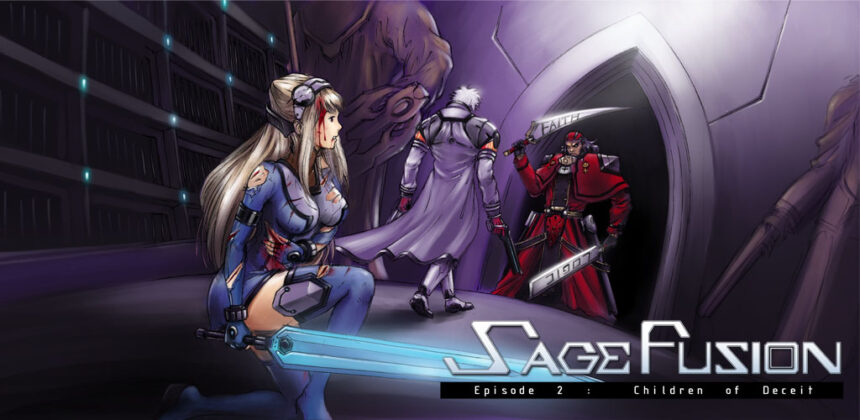
Yohan Alexander’s artwork remains central to how the galaxy holds together visually. He created the original story, character designs, and primary graphic art, with additional artists contributing to a game containing more than 120 hand-drawn backgrounds and story illustrations. The presentation often feels closer to an interactive science-fiction comic than a lavishly animated RPG, but that limitation also gives the series a consistent visual identity. Characters, spacecraft, religious architecture, city spaces, and stranger corners of Capistad all share the same illustrated language. There is not much animation to hide behind, so composition and character art have to carry much of the atmosphere themselves.
Tony Sugianto handled the music and audio, while the game also incorporates classical works by composers including Bach, Brahms, Beethoven, Dvořák, Holst, and Handel. That mixture suits a universe where religion, political ceremony, and futuristic technology are constantly sitting beside one another. The more formal pieces can make institutional scenes feel grander, while the original audio has to carry action and quieter character material between them. The soundtrack rarely called attention to itself as aggressively as the story did, but its range helped the sequel move between conspiracy, personal history, combat, and more reflective scenes without making every location feel emotionally identical.
Writing remains the real reason to continue. Yusdi Saliman handled both the script and game design, working from a setting and original story conceived by Yohan Alexander. That combination helps explain why the narrative and mechanics are so tightly mixed even when the individual gameplay systems remain simple. Battles, exploration, and puzzles are usually there because the story has moved into a situation that calls for them, not because the game needs to fill a quota of combat before the next dialogue scene. The tradeoff is that anyone approaching Children of Deceit primarily for RPG depth is likely to find the systems thin. The design has always treated story as the priority.
What actually got me invested was seeing the old setup stop behaving like setup. The package Marlon was hired to deliver, the tension between religious and governmental power, Vientiane’s position inside Tarrant, and Alvonse’s anger all begin carrying consequences rather than existing as promises about a larger story that might eventually arrive. Chapter 2 is not simply faster because more things happen. It feels faster because earlier information finally has direction. I could trace present events back to details I had already been taught, which made the conspiracy feel constructed rather than improvised.
That payoff matters because Children of Deceit is the concluding chapter of this particular story. Kidalang released it in August 2013, first on iOS and BlackBerry before later versions expanded to Android, Windows, macOS, and Linux. It was explicitly designed as the final chapter resolving the central storyline begun in Sage Fusion, even though the developers left room for the wider universe to continue elsewhere. Knowing that gives the escalation some necessary finality. Questions can still exist around the edges without making the main conflict feel as though it stopped halfway through another setup.
The ending worked for me because the conspiracy eventually feels proportional to how much time the first game spent constructing it. I will not say how its central conflict resolves, but the pieces converge with enough weight that I never felt the story was rushing simply because this was the last chapter. That was my largest concern going in. The first game had accumulated so much political and religious machinery that a short conclusion could easily have reduced everything to one villain speech and a final battle. Instead, the sequel uses its longer runtime to let character history and institutional conflict arrive at the same destination.
Verdict
Sage Fusion – Chapter 2: Children of Deceit is the point where the first game’s patience finally starts paying interest. Marlon and Alvonse return to a Capistad conspiracy that no longer needs hours of introduction, allowing the sequel to move faster while still being roughly twice as substantial. Vientiane’s history gives earlier scenes new meaning, Alvonse’s anger develops into something more than unexplained hostility, and the political struggle between church, government, and Tarrant finally stops behaving like distant world-building. The RPG and adventure systems remain simpler than the story surrounding them, though the Ferris-wheel battle against a giant mecha statue gives the familiar combat its best showcase. What mattered most to me was seeing details planted in Chapter 1 return with actual consequences. As a conclusion, Children of Deceit justifies much of the groundwork its predecessor demanded.