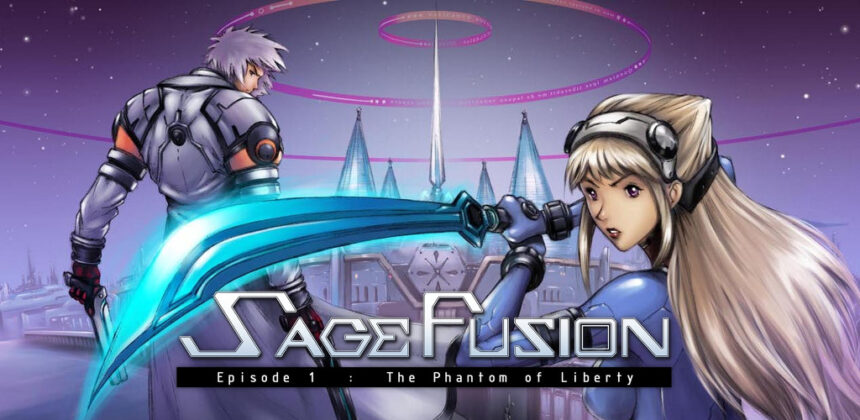
Capistad works best when it stops looking like a destination and starts looking like a trap. Marlon arrives expecting another business trip, Alvonse arrives expecting another job protecting him, and neither man has any reason to believe the planet’s political structure will matter personally. That assumption erodes slowly. The Galactic Union’s liberal government and the Zeian Church are already locked in a conflict far older than either visitor, artificial intelligence is treated as religious heresy, and the more Marlon and Alvonse learn, the harder it becomes to pretend they can simply finish their business and leave. What carried the tension for me was not any one battle or confrontation, but watching two outsiders realize that they have already become relevant to a struggle they barely understand.
Sage Fusion – Chapter 1: The Phantom of Liberty is unusually committed to making that discovery process the game rather than something surrounding a more traditional RPG. Kidalang deliberately removed level progression and equipment customization, leaving no grinding loop to distract from the story. Battles happen only when the plot calls for them, and there are no random encounters padding out the trip through Capistad. That design decision immediately changes how I read combat. A fight is not there because I have walked far enough across a map for the game to roll an enemy encounter. It happens because Marlon and Alvonse have reached a point where conversation or exploration has turned into conflict.
The turn-based system still asks for active participation through timed inputs. Tapping the shield icon at the right moment can increase outgoing damage or reduce incoming damage, while successful defensive timing also feeds the Action Point system used for stronger actions. The timing mechanic draws from the same tradition as games such as Ar Tonelico 2, while battles taking place directly within the surrounding scene recall the seamless encounter approach associated with Chrono Trigger. I liked the system because it keeps encounters from becoming passive, but it never disguises how deliberately limited the RPG layer is. Sage Fusion wants the player paying attention to what a battle means in the story, not calculating an optimized build.
That story takes its time getting moving. The first chapter spends a substantial portion of its runtime establishing Capistad, the Zeian Church, the government, Tarrant, and the larger social rules of a civilization where technological progress can become a religious offense. I could feel the patience required, especially before the conspiracy begins pulling Marlon and Alvonse into more immediate danger. At the same time, the slower groundwork is doing real work. The political tension never feels like a last-minute excuse for action because the game has already shown how deeply those institutions shape the people living under them. When the story finally tightens, the conflict has context.
Amon gives the church side of that conflict a face. His extremism would be easy to write as uncomplicated fanaticism, but the interesting part is the tension between the certainty of his faith and the calculated way he approaches violence. He is not the only figure preventing the ideological conflict from becoming abstract, either. Vientiane and Populux add very different personalities to a cast whose roots stretch back further than the finished game itself. Vientiane was among the characters conceived during the setting’s earlier development, while Populux also grew out of concept work that predated the final release.
That long gestation explains why Capistad often feels as though Marlon has arrived somewhere that was already functioning without him. The setting grew out of an interest in classic space opera and older science-fiction traditions, with the story taking more recognizable form during an unsuccessful attempt to create a science-fiction comic magazine in 2009. When Kidalang later turned toward developing an RPG, that existing material became the foundation for Sage Fusion. The finished game benefits from that history because the world does not seem assembled solely to support Marlon’s current mission. Institutions, religious ideas, character relationships, and political grievances feel as though they existed before the opening scene.
The artwork reinforces that impression. More than seventy hand-drawn backgrounds and story illustrations give Capistad enough visual variety that the setting rarely collapses into a few recycled science-fiction rooms. Yohan Alexander handled the original story, character designs, and primary graphic art, so the visual identity and the world-building come from the same creative source. Futuristic streets, interiors, political spaces, and religious architecture therefore feel connected to the ideas the script is discussing rather than merely decorating them. I found myself paying attention to environments because they helped sell the scale of a society Marlon and Alvonse are only beginning to understand.
Exploration also gives those spaces a little more purpose than static visual-novel backgrounds normally receive. Sage Fusion mixes point-and-click adventure elements with dialogue and RPG encounters, allowing environmental interaction to break up the long stretches of reading. The game still remains heavily text-driven, but moving through locations and examining details makes the political setting feel more tangible than if every revelation arrived through exposition alone. That balance is important because Chapter 1 asks the player to absorb a great deal of terminology and institutional history before it can start paying much of it off.
The music from Tony Sugianto does a lot to keep that information-heavy structure atmospheric. Original music and audio sit alongside additional classical material, giving the game a tone that can move between futuristic adventure and something more formal or ceremonial when the church and government come into focus. There is no voice acting, so every character has to live through writing, portrait work, sound, and pacing instead. I never found the absence distracting because the game is built so thoroughly around reading that voiced dialogue would have changed its rhythm considerably. The score matters more as a way of giving long stretches of conversation emotional shape without competing with them.
Marlon and Alvonse also benefit from the slower structure more than they initially appear to. The game is not only teaching me about Capistad. It is gradually filling in who these two men are and why they remain together despite very different temperaments and responsibilities. Marlon’s position as a businessman gives him reasons to keep moving toward situations a more cautious protagonist might avoid, while Alvonse’s job requires him to follow even when the wider situation becomes increasingly dangerous. Their outsider status makes the world’s ideological conflict easier to enter because neither starts with a complete understanding of what the church or government represents.
That perspective is also why the story’s first-chapter status works better than I expected. Sage Fusion was designed as the opening half of a two-episode story, and it absolutely ends with unfinished business. The closing stretch makes it clear that larger answers are being held for Children of Deceit. What saves it from feeling like an extended prologue is that the game still gives Marlon and Alvonse meaningful development, establishes the ideological stakes with enough detail to stand on their own, and pushes the central conspiracy far enough forward that the cliffhanger feels like escalation rather than the first sign that a plot exists.
The lack of branching is another sign of how tightly Kidalang prioritizes that one story. The visual-novel influence comes through in presentation and dialogue volume rather than route choices or alternate endings. There is one path through the chapter, interrupted by exploration, side material, and combat rather than rewritten by player decisions. That makes the game a poor fit for anyone coming primarily for role-playing freedom, but it also lets the writers control exactly when each part of the political conflict becomes visible. The result feels closer to an illustrated science-fiction serial with interactive systems attached than to a conventional RPG.
Kidalang itself was essentially built around three core contributors. Ivan Haryadi and Yusdi Saliman brought programming experience, while Yohan Alexander supplied the visual and conceptual foundation that became Sage Fusion. Yusdi handled writing, game design, and programming, Yohan handled the original story, character design, and graphic art, and Tony Sugianto provided music and audio, with Ivan contributing additional programming. That small-team structure is easy to see in how concentrated the game’s priorities are. It is not trying to compete through mechanical breadth. Nearly everything is pointed toward delivering the setting and story as clearly as possible.
The first chapter’s biggest weakness is therefore inseparable from what makes it worthwhile. It takes time. The story wants me to understand why the church’s hostility toward artificial intelligence matters, why Capistad’s political balance is unstable, and why people such as Vientiane and Amon occupy the positions they do before the conspiracy can start producing larger consequences. There were stretches where I wanted events to move faster, but the payoff is that when Marlon and Alvonse finally realize how deep the conflict runs, I already know enough to understand why getting involved is dangerous. The game earns tension through context rather than speed.
Verdict
Sage Fusion – Chapter 1: The Phantom of Liberty succeeds because it is willing to sacrifice conventional RPG progression in order to make Capistad itself the main attraction. The lack of levels, equipment builds, and random encounters keeps every battle tied directly to the story, while the timed shield mechanic adds just enough interaction to stop those fights from becoming completely passive. Its opening can be slow because Kidalang spends so much time establishing the clash between liberal government, Zeian religious power, and a society where artificial intelligence is treated as heresy, but that groundwork gives the later conspiracy real weight. More than seventy hand-drawn illustrations give the setting a strong visual identity, Tony Sugianto’s score keeps the dialogue-heavy structure atmospheric, and Marlon and Alvonse work well precisely because they begin as outsiders with no idea how much of Capistad’s conflict is about to become their problem. It ends as the first half of a larger story, but it does enough before the cliffhanger to make the promise of Chapter 2 feel earned rather than compulsory.