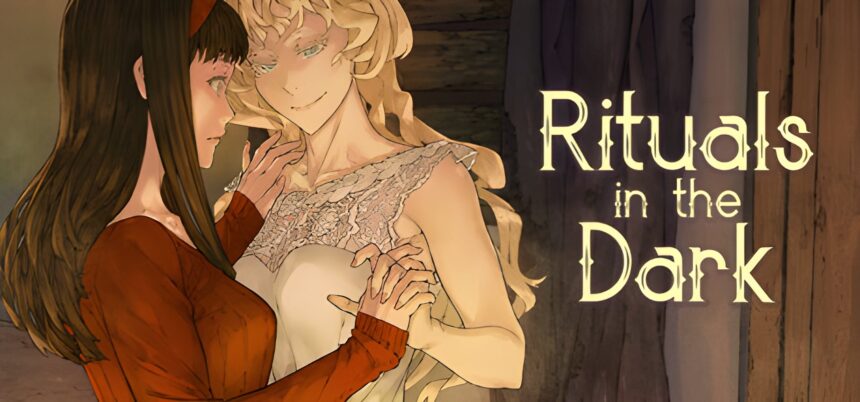
Rituals in the Dark sends Aspen Draper into exactly that kind of dare, pushing her back into the house of her elderly neighbor Mrs. Leigh. Aspen was the last person to see the woman alive and the first to find her dead of a heart attack six months earlier, a discovery that turned her into something of a reluctant local celebrity in Scarborough, fielding intrusive questions about the incident from strangers and friends alike ever since. During a sleepover, her friend Pippa dares her to break back into the now-boarded-up house to disprove a rumor about the place being haunted, and Aspen, too anxious to refuse, goes in expecting nothing and instead meets a ghost named Althea who somehow already knows secrets about Aspen that she’d never told a living soul.
Ebi-hime wrote and coded the whole thing as a short, standalone kinetic novel, released November 20, 2019, three to four hours and roughly fifty thousand words with no branching choices to steer the story in a different direction. It sells for $6.99 on Steam, where it carries seven achievements and Steam Trading Cards support, runs on Steam Deck with some caveats, and has since been translated into German by marantana, Latin American Spanish by Hector Esquivel, and Chinese by Yuri Atelier, on top of its original English text, though the current build isn’t compatible with macOS Catalina or later versions of the operating system. The game later found a second life outside its own storefront too, included in a Palestinian relief charity bundle in 2024 alongside a wide swath of other indie games. Scarborough’s rain-soaked seaside setting stays present in nearly every scene, and the game’s own pitch leans into that specificity directly, billing itself as probably the only visual novel ever set there. I found the constant damp, grey atmosphere doing as much to sell the story’s unease as anything Althea herself ever says or does.
Aspen walks six months of guilt into that house before Althea ever appears, replaying her last conversation with Mrs. Leigh in a way that made her feel less like a horror protagonist. She read more like someone still working through a very real grief, and her friends Pippa and Lakhi round out a small circle of people who care about her without always handling that care well, giving Aspen’s home life outside the haunted house its own quiet friction alongside the main mystery. Althea meets that grief with knowledge she has no obvious way of possessing. The gap between how much she seems to know about Aspen and how little Aspen knows about her kept every scene between them feeling slightly off balance, in a way that worked in the story’s favor.
Long stretches of narration walk the reader through Aspen’s own thoughts between conversations, closer to reading a novel than watching a typical scene play out. That choice slowed the pace down enough that the romance between the two of them had to be taken mostly on faith rather than built scene by scene. What Althea actually turns out to be stays out of scope here, but the reveal recontextualizes every one of those quiet, narration-heavy passages that came before it.
Sinsystem and Renmiou handled character art between them, giving Althea an unsettling presence even in her calmest scenes. Something in how she’s drawn kept me from ever fully relaxing into the romance the way the story wanted me to. Ruderoo’s background art keeps that same seaside town consistent across the empty house and the streets outside it alike, rendered at a clean 1080p that let even the smaller architectural details of the boarded-up house actually register. GUI designer sitraxis built the interface around that same presentation, understated enough to stay out of the way of all that atmosphere rather than compete with it.
Hope composed the eight-track original score, drawing explicitly on The Cure as a stated influence, and tracks like The Smell of Decay and Ashes to Ashes matched the story’s mood closely enough that I could tell what kind of scene was coming just from the first few notes of a new track starting.
By the time the house’s secrets finally came together, I found myself thinking less about whether Aspen and Althea’s romance had been given enough room to grow. I thought more about what that damp, empty house had actually been holding onto for six months before Aspen ever dared to walk back in. A story this short doesn’t have room to waste. Rituals in the Dark spends nearly all of what it has on atmosphere rather than plot mechanics, exactly the trade I’d expect from something built around a dare gone further than anyone intended.
Verdict
Rituals in the Dark leans almost entirely on mood, using Scarborough’s damp seaside setting, sinsystem and Renmiou’s unsettling character art, and hope’s Cure-inspired score to sell a ghost story that its own short runtime never quite gives the central romance enough room to earn. Aspen’s grief and Althea’s impossible knowledge of her secrets make for a real off balance dynamic, even if a kinetic structure with no branching choices means there’s little pulling you back for a second read.