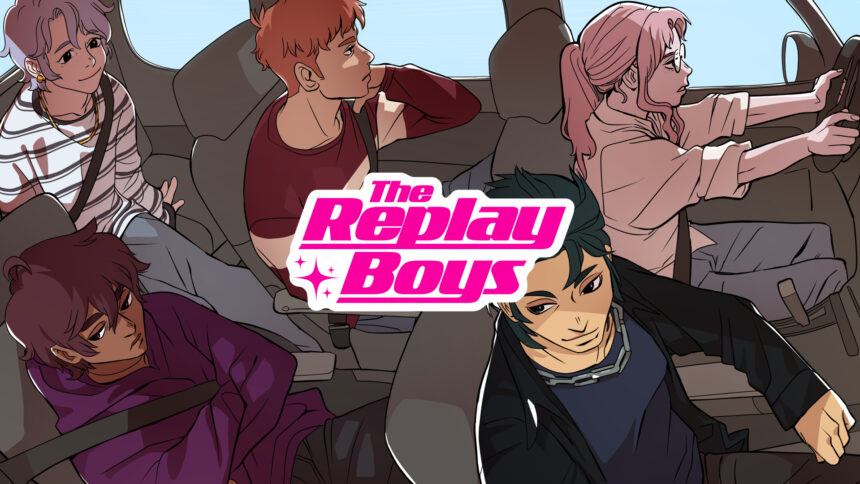
The first thing that started falling apart for me was not the concert. It was the group itself. The Replay Boys already look functional from the outside, polished enough to have fans, management, and a major performance waiting for them, but spending any real time around Jax, Tyler, Niko, and Caleb makes that stability feel increasingly cosmetic. Every one of them is carrying something the public-facing version of the band has no room for, and Hannah gets dropped directly into the middle of those tensions on the exact day she was supposed to be off. Long before ghosts and time loops become relevant, keeping four incompatible personalities moving in the same direction is already enough of a crisis.
Hannah normally works behind the scenes as the group’s video editor, which makes her sudden promotion to emergency manager especially effective. Their regular manager calls in sick immediately before The Replay Boys’ first big concert, leaving Hannah to deal with people she knows more through edited footage than through sustained personal contact. That gap between image and reality becomes one of REPLAY BOYS’ strongest ideas. She has already helped package these men for an audience, yet being responsible for them in person means discovering how little the finished product resembles the people producing it.
Jax makes that difference obvious almost immediately. He is the dancer, a shameless flirt, and easily the most willing to turn any room into a stage for himself. His confidence is useful whenever the band needs somebody willing to act first, but it creates problems just as quickly because he rarely seems interested in asking whether everyone else wants to follow. Tyler sits at the opposite end of that energy. As producer and leader, he carries the pressure of keeping the group functional and looks increasingly like someone whose sense of responsibility has been stretched past anything healthy. Putting those two personalities in the same band gives Hannah two very different kinds of instability to manage: one person who creates chaos because he enjoys moving faster than everyone else and another who risks collapsing because he believes he has to keep everything under control.
That difference carries directly into the romantic side of the story. Jax and Tyler are the two members whose paths can become romances, and they do not feel like interchangeable versions of the same boy-band fantasy. Jax’s chemistry with Hannah comes through friction, teasing, and the possibility that some of his confidence is performance even when there is no audience around. Tyler’s route carries much more of the pressure attached to leadership, making emotional closeness feel tied to whether he can stop treating every problem as something he personally has to contain. The game is not especially long, so some romantic turns arrive faster than I would have liked, but the two routes still have distinct reasons for working.
Niko and Caleb remain platonic, which ended up being one of the smartest choices in the cast design. Niko is the group’s singer and resident conspiracy theorist, strange enough that even ordinary comments can sound as though he is two sentences away from explaining a secret government frequency. Caleb is the newest member, much sweeter and less confrontational than the rest, which gives the group a personality capable of absorbing tension instead of creating more of it. Keeping those relationships non-romantic lets Hannah build intimacy that does not automatically have to become attraction, and it makes the band feel more like a group of people she is learning to care about rather than four candidates waiting for their route flag.
That variety matters once the story starts moving beyond ordinary band dysfunction. Overzealous fans would already be enough to turn the concert into a nightmare, but REPLAY BOYS keeps escalating through conspiracies, a cult, time loops, and eventually a resurrected pop star from the 1980s. Written out in a list, that sounds like several games colliding by accident. Playing through it, I was surprised by how naturally the escalation felt attached to the same basic problem Hannah started with. She keeps being handed situations nobody trained her to handle and then has to decide which person around her is least likely to make things worse.
The time-loop structure is what gives those decisions more weight than a normal sequence of dialogue choices. Outcomes can shift across different timelines, allowing earlier knowledge and different responses to push relationships toward romantic, platonic, or darker conclusions. The game does not treat replaying as simply choosing a different boy from the same opening material. Routes reveal different weaknesses within the group, and the increasingly strange circumstances make decisions that looked trivial on one pass feel more important after I had seen what another path could become.
What actually kept me hooked was watching each member crack differently as the pressure increased. Jax’s ego does not break in the same places as Tyler’s control issues. Niko’s eccentricity becomes harder to dismiss once the story itself starts behaving like one of his conspiracy theories, while Caleb’s sweetness becomes more complicated once being the newest member stops protecting him from the band’s larger problems. I expected the supernatural material to become the main attraction once it arrived. Instead, it kept functioning as another stress test for personalities that were already struggling before anything impossible happened.
The best comedy comes from that same mismatch. REPLAY BOYS knows exactly how absurd its escalation becomes and rarely asks the cast to treat every development with identical seriousness. A cult can exist in the same story as petty band arguments because Hannah does not suddenly stop dealing with interpersonal nonsense just because the larger problem has become ridiculous. That creates a tone closer to controlled chaos than straightforward horror or romance. The story can become darker without losing the sense that these people are still capable of annoying one another over something completely trivial five minutes later.
Split Narrative built the game in Storytime, the studio’s in-house tool for developing interactive narrative projects. That background shows most clearly in how quickly the choices move. Scenes rarely pause for elaborate mechanical systems, and decisions are presented as part of the conversation rather than as a separate layer of gameplay. The focus stays on how Hannah responds to people and what those responses do to later events. It is a visual novel first, but one where branching is central enough that a single run never feels like the whole shape of the story.
The visual presentation supports that pace with stylized character work and full-screen CG illustrations at major moments. The boys are designed strongly enough that their personalities read before the script has to explain them in detail, especially Jax’s performative confidence and Niko’s stranger energy. Important scenes receive dedicated illustrations rather than relying entirely on portraits, which helps the more dramatic turns feel like genuine events instead of another conversation using the same background.
There is no full voice acting, so the writing and expressions have to carry the performances themselves. That never bothered me much because REPLAY BOYS moves quickly enough that voiced dialogue could easily have slowed the rhythm that makes its comedy work. The soundtrack and sound design support the shifts from ordinary band trouble into increasingly strange territory without making the early scenes sound as though a supernatural disaster is obviously waiting around the corner. The escalation works better because the first part of the game is allowed to feel comparatively normal.
Hannah is also important to that rhythm because she is not written as somebody desperate to get closer to celebrities. She already works with the band and is mostly trying to survive the responsibility suddenly placed on her. That gives her relationships with the four members a more practical starting point. She can find Jax attractive and still need him to stop making her job harder. She can care about Tyler while also recognizing how badly his stress is affecting everyone around him. Attraction never completely replaces the fact that she is supposed to get these people through a professional disaster.
The game’s biggest limitation is the same thing that keeps it moving so confidently: speed. Four major relationship paths, multiple endings, time-loop mechanics, a cult, fan trouble, personal crises, and supernatural escalation are a lot to fit into a comparatively compact visual novel. Some emotional developments would benefit from another scene or two before reaching their payoff, particularly when a relationship is shifting from work tension into romance. Niko and Caleb’s platonic paths generally suffer less from that because friendship can develop without needing the same transition into intimacy.
Still, I preferred the game moving too quickly to the alternative of stretching its premise until every strange development lost its surprise. REPLAY BOYS understands that part of the fun comes from wondering what could possibly happen next after the story has already passed the point where a normal concert crisis would have ended. A resurrected ’80s pop star ghost sounds absurd because it is absurd. The achievement is making that absurdity feel like the logical destination of a day that began with Hannah being asked to cover one shift.
Split Narrative first released the Windows version in October 2023, followed by macOS support in June 2024. Xbox One, Xbox Series X|S, and the Windows Store followed in February 2025, expanding the game beyond its original Steam release. The system requirements remain light, which fits a project built around text, choices, illustration, and branching rather than demanding technical effects. It is also available entirely in English, with no spoken dialogue competing with the text-heavy structure.
By the end, the time loops and supernatural chaos mattered less to me than the way they stripped away each member’s public image. Hannah begins the story knowing The Replay Boys as a product she helps present to other people. Managing them means seeing the anxiety, selfishness, insecurity, sweetness, resentment, and fear that editing normally removes. That made the stranger parts of the story useful instead of distracting. Every new crisis gives one of them another chance to stop performing.
Verdict
REPLAY BOYS works because its supernatural escalation never matters more than the four personalities being pushed through it. Jax and Tyler offer genuinely different romances, Niko and Caleb make the platonic paths worthwhile, and the time-loop structure gives replaying real purpose. Some relationships move too quickly, but the cast keeps the chaos entertaining long after the concert stops being the biggest problem.