


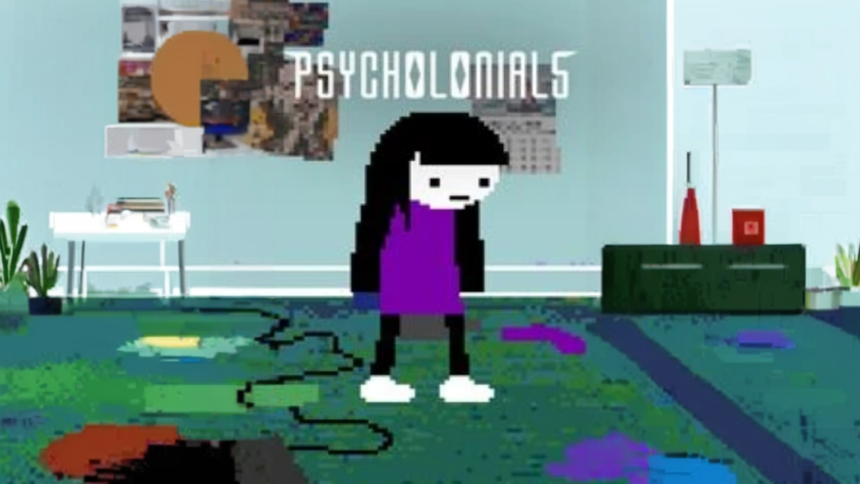
Z., twenty-three and freshly fired from a waitressing job the pandemic killed, spends the early days of quarantine locked into a mostly empty studio apartment on Nantucket. She’s still carrying the wound of an online cancellation from a year before, one that Psycholonials never actually explains. She spends her days trying to claw an audience back through absurdist posts and flirty content, right up until something stranger enters the picture.
Andrew Hussie wrote and illustrated the whole thing himself, publishing it through his own outfit, The Silence Mill Inc., as a nine-chapter visual novel released serially rather than all at once. A mystic vision involving ghosts, her dead father, and a towering shadowy presence looming somewhere out in space is what actually knocks Z off that holding pattern. It convinces her to rededicate herself to something she’d written a year earlier called the Jubilite Manifesto.
Chapter 1 went up on Steam on February 3, 2021, with the remaining eight chapters following roughly every one to two weeks until the finale landed on April 20 of that year. Hussie was forty-one when he started writing it and forty-two by the time it wrapped, a detail that feels oddly fitting for a story this preoccupied with rebranding yourself in real time. The whole thing eventually made its way to iOS and Android too, and a browser version through Homestuck.com arrived exactly five years after that original finale, on April 20, 2026. Translations pushed it into seven additional languages beyond English, making it Hussie’s most translated work to date.
Z’s chaotic, performative online persona plays against Abby’s steadier presence, the friend who ends up bankrolling her through most of the story without much complaint. The game’s own internal system for gender identity runs on a full pyramid rather than the simpler triangle Z eventually settles into using, combining a grey triangle icon with symbols for male, female, non-binary, horsegender, and clown gender assigned to every character in the cast, down to background extras who never get a line. Z invents the concept herself partway through the story and expands it again later, which tracks for someone who treats identity the way she treats her brand, something to keep iterating on in public. She lands on clown gender for herself, described as whimsically detached from the binary altogether, while Abby sits at the pyramid’s opposite corner as horsegender, about as far from Z’s studied detachment as the system allows. Publicly Z goes by she and they, though she keeps a stranger, more personal set of pronouns mostly to herself out of a fear that saying them out loud would make her look insincere.
Familiar conventions carry over for anyone who’s read Hussie’s earlier work. Second-person narration runs through the whole thing, dialogue stays color-coded by character the same way it always has in his writing, and there’s no meaningful interactivity to speak of, just forward momentum through the text. That restraint kept the focus squarely on the writing rather than on mechanics competing for attention, and after nine chapters of it I never once missed having a choice to make.
None of this stays contained to internet culture either. The story is pinned specifically to the days right before the 2020 protests broke out across the US, and capitalism, media consumption, and depression all get folded directly into that politically charged backdrop rather than sitting off to the side as commentary. Z’s own unraveling never once feels separate from the wider moment happening just outside her apartment.
The cast fans out well beyond Z and Abby once the movement actually gets moving. Percy is one of the earliest to get pulled into her orbit, a devoted follower who goes along with whatever scheme she asks of him, and watching his easy loyalty curdle once the stakes turn real is one of the more quietly devastating threads in the back half of the story. Joculine enters as one of Z’s actual haters before ending up folded into her circle anyway, a reversal the story never fully explains and doesn’t need to. Mizzlebip shows up later still, introduced in chapter six as a quiet presence who mostly speaks in emoji, and her hovering, sycophantic devotion to Z reads as unsettling almost from her first scene. The official cast page sorts this sprawling ensemble into named tiers, Ring 3, Zealots, and various successors among them, and even minor players get folded into that hierarchy rather than floating around unaccounted for.
Art carries a clear hierarchy across all of that. Z, Abby, Joculine, Mizzlebip, and the shadowy Riotus all get the same detailed treatment throughout, while the sprawling rest of the Jubilite movement gets rendered in a flatter, lower-resolution style that makes the core cast pop even in crowded scenes. It’s a smart bit of visual triage for a story that eventually fields dozens of named characters without ever losing track of who actually matters.
Crude language, violence, and drug and alcohol use all show up across the nine chapters, worth flagging plainly without dwelling on it further. What impressed me more than any of that was how much the writing is willing to leave unresolved. The story never explains what The Incident that got Z canceled in the first place actually was, never clarifies exactly how her father died, and never spells out the argument that drove a wedge between Z and her mother. Letting all three sit unanswered by the end took real nerve, and it’s a restraint a lot of writers reaching for this much internet-brained chaos wouldn’t have trusted themselves with.
Composer Clark Powell built the score, leaning heavily on cello in a way that gives even the quieter chapters a persistent, mournful undertow underneath the reading and the occasional cutscene. There’s no voice acting anywhere in the experience, which tracks for something this dialogue-dense and internet-native, but the music picks up enough of that slack that the silence never once felt like an absence.
Grief is doing more work underneath all of this than the internet satire lets on at first. Z’s mourning for her father keeps blurring into whatever force actually seems to be steering her rise. The story never lets me settle on whether her visions are something real or something her own mind built to survive the loss. I won’t say how that mystery resolves, or what actually happens to her by the end, only that sitting in that uncertainty carried more weight than a clean answer would have.
The whole Jubilite structure reads, to me, like a piece about fandom leadership dressed up as a doomsday cult, ambition and devotion getting rewarded with tiers and titles the same way any online fanbase promotes its most dedicated members. I don’t think that reading is required to get something out of the story, but once I noticed it I couldn’t stop seeing it in how the Ring and successor titles get handed out as the movement grows.
Hussie’s own public persona had shifted into a strikingly similar clown aesthetic right around the same time this released, gender-nonconforming makeup and all. That’s a parallel close enough that it’s hard to read Z’s arc as pure fiction once you know it’s there. That overlap never once made the satire feel like a vanity project, though, mostly because Z’s specific unraveling stays so grounded in the mundane details of a canceled twenty-something scraping by on a dead-end island in the middle of a pandemic.
Verdict
None of Psycholonials’ internet-brained absurdity stays just absurd for long, not once Z’s grief and the Jubilite Manifesto start pulling in the same direction. Her bond with Abby, sketched through that gender-identity contrast as much as through anything either of them says, gives the whole escalating movement real human stakes underneath the chaos, and a supporting cast this large rarely holds together as well as Percy, Joculine, and Mizzlebip manage to here. The refusal to explain The Incident, her father’s death, or the argument with her mother isn’t a gap in the writing, it’s the whole point, and Hussie trusts that restraint to carry weight a tidier ending never could have.



