“The human heart is but a vessel for pain” is not just a line Perennial Dusk -Kinsenka- uses to announce its mood. The whole story keeps returning to that idea through people who have learned to survive by sealing off some part of themselves, whether that means shutting down emotion, splitting a personality in two, or turning cruelty into something that feels easier to control than vulnerability. That repetition could easily have become empty misery, but what kept the story together for me was how differently each character carries the same basic wound. Pain is never treated as one universal experience. It changes depending on who is holding it.
Matsuri is the most immediately unsettling example. She barely speaks, keeps her eyes closed, and moves only when someone takes her by the hand, giving her the stillness of a doll rather than someone fully participating in the world around her. An incident in her past closed her heart so completely that another personality, Nobody, now exists inside it and surfaces while Matsuri sleeps. Nobody is everything Matsuri is not on the surface: loud, selfish, sharp-tongued, and willing to push against people rather than retreat from them. I found that contrast much more effective than treating them as a simple quiet-girl and wild-girl pairing, because Nobody understands herself as the shield that keeps Matsuri safe from a world that has already hurt her badly enough once.
Manaka Iwami voicing both of them is central to why that distinction works. Matsuri and Nobody share a body, but Iwami gives them such different rhythms and emotional force that their scenes never feel like one performance with a different attitude layered over it. Matsuri’s restraint and Nobody’s aggression create the sense of two genuinely separate presences trying to occupy the same emotional space. The story asks a lot from that casting decision because so much of their relationship depends on believing that one personality can protect another without simply becoming a louder version of the same person. For me, the voice work carries that burden.
The larger mythology gives their condition a place inside the world rather than treating it as an isolated psychological device. People who die while still carrying intense pain and regret can become Maledicts, malevolent spirits capable of attacking the living. The Benio family has spent generations dealing with those spirits, and certain members are Curse Bearers capable of using Maledict-related powers themselves. Matsuri belongs to that family and can give Maledicts form and wield their abilities, which makes her withdrawal from the world especially striking. Someone with enormous supernatural usefulness is still emotionally almost unreachable.
Tsui Benio sits at the head of that family and gives its traditions a much uglier face. She is Matsuri’s younger sister, despite her position as the current family head, and treats the wider Benio household as her children regardless of actual blood relation. The authority she carries is not comforting. Her three internal personalities are all described as cold, cruel, and ruthless, which makes the family structure feel dangerous even before the Maledicts enter the picture. I liked that the human side of the setting could feel as threatening as the supernatural one. The people responsible for putting restless spirits to rest are not automatically kinder just because their enemies are monsters.
Sai Tachibana enters that world from another emotional extreme. He cannot feel pain in his heart and lives almost entirely around protecting his younger sister, often using lethal violence against anyone he decides threatens her. That numbness could have made him impossible to engage with, but Yumiri Hanamori’s performance keeps him from sounding simply empty. There is enough tension in the way he speaks to suggest that the absence itself bothers him, especially once Matsuri gives him an emotional sensation he does not know how to process. His interest in understanding the human heart gives the story a perspective very different from Matsuri’s, because one character has shut feeling away while the other has spent his life wondering what feeling is supposed to be.
The kinetic structure suits that material because no single viewpoint has to carry the entire story. Yukito Urushibara’s script shifts perspective often enough that the emotional burden can move between characters rather than forcing every revelation through one protagonist. That matters in a story built around people misunderstanding themselves as much as they misunderstand one another. A character who looks frightening or unreadable from the outside can become much easier to understand once the narration changes hands, and those shifts keep the story from becoming one long account of suffering filtered through a single consciousness.
The shared home at Maison sans Nom also gives those different personalities somewhere to collide outside immediate danger. Sai joins a group of young residents who are all carrying their own damage while training to confront Maledicts, with Yozora Kandori acting as the reckless adult guardian around them. The apartment setting matters because the story spends so much time asking whether people shaped by violence can still create something resembling ordinary warmth together. Kinsenka is bleak, but it is not effective because every scene is cruel. The smaller domestic stretches give the darker material somewhere to return from, making the moments of connection feel like more than temporary breaks between tragedies.
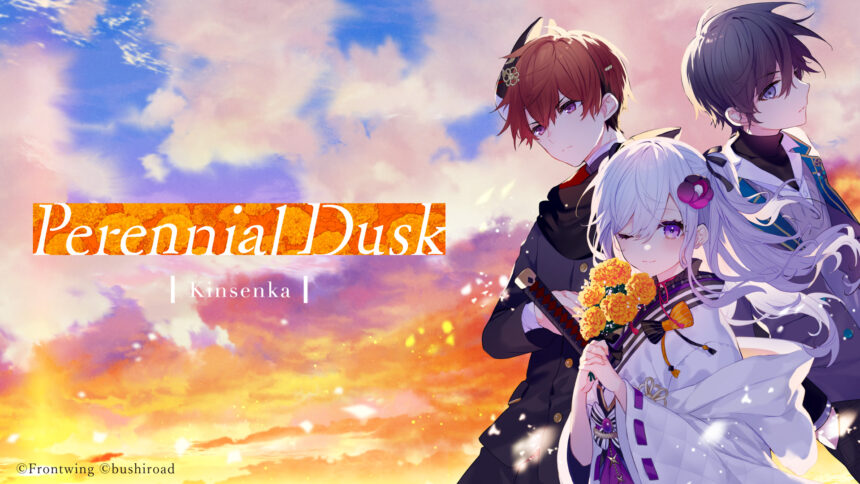
Saine’s character art fits that balance particularly well. The designs remain bright and immediately expressive even when the characters themselves are emotionally closed off. Matsuri’s almost doll-like composure, Nobody’s sharper expressions, and Sai’s numb presentation all communicate personality before the script has to explain it. Saine’s background in Vocaloid illustration and VTuber character design shows most clearly in how strongly each face reads at a glance, which is useful in a kinetic novel where long stretches of dialogue depend on portraits carrying subtle changes in mood. The art can be attractive without making the world feel soft.
The soundtrack works along the same line. Fuminori Matsumoto and Hitoshi Fujima split the background-music duties, giving the story enough range to move between horror, grief, domestic quiet, and the moments where affection begins cutting through all of that emotional damage. The theme song, “Inside Your Memories,” is performed by Mao Uesugi, with Hitoshi Fujima handling composition and arrangement and Yoshikazu Kuwashima writing the lyrics. The score does not need to overpower the script because the writing is already explicit about how much these people are suffering. Its better role is giving that suffering different textures instead of letting every dark scene collapse into the same emotional register.
The full Japanese voice cast strengthens that variation further. Alongside Iwami and Hanamori, Shuta Morishima voices Tatsuki Kanbara, while the wider ensemble includes Hitomi Sasaki, Hika Tsukishiro, Yukina Shuto, Hana Kuga, Takako Tanaka, Reika Fujisawa, and others. Kinsenka depends heavily on characters who can sound detached, volatile, cheerful, cruel, or exhausted without making those states feel interchangeable. The cast gives the dialogue enough personality that the kinetic format rarely feels like a limitation. With no branching paths to create mechanical momentum, performance and narration have to supply it instead.
That linearity is worth emphasizing because Perennial Dusk -Kinsenka- asks for a different kind of investment than a route-based visual novel. There are no alternate romantic paths or major choice trees providing replay value. The appeal comes from trusting Urushibara’s sequence and letting the story build one interpretation of its characters from beginning to end. That can feel demanding in something this emotionally heavy, but I found the commitment worthwhile because the personalities and mythology are designed to reveal themselves gradually rather than be separated into mutually exclusive branches.
Frontwing developed the game, with Frontwing USA and Bushiroad Inc. publishing the Steam release for Windows in May 2025. English, Japanese, and Simplified Chinese text are available, while the Japanese track is fully voiced. The later Nintendo Switch release arrived on April 29, 2026, carrying Japanese, English, and Chinese language support. That broader release makes sense for a project that has been presented from the beginning as a substantial collaboration between Frontwing and Bushiroad Games rather than a small side experiment.
What stayed with me most was how thoroughly the story commits to the idea that surviving pain does not automatically make someone kinder. Matsuri retreats from the world. Nobody becomes aggressive in order to protect her. Sai turns emotional emptiness into violence. Tsui uses authority without becoming compassionate simply because she understands Maledicts. The script keeps returning to the same wound from different angles, and the interesting part is seeing what each person chooses to build around it. That is where the bleakness earns its weight for me. Suffering is not just decoration or a shortcut to seriousness. It changes the architecture of every relationship.
Verdict
Perennial Dusk -Kinsenka- asks for complete trust in a linear story and rewards that trust by making its characters feel shaped by pain in genuinely different ways. Matsuri and Nobody are the strongest example, with Manaka Iwami making one body sound like two separate people whose relationship is protective, hostile, and intimate all at once. Sai’s emotional numbness gives the story another useful counterpoint, while Tsui and the Benio family keep the human side of the setting from ever feeling safer than the Maledicts themselves. Yukito Urushibara’s script is relentlessly bleak, but Saine’s expressive character work and the score from Fuminori Matsumoto and Hitoshi Fujima give that darkness enough variety to keep it from flattening into one note. It is a demanding kinetic novel, but its mythology and voice performances make the emotional damage feel structural rather than ornamental.