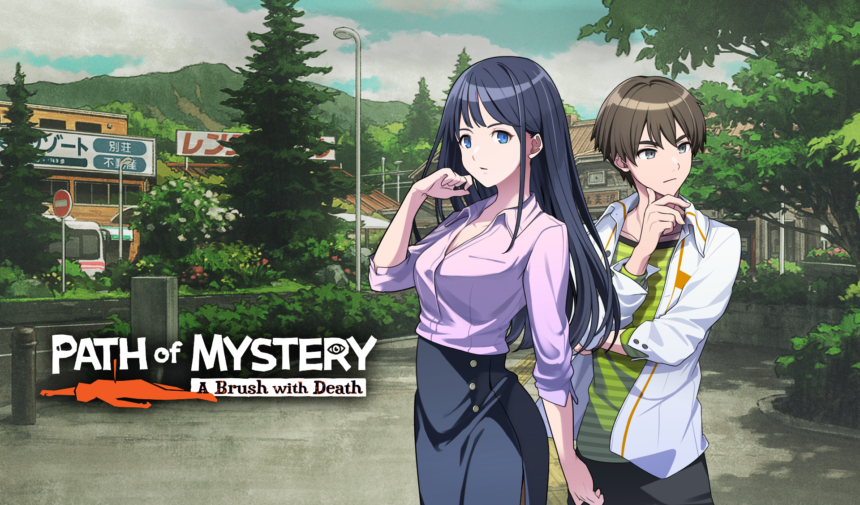
Doppo Akazawa becomes the fourth member of Teito University’s Mystery Research Club after his friend Kotaro Izawa talks him into joining, and the club’s very first real assignment, handed down by their perpetually absent advisor Professor Ayame Minato, turns out to be a case nobody’s touched in thirty years. A famous landscape artist named Suiryu Uchida was found stabbed in the back late one night while painting at his own home, Sanmei Manor, the murder weapon thrown into a nearby pond to erase any prints, his body left face-down beside an unfinished painting with a paintbrush stuck oddly close by. Investigators found the whole scene riddled with unresolved irregularities, and the case was closed only after the prime suspect, Suiryu’s own wife, died in an apparent suicide before the truth could actually be settled.
Path of Mystery: A Brush with Death, known in Japan as Mystery Walk, marks the opening chapter of a planned three-part series, developed by Toybox Inc. with a script credited to the same team behind World End Syndrome, published by Imagineer in Japan and brought west through Aksys Games. Doppo’s own name carries a small joke built into it too, borrowed from the pen name of the famous writer Kunikida Doppo and meaning something close to walking alone or self-guided, which fits a story about someone piecing together the truth mostly on his own even while surrounded by friends.
What Doppo doesn’t tell his new club is that he can travel directly into the past himself, a retrocognition ability that surfaces as a purple haze surrounding certain objects or people, and touching whatever’s glowing pulls him into a brief vision of what actually happened there. He has to keep that secret even from the people relying on his help to crack the case, with only his younger sister Mizuki aware of what he can really do. The story shifts freely between decades, present-day investigation informing what he finds when he steps back into 1994’s version of events, and vice versa. None of this plays out through the usual stock-dialogue guessing that a lot of mystery visual novels lean on either, since actually answering questions correctly or steering fellow club members using what Doppo’s uncovered demands real attention rather than clicking through until something sticks. A lighter tutorial case eases players into that system early, a stolen bundle of idol merchandise on a train and a locked-room puzzle over which of three suspects actually took it, before the Sanmei case takes over as the real weight of the story.
Alice Nanjo carries the title of the club’s self-styled Blue-Blood Detective, sharp enough to keep everyone honest, while Kagero Tono holds the group together as its actual leader, or at least insists he does, playing up an upbringing that reads far more capable on paper than his actual comedic missteps in the moment ever let him live up to. Kotaro’s easy, skirt-chasing friendship with Doppo gives Kagero’s self-importance something to bounce off of, and watching those three very different temperaments argue over the same scraps of evidence gave the investigation real texture beyond just Doppo’s own solo detective work. Uchida’s surviving family, along with Doppo’s own home life through Mizuki, keep pulling the story back toward something more personal than a straightforward whodunit, and a separate thread involving an active, present-day vigilante killer stalking the wider region adds real tension sitting alongside the decades-old case without ever swallowing it whole.
None of the murder mystery weight keeps the tone from staying real funny in places, and that balance carries over into the fictional town of Narumizawa itself, modeled after the real resort town of Karuizawa, charming enough on the surface to make the thirty-year-old crime underneath feel even more out of place. Exploring that town rewards more than just following the case too, since wandering around and talking to residents unlocks collectible keychains, and a handful of simple retro-style arcade minigames, closer to Digger or Asteroids than anything modern, sit around as optional distractions between interviews.
Every present-day scene commits to a cinematic sense of direction, dynamic zooms pulling focus toward whoever matters most in a given moment, character portraits layered and positioned with real intention rather than just standing flat against a background, and character designs that stay grounded in a clean anime style without leaning on exaggerated proportions. Doppo’s visions into the past break from all of that entirely, rendered in a 16-bit retro pixel style that contrasts hard against the modern presentation surrounding it, a choice that reinforces the actual distance between memory and the present rather than just existing as a visual gimmick. A quiet option to hide the dialogue box for clean screenshots of the town’s vistas rounds out a presentation package that clearly had real budget behind it.
Composer Satoshi Okubo, who previously scored Hotel Dusk: Room 215, built a compact score here too, somewhere around ten tracks total, laid-back enough to match the town’s easy atmosphere while still landing a real memorable main theme that stuck with me well after a session ended. The full Japanese voice cast carries real pedigree behind it, Yui Ishikawa, known for voicing 2B in NieR: Automata, plays Alice, Yuki Yonai, recently heard in Trails in the Sky 1st Chapter, voices Doppo himself, Mayuka Tani gives Mizuki her voice, and idol-turned-actress Yui Ogura rounds out the main cast alongside them.
What actually carried the emotional weight wasn’t the murder reveal itself so much as what Doppo’s own ability lets him do, quite literally stepping into someone else’s past and seeing a moment the way they actually experienced it. Using time travel as a stand-in for empathy gave the mystery a warmth that a straightforward whodunit usually skips past, and that warmth extended naturally into the quieter stretches involving Mizuki and the rest of the Uchida family, where the thirty-year-old crime stopped feeling like a puzzle to solve and started feeling like a wound several people were still actually carrying.
Built around a structure of one prologue, ten numbered episodes, and one additional mystery episode marked only with a question mark, the whole thing suits portable Switch play well, running somewhere around ten to twelve hours, translated into English that reads naturally rather than stiffly, setting up two more entries still to come in the wider series. Japan saw the original release in late 2024, with the west following on February 26, 2026.
Verdict
Path of Mystery: A Brush with Death turns a thirty-year-old cold case into something absorbing by giving its amateur detectives real personality and its protagonist a power that reframes what solving a mystery even means. Alice and Kagero’s push and pull against Doppo’s hidden ability keeps the investigation feeling collaborative rather than one-sided, backed by cinematic staging and a deliberate shift into retro pixel art for its flashbacks that elevates familiar visual novel presentation into something more distinct. As an opening chapter to a longer series, it closes its own case while leaving real reason to want the next one.