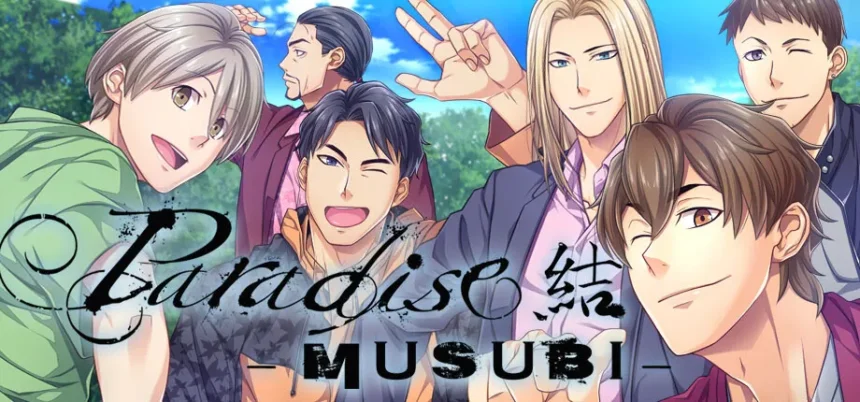
Paradise: Musubi is the lighter of two fandiscs built from the original Paradise, with a second release called Paradise: Kiwame serving as the darker, more intense counterpart released the following year.
A deserted island vacation gone catastrophically wrong made for an unsettling premise in the original Paradise, stranding Azuma and the other winners of a free trip to Togajima island once their supply boat never arrives and the radio goes dead. This fandisc’s whole appeal rests on trusting that the people who survived that ordeal, and stuck around to fall for each other along the way, deserve more time together once the immediate danger has passed. Rather than inventing a new crisis, Musubi picks up directly from each of the base game’s good endings, following Azuma’s continued relationships with the prickly architect Mitsugi, gruff fisherman Matsuda, and bright, secretive Takara.
Pil/Slash developed the game in collaboration with LOVE&DESTROY, the same team behind the original, with JAST Blue publishing the English release.
Once each route’s main content is cleared, Musubi unlocks flashback material retelling key moments from the original story through other characters’ eyes. That structural choice, letting the same events be re-experienced from new perspectives, is a thoughtful way to build out a fandisc rather than simply padding runtime with disconnected epilogue fluff. It gives longtime fans real incentive to revisit story beats they already know the outcome of, since seeing Mitsugi’s or Matsuda’s side of a pivotal scene reframes it in ways the original single perspective telling couldn’t.
Each pairing is already a couple by the time their route begins here, meaning the romance stays in full swing throughout rather than building from scratch the way the base game’s routes did. Mitsugi’s route unravels more of his own mysterious past once he and Azuma are actually living together. Matsuda’s has the two of them facing down lingering shadows from the island directly, and Takara’s follows the pair escaping overseas together before returning to Japan to challenge the authority of his family.
Beyond the three main returning routes, side stories built around supporting characters Hongou and Shimada round out the cast further, giving figures who existed mostly in service of the main trio’s arcs in the original game some dedicated attention of their own. Each route also unlocks new characters entirely, friends, colleagues, and relatives who never appeared in the base game, expanding the world past just the survivors of that original island trip.
The Steam release strips out every applicable CG for an all ages presentation, though written descriptions of what happened during the story’s darker moments remain intact even without the accompanying art, alongside a separate patched adult version for anyone who wants the full original presentation.
Picking up directly from the good endings rather than inventing a fresh crisis to justify more content is what makes Musubi feel like a continuation worth having rather than a cash grab epilogue tacked onto a story that had already wrapped up cleanly.
Verdict
Paradise: Musubi succeeds as a thoughtful continuation rather than a cash grab epilogue, using its reframed flashback structure to give the original Paradise’s story real new value out of scenes a reader already knows the outcome of, while letting Mitsugi, Matsuda, and Takara’s relationships with Azuma develop further than the base game’s endings allowed. Side content for Hongou and Shimada rounds out a cast that deserved more room to breathe, and the Steam release’s all ages adaptation still keeps the story’s darker written content intact even with its CGs stripped out. This fandisc leans entirely on prior familiarity with the original to land, which keeps it from working as a standalone experience, but for anyone who finished Paradise wanting more time with this cast, it delivers exactly that.