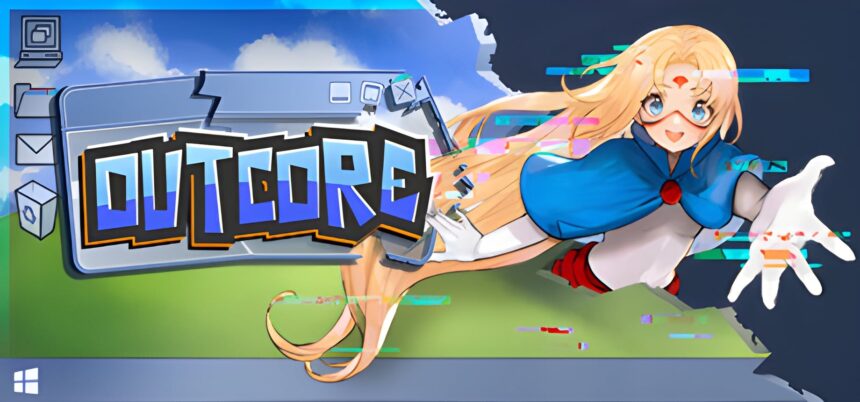
There was a time when inviting a friendly little helper onto your desktop felt perfectly normal. Then enough of those smiling mascots turned out to be annoying, invasive, or outright malicious that an entire generation learned to hesitate before clicking “Yes.” on installing them on their desktops. Outcore: Desktop Adventure understands that instinct, and it spends much of its opening convincing me I was right not to trust it. Instead of confining itself to a traditional game window, Outcore begins by placing a mysterious presence directly onto the Windows desktop. Giving it a file named “Lumi” allows the figure to take shape, revealing a girl with no memory of who she is or why fragments of her past are scattered across the player’s computer. Recovering those memories means searching through ordinary Windows tools and hidden files rather than solving puzzles inside a conventional menu, and I immediately appreciated how committed the game was to treating the operating system itself as part of the adventure instead of a gimmick that would disappear after the opening.
That premise constantly changes how the game expects me to think. One moment I was editing text inside Notepad or manipulating images in Paint to uncover encrypted clues. The next, dragging a recovered memory into a window transported Lumi into a side-scrolling platforming stage representing that piece of her past. Those transitions never felt arbitrary because each platforming sequence exists as another way of exploring information I had already uncovered on the desktop. The result is a game that keeps alternating between puzzle solving and action without making either side feel disconnected from the other.
The platforming itself is more varied than I expected. One stage openly celebrates Sonic Heroes through a casino-themed level built around bouncing hazards and pinball mechanics, while another optional challenge introduced later asks for far tighter movement than anything in the main story. There is also a small scripting minigame where simple commands written in Notepad control an automated character, although players who are not interested in experimenting with basic programming logic can simply let Lumi complete it herself. I liked that flexibility because it kept the joke intact without forcing every player through the same puzzle.
Doctor Shinobi’s writing constantly blurs the line between the player and the game. Outcore clearly draws inspiration from desktop-interactive visual novels such as OneShot and Doki Doki Literature Club while also embracing the legacy of early desktop companions like BonziBuddy. Rather than relying entirely on surprise, it repeatedly plants small details that become meaningful much later, allowing the psychological horror to emerge gradually beneath a layer of cheerful fourth-wall humor. I found that approach far more effective than if the game had immediately announced itself as horror from the beginning.
Lumi is central to making those shifts work. Her curiosity, awkward humor, and willingness to acknowledge the player directly give the story an unusual warmth, and the game rewards curiosity by letting her react to more than just her default filename. Renaming her triggers numerous unique responses, including references to unexpected names and even the developer’s own studio. Those moments are completely optional, yet they reinforce the illusion that Lumi is paying attention to what I am actually doing rather than following a fixed script.
A substantial update released on August 1, 2024 expanded the experience with revised artwork for the “Life” chapter and an optional stage called “Lab.” Unlike the main story, Lab exists almost entirely as a demanding platforming challenge, giving experienced players something mechanically tougher to master without interrupting the pacing for everyone else. The same update also continued the game’s habit of folding technical limitations into its humor by incorporating deliberately scrambled dialogue into the fiction itself for unsupported languages instead of quietly leaving untranslated text behind.
Presentation consistently reinforces the illusion that Lumi has invaded the desktop rather than merely appearing inside a game. Interface elements, fake system windows, file interactions, and animated artwork all work together to blur that boundary. The revised CG illustrations introduced after launch noticeably improve one later section without clashing with the original visual style, and the soundtrack comfortably shifts between playful electronic themes and quieter pieces whenever the story begins revealing more about Lumi’s forgotten past.
Voice acting is used selectively rather than continuously, supporting key scenes without replacing the text-driven presentation. I was unable to verify a complete cast listing, but the performances that are present helped sell Lumi’s personality without overwhelming the game’s quieter moments. More importantly, the audio never distracts from the central illusion that the desktop itself has become the interface.
The monetization deserves mention because it mirrors the game’s own sense of humor. Outcore is completely playable for free, while optional DLC packs mainly exist to support the developer rather than unlock substantial new content. Even the deliberately overlong “Director’s Cut” package openly jokes about premium editions instead of pretending to offer a dramatically different version of the experience. I appreciated that honesty because it left the free release feeling complete instead of strategically incomplete.
Verdict
Outcore: Desktop Adventure succeeds because it commits completely to its central idea. Instead of treating desktop interaction as a novelty, it builds puzzles, comedy, platforming, and psychological horror around the assumption that your computer is part of the world itself. Lumi quickly becomes more than a clever interface trick, and the game’s willingness to reward experimentation keeps the illusion alive from beginning to end. Few free games make such confident use of their medium, and even fewer manage to balance humor, mystery, and genuine unease as naturally as Outcore does.