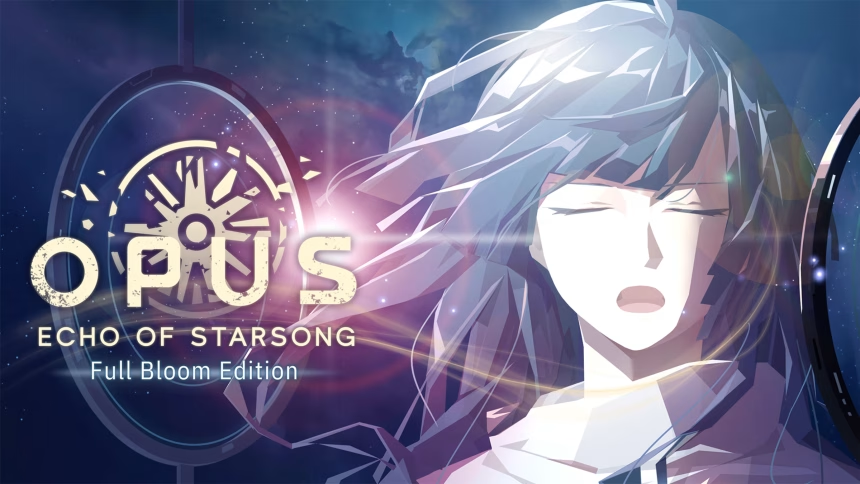
OPUS: Echo of Starsong follows Jun, an exiled young noble chasing a valuable mineral called lumen in hopes of redeeming himself and earning his way back home. His guardian Kay travels with him, and their search turns into something bigger once they cross paths with Eda, a witch who can hear the mysterious asteroid melodies known as starsongs and use that ability to guide their ship toward hidden lumen caves.
SIGONO, the Taiwanese studio founded in 2013 by Brian Lee and Scott Chen, built this as the third installment in the OPUS series, following The Day We Found Earth and Rocket of Whispers. The game first released for Windows and macOS on September 1, 2021. An expanded Full Bloom Edition followed later, adding voice acting for the first time and reaching Switch on May 11, 2022, updating the PC and Mac versions on May 19, 2022, arriving on Xbox that August, iOS that November, and eventually PlayStation 5 in February 2026.
Story is where this game either grabs you completely or leaves you cold, and there wasn’t much middle ground in my own reaction either. The Red Chamber, the ship at the center of the whole journey, becomes a character in its own right the more time I spent flying it between star systems. The slow accumulation of world lore, gods, flowers, exiled clans, a war that ended before the story even begins, gave the setting a texture I didn’t expect from what looked at first like a fairly small character drama.
Eda in particular stuck with me. Her connection to the starsongs isn’t just a plot device, it’s tied directly into who she is and what she’s sacrificing by using that ability at all. Kay’s steadier, more protective presence sits in contrast to that risk, a guardian trying to keep both Jun and Eda from paying too high a price for what they’re chasing, and watching Jun slowly realize the cost of what Eda is doing for him is where the writing does its best work.
Where my patience wore thin was the pacing between those stronger moments. Long stretches of the journey play out through brief flavor text and a couple of lines of dialogue at each stop on the star map, and there were points where I felt like I was collecting scraps of a story rather than actually living inside one.
A side character who could have carried real emotional weight gets removed from the plot fairly early, and I kept waiting for the story to circle back to what that loss actually meant for Jun, only to watch it move on faster than I wanted it to. The dice-based event system tied to exploration and resource gathering technically breaks up the reading, but it rarely felt like it mattered whether I rolled well or poorly. Either outcome nudged the story forward in roughly the same direction, which made those interruptions feel more like pacing filler than real stakes.
The music, given how central singing and sound are to the entire premise, ended up being the single biggest surprise of the whole experience, and not in the direction I expected. Triodust, the composer behind the earlier OPUS soundtracks, worked alongside Chia-Wei Hsu on the score here, with a track called Witch’s Starsongs carrying vocals from a singer credited as Cikado. For a story literally built around the power of a voice, I kept waiting for a theme or a motif that would justify all the talk about starsongs, and it never really arrived. The score is pleasant and unobtrusive in the way most ambient game music is, but nothing in it carries the emotional freight the plot keeps insisting these songs should carry. That gap between what the story tells me a piece of music means and what I actually heard is the single biggest reason the ending landed softer for me than it clearly did for other people.
Voice acting arrived specifically with that Full Bloom Edition update, a real addition for a series that started out entirely text driven. Ikumi Hasegawa voices Eda and Junta Terashima voices Jun in the Japanese cast, with Mitsuaki Kanuka behind Kay, and Sayumi Suzushiro, Asami Shimoda, Megumi Okada, and Kengo Tsujii rounding out Remi, Dr. Rushell, Red, and Bones respectively. Hearing Eda’s actual voice land in scenes I’d previously only read added a layer the earlier text only version simply couldn’t have offered, even with the music around it landing softer than I’d hoped.
None of that means the whole thing left me cold. The low-poly art style, close-up anime portraits layered over blocky, almost toy-like environments, gives Starsong a visual identity that’s its own, and there’s a warmth to how characters are staged during quiet moments, sharing a meal, sitting together watching the stars, that the writing doesn’t always earn through dialogue alone. Jun and Kay’s dynamic in particular has an easy, lived-in quality from the opening scene, the kind of relationship that doesn’t need constant exposition to feel real. The final stretch, once every thread the game has been slowly laying out finally starts pulling together, does deliver a payoff that recontextualizes a lot of the quieter, slower material that came before it. I just wish getting there hadn’t required so much time spent nodding along to characters repeating the same worries about duty and loss for hours on end without much forward movement.
On PC specifically, where I played this, load times between star map locations stayed short enough not to be a real issue, and the interface for managing supplies and crew never got in the way of the reading itself, which is about the best you can ask from the more mechanical half of a game built primarily around its narrative.
Verdict
OPUS: Echo of Starsong tells a story I wanted to love completely and only ended up loving in pieces, a beautifully staged sci-fi romance about sacrifice and memory that spends too much of its middle stretch drip-feeding lore through disconnected flavor text instead of trusting its stronger scenes to carry the weight. Jun, Eda, and Kay all earned real investment from me by the credits, and the closing chapters pull the whole journey together with real emotional force. A soundtrack that never matches the story’s own claims about the power of song, paired with dice-based exploration that rarely feels consequential, kept this from being the complete experience its ending clearly wants it to be.