It is easy to trust a story when the person telling it sounds like they are laughing at themselves. A joke lowers my guard. A self-deprecating aside makes the speaker feel harmless. By the time I started questioning what I had accepted at face value, the problem was no longer whether I believed the narrator. It was how much of the story I had already built around that belief. One Thousand Lies follows Ciarán Endyein, a secondary-school student whose final year is interrupted by a strange email from an unknown sender. The message asks an absurd question about whether a figurine can come to life, and from there the story drifts through school comedy, romance, friendship, and increasingly personal psychological material. Keinart Lobre developed and published the game, which runs in Ren’Py and follows a single fixed path rather than offering branching choices. That makes it a kinetic novel in the strict sense. I never had to decide what Ciarán should do. My role was to decide what I thought about what he was telling me.
That distinction ended up mattering far more than I expected. Ciarán writes, jokes, deflects, and turns awkward moments into performances, so his personality becomes part of the structure rather than just another character trait. I initially treated his exaggerations as part of the comedy. The longer I read, the more suspicious I became of the distance between the way he presented events and the feelings underneath them. The game is careful enough that this shift did not arrive as one giant announcement. It accumulated through inconsistencies, odd emphases, and moments that felt slightly too convenient to accept without question.
I appreciated that the fixed structure gives the writing room to control those suspicions. A choice system could easily have encouraged me to think about routes or outcomes instead of the narration itself. Here, every scene belongs to one deliberately arranged sequence. That can make the opening stretch feel slow because I had no mechanical distraction from conversations that sometimes linger longer than necessary, but the payoff is a stronger sense that apparently disposable jokes may be doing more work than they first appear to.
Luce gave that tension its most convincing human anchor for me. She keeps Ciarán at a distance for much of the story, and their exchanges are sharper than the warmer group banter around them. I liked how that friction stopped the romantic side of the novel from becoming too easy. Lech brings a more relaxed confidence, while Ziva’s cooler, analytical presence changes the rhythm again. Their personalities are broad enough to support comedy, yet the best scenes let those traits collide rather than reducing anyone to a single running gag.
The humor itself is inconsistent, although I enjoyed more of it than I expected. Some jokes land because the cast has enough chemistry to make even ridiculous setups feel like extensions of existing relationships. Others run too long. The unnamed substitute teacher is a good example of both extremes. Repeatedly throwing an authority figure into the group’s nonsense gives the school scenes a recognizable comic rhythm, but repetition eventually becomes the joke, and not every recurrence added something new for me. One Thousand Lies is funnier when characters are reacting to one another than when it is waiting for me to recognize a familiar bit.
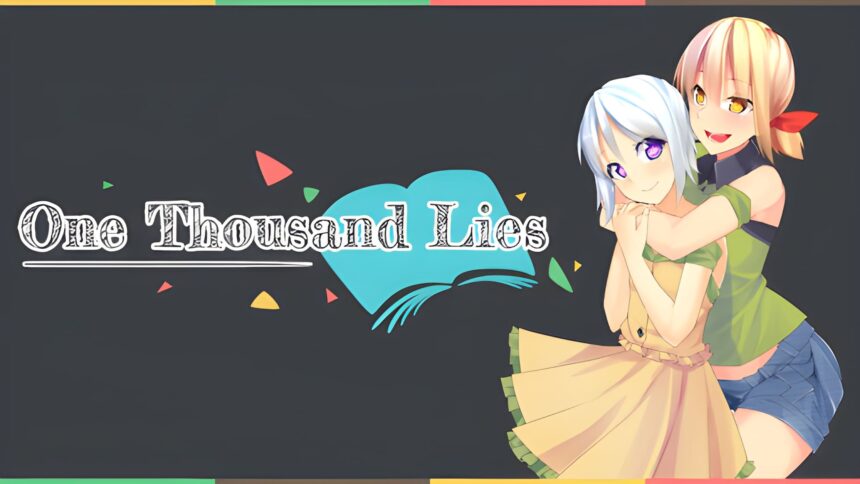
Its visual limitations are easier to forgive. The character sprites use a bright anime-influenced style, with enough pose and expression changes to give conversations movement even when the staging remains simple. Ciarán himself and several secondary characters are not represented with character art, which initially made the cast feel visually uneven. After a while, I stopped treating that as a missing feature and started reading it as part of the novel’s selective point of view. The people the game chooses to show inevitably occupy more visual space in my memory than those I have to imagine.
Backgrounds are more subdued, often using processed photographic imagery rather than competing with the sprites for attention. They are functional rather than spectacular, and repetition becomes noticeable across a longer reading session. A small number of more elaborate illustrations break that routine at important moments. I liked those interruptions because they gave certain scenes extra visual weight without turning the whole game into a showcase of isolated CGs.
The soundtrack surprised me for a different reason. The free soundtrack release contains 31 tracks drawn from multiple artists, which sounds like a recipe for tonal inconsistency. In practice, the selection fits the story’s broad swings between comedy, romance, reflection, and heavier material better than I expected. I rarely thought about the fact that the music came from different contributors while I was reading. That is probably the best compliment I can give the curation. The tracks feel chosen for scenes rather than collected to fill silence.
There is no voice acting, so every character depends entirely on text, art, and music. For this particular game, I preferred that. Ciarán’s narration is so central to how the story works that a performed voice might have made some of his intentions feel too fixed. Reading at my own pace gave me room to pause on suspicious phrasing or reconsider an earlier assumption. The absence of voices also places more pressure on the dialogue, and not every long conversation earns that attention, but the strongest sections benefit from the quiet.
What impressed me most was how gradually the psychological material takes control without completely replacing the romantic comedy around it. The game does not suddenly become a different genre once it wants to be serious. Instead, the sillier material starts looking different because I understand more about why certain characters behave the way they do. I began revisiting earlier jokes in my head and asking whether they were actually jokes, defenses, inventions, or some mixture of all three.
That is also why I would not want the story’s later revelations explained to me before playing. One Thousand Lies contains additional framing beyond the main narrative, and it changes how parts of the earlier story can be interpreted. The important part is not simply learning that some details deserve skepticism. The more interesting experience is recognizing how willing I was to accept them because Ciarán made them entertaining.
The game is not always disciplined on the way there. Its philosophical conversations can become wordy, and the high-school setting occasionally makes the characters sound more composed and analytical than I believed in the moment. I also felt the middle stretch repeating emotional questions before it was ready to move them forward. Since there are no choices, I could not alter the pace or redirect my attention. When a scene dragged, I had to wait for the writing to find its point again.
Still, I never regretted following that fixed path. One Thousand Lies is free, but its value has nothing to do with lowering expectations for a no-cost game. What kept me reading was the growing suspicion that the story itself was asking me to examine why I believe people when they tell me who they are. Ciarán’s humor makes that question easier to approach, then much harder to dismiss once the comedy stops feeling like a complete explanation.
Verdict
One Thousand Lies worked best for me when its comedy and unreliable narration were pulling in the same direction. Ciarán is entertaining enough that I understood why I wanted to trust him, which makes the moments that challenge that trust more effective. Luce, Lech, and Ziva give the school-life material enough contrast to keep the cast lively, while the anime-styled character art and carefully selected multi-artist soundtrack support a story produced on a much smaller scale than its emotional ambitions. Some jokes overstay their welcome, the philosophical dialogue can become heavy, and the fixed structure leaves nowhere to escape slower stretches. Even so, I came away thinking about how easily personality can become camouflage. For readers who enjoy kinetic novels and do not mind surrendering control to a deliberately paced story, that is a good reason to keep reading.