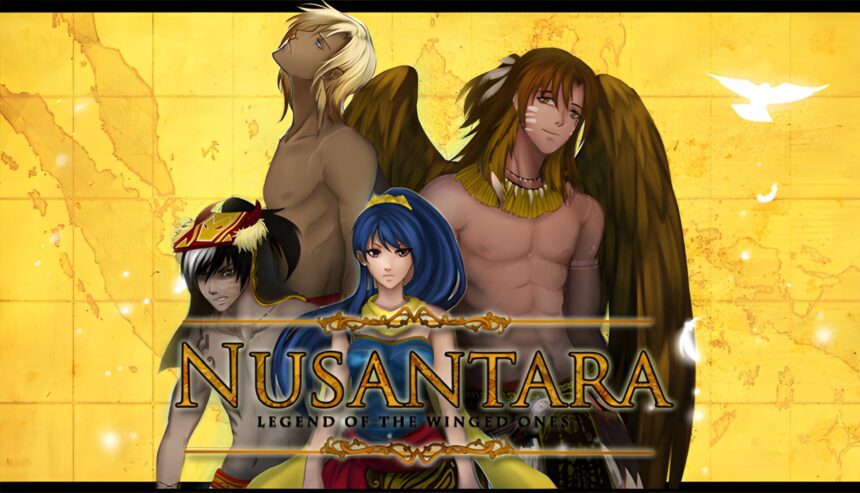
The Sakma, humans born with wings, and the Komodo, humans with skin tougher than steel, anchor the central conflict in Nusantara: Legend of the Winged Ones, two vanished peoples whose fate ties directly into a blessing and curse called the Blue Crystal.
Tamara’s own life falls apart well before she ever reaches that world. Her parents have already passed away, and her uncle takes it upon himself to annul her lease and force her to move in with him instead, leaving her arriving in one of Indonesia’s biggest cities with nothing settled. A small white bird that can actually talk pulls her down an alley toward a powerful figure with far bigger plans than a lost young woman could have expected, and the Goddess of Fate ends up choosing her, dropping Tamara into Nusantara with no way back home.
SweetChiel wrote and illustrated the whole thing, an indie project that goes somewhere the isekai genre almost never bothers to look, building an entire mythology out of Indonesia’s own folklore rather than the feudal Japan or generic medieval fantasy settings the genre usually defaults to.
The Omed-omedan tradition drawn from Bali appears alongside actual Balinese batik patterns and architecture. The Caci Dance and clothing styles tied to the Manggarai people of Flores get their own distinct tribal representation. Each of the three love interests is symbolically linked to a real Indonesian animal too, Mitra to the Javan Hawk-Eagle, Rama to the Cenderawasih bird of paradise, Reksa to the Komodo dragon.
A built-in mini encyclopedia lets a curious reader dig into the real cultural touchstones behind the fantasy without having to leave the game to look anything up separately.
Rescued by the Sakma and brought into Loma Village, Tamara ends up caught between three very different men. Mitra plays the straightforward knight in shining armor role, reliable and warm in a way that makes for a comforting starting point. Reksa carries a rougher, tsundere edge that softens slowly across his own route. Rama’s route is where the story takes its biggest risk, built around psychological depth heavy enough that his history reads as difficult territory even by otome standards.
Real stakes tie directly to how his arc gets handled, and the story doesn’t soften that risk into a guaranteed safe landing the way a lot of otome titles default to once a route gets dark.
Reksa’s own route pushes Tamara into breaking rules she’d otherwise never risk, secretly helping a member of the Komodo despite her place inside Avian society, since she can’t afford to let anyone around her know she’s aiding the enemy her new home is at war with.
Six total endings wait across the three routes, tracked through an achievement system that rewards paying close attention to which choices actually matter rather than clicking through on autopilot.
SweetChiel gave each sprite distinct facial expression changes rather than relying on a single static pose per emotion, and even unnamed side characters get a few visual tricks within Ren’Py to keep the wider cast from blurring together. Character art still reads as rough by more polished modern otome standards, sketchy enough in places that the presentation doesn’t always match the ambition of the writing underneath it.
The original engine carried a reputation for real instability, crashes and lost save files among the more common complaints in earlier versions, though a later Steam re-release addressed a meaningful chunk of those issues alongside an updated, revised script.
SweetChiel has since moved on to a second project set within the same universe, carrying a different cast forward into whatever comes next for this corner of Indonesian myth.
A small, homemade production built around specific, carefully researched Indonesian folklore rather than generic fantasy trappings gives every route here real texture well beyond what its rough presentation alone would suggest.
Verdict
Building an entire mythology around Sakma, Komodo, and the Blue Crystal out of real Indonesian folklore rather than generic fantasy trappings is what actually sets Nusantara: Legend of the Winged Ones apart, and that cultural grounding gives Mitra, Reksa, and Rama’s routes real texture beyond just three different personality types. Rama’s psychologically heavy arc shows a willingness to let real stakes and real darkness sit alongside the romance rather than softening every outcome, and the built-in encyclopedia rewards curiosity well beyond the central love story. Rough, dated art and a history of technical instability keep it from feeling fully polished, but the cultural specificity underneath more than makes up for those rough edges.