Chinese-developed visual novels have spent years working in the shadow of an assumption that the genre’s best work only ever comes out of Japan. Most attempts to break that assumption lean hard on either aesthetic mimicry or shock value to get noticed. The bigger question worth asking is whether a Chinese studio can build something that stands on its own terms instead, drawing from its own cultural material rather than borrowing someone else’s. Lay a Beauty to Rest answers that question by reaching backward more than a millennium, and the answer holds up.
Ji Ming arrives in that world by accident, a man who’s just lost his job and his girlfriend in short order, wandering the mountains looking for some kind of clarity when he follows a creek lined with peach blossom trees into a cave. On the other side is Peach Blossom Spring itself, seemingly lifted straight out of the classical poem it’s named for, a village of friendly, simple people living untouched by modern life. That poem, Tao Yuanming’s Peach Blossom Spring, dates back to somewhere between 365 and 427 CE, and the game leans directly on its imagery of a utopia cut off from the outside world rather than treating the reference as decoration. The catch arrives almost immediately. Nobody is allowed outside after sunset, because something called mountain demons are said to roam the valley at night. From the moment that rule gets laid down, the game starts quietly asking whether this utopia is exactly what it appears to be, and it takes real pleasure in letting that question fester rather than rushing to answer it.
Zero Creation Games developed and originally published this in China, releasing it on Steam on October 22, 2021, with Fun Quarter bringing an English localization to the same platform later that same year rather than after any extended wait. Ji Ming himself is worth a specific note. The name is a constructed alias rather than a real one, built from characters that reference remembering and naming, and the actual identity behind it stays a choice left open to you rather than fixed by the writing. That small piece of naming trivia matters more than it first appears, since a story this preoccupied with masks, night forms, and hidden identities gets an extra layer of irony out of its own protagonist technically going by a fake name from the very first scene. Nekoday, the same team behind Christmas Tina: Ephemeral Views of Winter, contributed the UI design, promotional video work, additional art direction, sound effects, and soundtrack alongside Zero Creation’s own team. That collaboration shows clearly in how polished the finished presentation feels for a project this size, closer to what a larger commercial studio would put out than a smaller independent Chinese release usually manages on its own.
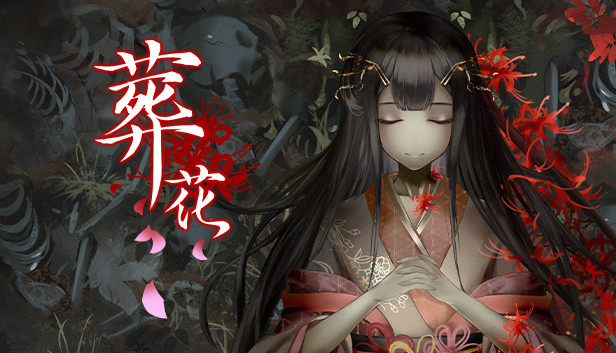
The structure leans into player agency more than a lot of VNs in this genre bother to. You can chase the unsettling threads running under the village’s surface immediately, or take your time getting to know the people living there first, and the game lets both approaches feel legitimate rather than punishing patience or curiosity. Shuang Hua, the young woman at the emotional center of the story and the village’s spiritual leader, carries a double meaning in both her name and the game’s own Chinese title, which literally translates to burying flowers, a detail that becomes more pointed the further the mystery unravels. Her relationship with Ji Ming develops with enough restraint that the eventual emotional weight actually lands rather than feeling rushed, the two of them circling each other cautiously for a long stretch before the story lets either one drop their guard completely. The village elder Cun Zhang and the protective hunter Da Niu round out a small, well-drawn cast that keeps this from feeling like a mystery populated by faceless suspects, each carrying enough of their own personality that suspecting any one of them of hiding something feels like a real accusation rather than a generic plot beat.
Where the writing takes its biggest swing is in how it handles the village head’s dynamic with Ji Ming, particularly during scenes involving what the story frames as a night form of the protagonist, where the character’s demeanor turns into something considerably more unsettling than simple fondness. It’s a bold, ambiguous thread that the game doesn’t over-explain, trusting atmosphere and implication to do more work than direct exposition, which pays off well given the story’s overall commitment to slow-building dread over cheap jump scares. That same Jekyll-and-Hyde instability runs through the whole village after dark, in fact, with residents shifting into far less stable, sometimes violent versions of themselves once the sun goes down. That reinforces the sense that daylight civility here is a performance rather than the full truth, and it recontextualizes the sunset curfew introduced right at the start as something closer to a survival rule than simple village superstition.
The translation is solid without being flawless. There are scattered rough patches, a mistranslated turn of phrase here, an achievement description that never quite got localized, but nothing severe enough to muddy the actual plot or emotional beats. The voice acting stays in Mandarin throughout regardless of which text language you pick, and following along with the subtitles ends up doubling nicely as a light bit of listening practice for anyone studying the language casually, an unplanned side benefit of a release built this way.
This is a clear visual standout. The art carries a bright, painterly warmth described by its own marketing as impasto-inspired, drawing specifically on Qin and Han dynasty aesthetics for its clothing and village architecture, which makes the village’s surface-level idyll convincing before the story starts pulling at its threads. The character designs stay expressive without over-relying on stock anime shorthand, and the whole presentation leans on deliberate visual contrasts, day against night, peach blossoms against equinox flowers, life against death, running as a consistent thematic thread through the art direction itself rather than surfacing only in the writing. The music matches that tone closely, understated and atmospheric rather than reaching for melodrama, giving quieter scenes real room to breathe. The full Chinese voice cast performs with clear emotional range, anchored by Hanser voicing Shuang Hua across more than six hundred individual lines, and the English subtitles track the performances closely enough that nothing gets lost in the gap between spoken language and written translation.
Length is the one place this doesn’t quite match its own ambition. The core experience runs shorter than its atmosphere and mystery might suggest it should. A few narrative beats repeat themselves more than the pacing really needs across a single playthrough too, stretches that feel like they exist to pad runtime rather than deepen the mystery further. The paid DLC, A Butterfly Dream, released the following July for a modest few dollars, extends the world considerably, adding roughly one hundred thousand new words of text, eighty new CG illustrations counting variations, seven new tracks composed by Candy_wind, and full voice dubbing across its own dual structure. Its first half follows a new character, Yueqiu Yan, and her own journey to Peach Blossom Spring alongside a companion named Qing He. The second half then shifts back to Ji Ming’s perspective along an altered timeline, one where his own arrival at the village happens three full days earlier than it did in the base story. That shift lets familiar events play out with just enough variation to feel new rather than simply repeated. It’s worth picking up as a package rather than an afterthought if the base story hooks you, since it deepens the mythology in ways the main game leaves deliberate room for.
Verdict
Lay a Beauty to Rest takes a centuries-old poem about a hidden paradise and turns it into an effective slow-burn mystery, using patient pacing and a restrained, ambiguous approach to its darker threads instead of leaning on shock value. Shuang Hua and Ji Ming’s relationship earns its emotional weight, and the art and music, backed by a real collaboration between Zero Creation Games and Nekoday, both punch well above the price point, even if the core story runs shorter than its atmosphere deserves and the translation shows some rough edges. A real, distinctive entry in a genre still dominated by Japanese output, and proof a Chinese studio can build something this atmospheric on its own cultural terms.