Lake of Voices gets crueler the moment I stop thinking of survival as a puzzle with a correct solution. Kikka can make sensible choices, protect people she cares about, build genuine relationships, and still reach the far shore having lost someone who mattered. The game establishes that possibility before the crossing properly begins and then spends the rest of its 88,000 words proving it was not bluffing. Anyone can be saved. Not everyone can be. That difference turns what could have been a straightforward horror-romance into something much harsher, because affection never becomes insurance against tragedy.
Kikka the Steadfast is a village guard ordered to travel with fellow guard Bemelle to an allied settlement under attack by raiders. Reaching it requires crossing Sinnlos, a black-water lake inhabited by the Nixi, creatures notorious for dragging humans beneath the surface. The only reliable route is a maze of bridges navigated by a nameless Guide who has spent years taking travelers across. Kikka and Bemelle are not the only people waiting on the shore, and the Guide immediately warns that the group is too large to expect everyone to survive the journey. Nobody volunteers to stay behind. They cross anyway.
That warning changes the way every decision feels. Lake of Voices does not conceal the possibility of sacrifice until some dramatic midpoint revelation. It tells Kikka from the beginning that saving one person may mean abandoning another and then makes me decide what that principle looks like when the people involved have names, personalities, and relationships with her. A choice that feels compassionate in one moment can remove an opportunity somewhere else. Standing still can be as consequential as acting. Even Kikka herself is not protected simply because she is the protagonist.
Timed decisions are essential to making that work. Some choices begin counting down before I have time to calmly compare every possible outcome, which suits a crossing where hesitation can be as dangerous as choosing badly. Letting the timer expire can itself become a decision, so even refusing to commit does not necessarily release Kikka from responsibility. The mechanic is simple, but it prevents the survival sequences from becoming detached strategy exercises where I can stare at the screen until the mathematically safest answer reveals itself.
The affection system complicates those decisions further because the people Kikka grows closest to are also the people I become most reluctant to risk. Bemelle, Margret, Lu, and the Guide can all form deeper relationships with her, including romantic possibilities, but closeness never creates a protected character slot. Increasing affection can open scenes and alter endings while survival continues to depend on decisions made elsewhere. The game therefore makes romance part of the danger rather than a separate reward system waiting safely beside it.
Bemelle feels like the most natural extension of Kikka’s life before Sinnlos. They already work together as guards, and his steadier familiarity gives their relationship a grounded quality the more supernatural paths cannot offer. He can be blunt and stubborn, particularly when the Guide is involved, but there is a sense of history underneath those disagreements. Pursuing him does not feel like discovering a stranger during one dramatic night so much as forcing feelings that could have remained unspoken into a situation where there may not be another chance to say them.
Margret gives Kikka something very different. She is intelligent, proud of that intelligence, and perfectly capable of sounding abrasive when she thinks someone else is wrong. Her sharper personality makes the quieter affection in her path more effective because tenderness never replaces what makes her difficult. The relationship can become explicitly romantic, giving the game a genuine female romance alongside its male options rather than treating it as an afterthought. One of her strongest outcomes contains some of the softest material in the game, which makes the danger surrounding that tenderness feel even more pronounced.
Lu complicates the initial human-versus-monster division simply by existing. As a Nixi capable of taking human form, he turns the creatures beneath Sinnlos from an abstract threat into something that cannot be dismissed as uniformly monstrous. He is indecisive, sardonic, and visibly less prepared for the crossing than the people around him, which makes protecting him particularly difficult. His presence forces Kikka to judge an individual rather than a species, and his path opens parts of Sinnlos that would otherwise remain much harder to understand.
The Guide is harder to classify. He knows the lake better than anyone in the group, but familiarity with death has made his pragmatism uncomfortable to trust. He can tell Kikka how Sinnlos behaves without necessarily giving her the reassurance she wants, and his willingness to accept loss can sound either experienced or horrifying depending on what has just happened. That ambiguity works because the game never needs to turn him into an obvious villain to make me question him. A person can be useful, sincere, and still operate by rules I would never willingly accept.
Those four relationships prevent the survival structure from collapsing into a simple optimization problem. I was never only thinking about how many bodies could technically reach the other side. I cared about who those survivors would be and what Kikka’s choices had done to the relationships between them. An ending where more people survive is not automatically emotionally cleaner than one with fewer survivors, especially once affection and sacrifice start colliding.
That is why replaying feels purposeful rather than completionist busywork. Lake of Voices has multiple endings with numerous variations based on survival, affection, and the choices made across the crossing. Different combinations reveal conversations and branches that are impossible to see together in one run. I could change one decision expecting a small correction and instead find the entire emotional balance of the group shifting because the person present for the next crisis was different.
The game is especially good at refusing the fantasy that enough knowledge will eventually unlock a version where every problem disappears. Learning the routes helps. Understanding affection helps. Knowing where somebody is endangered helps. None of that changes the basic design philosophy that Sinnlos demands something from the group. The strongest outcomes still carry loss or compromise, which keeps later runs from turning the horror into a solved checklist.
That permanence matters more than jump scares ever could. Sinnlos is frightening because I know characters can vanish from the story and stay gone. Death changes who speaks in the next scene, who Kikka can rely on, which relationships remain possible, and what emotional state the surviving group carries forward. The horror therefore grows out of absence. Someone who was joking several scenes earlier can simply no longer be there.
The Nixi themselves benefit from that restraint. Black water, shapeshifting creatures, and voices beneath the lake provide plenty of traditional horror imagery, but the game does not need to constantly display a monster to stay tense. The threat works because the crossing is already structurally hostile. Narrow bridges, darkness, uncertain rules, and the knowledge that the Guide expects casualties make ordinary conversations feel temporary.
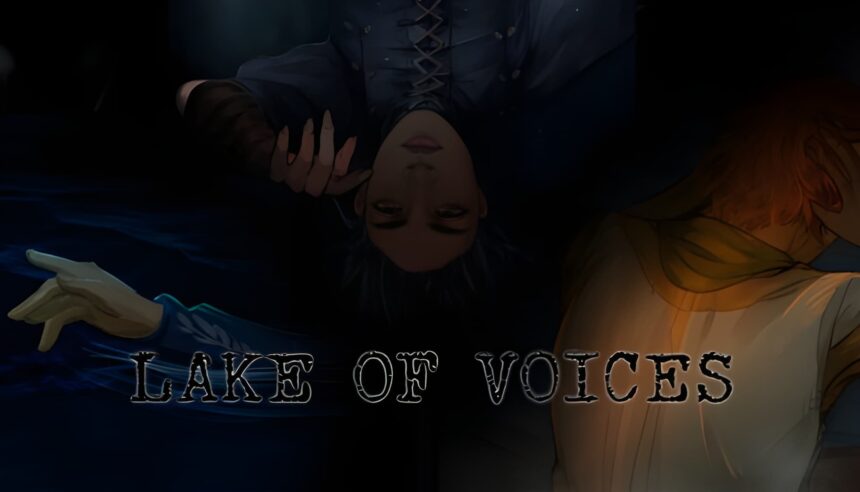
Visually, Lake of Voices leans into that atmosphere with an ethereal style that changes considerably with lighting and location. Character portraits remain expressive during long stretches of dialogue, while the backgrounds give Sinnlos enough variation that crossing the same body of water never feels like standing in one repeated black void. Cooler night scenes, shifting illumination, and the contrast between faces and the darkness around them help the lake feel less like scenery and more like something surrounding the group.
The character art is equally important because so much of the horror depends on becoming attached to people before their safety is threatened. Small expression changes can make a defensive remark feel more vulnerable or turn a calm response into something much harder to read. The presentation never needs elaborate animation to communicate how badly a character is holding together.
Full English voice acting strengthens that intimacy. Elissa Park gives Kikka the controlled delivery of someone accustomed to hiding emotion, with that control becoming harder to maintain as the crossing worsens. Michael Potok gives Bemelle a louder, more expressive presence, while Elsie Lovelock lets Margret’s sharpness coexist with warmer moments without turning her into a different person. Brendan Blaber’s restrained Guide fits a man who has spent too long treating death as routine, and Phil Avalos gives Lu enough uncertainty that his indecision feels like part of his personality rather than an excuse for the plot.
The performances work because nobody treats every threatening scene as an excuse to shout. Lake of Voices is much better at quiet dread than theatrical panic, and the voice direction understands that. Fear often appears as hesitation, exhaustion, anger, or someone trying very hard to sound calmer than they are. That naturalism makes the louder moments more effective when they finally break through.
The piano-led soundtrack takes a similarly restrained approach. It can become mournful without immediately telling me exactly how I am supposed to feel about a decision, and the quieter pieces leave enough room for the voices and environmental tension to dominate. The music supports tragedy rather than announcing it in advance.
GB Patch Games released Lake of Voices for Windows, macOS, and Linux in August 2018, and the entire game remains free. That makes the production unusually generous considering the full voice cast, 88,000-word script, branching survival structure, artwork, soundtrack, and replay-dependent material. The small unlockable bonus events also provide a welcome tonal release after spending so much time calculating who might die next.
The most effective thing the game does is make affection dangerous without treating affection itself as a mistake. Caring about Bemelle, Margret, Lu, or the Guide can increase the pain of losing them, but becoming distant from everybody is not presented as some enlightened solution either. Kikka is still a person crossing the lake with other frightened people. Connection matters even when it cannot guarantee survival. That refusal to provide emotional armor is what stayed with me. Many branching visual novels train me to believe enough affection, route knowledge, and careful choices will eventually produce the version where I keep everything I value. Lake of Voices lets me improve outcomes without ever granting that level of control. The more attached I became to the group, the more every timed decision felt like it was asking what I was willing to lose rather than whether I had found the secret correct answer.
Verdict
Lake of Voices makes survival frightening by refusing to let affection guarantee safety. Its timed choices, branching deaths, strong romances, striking art, and natural English voice performances turn one night on Sinnlos into a genuinely tense tragedy. The replay structure works because better knowledge can change who survives, but it never removes the cost of choosing.