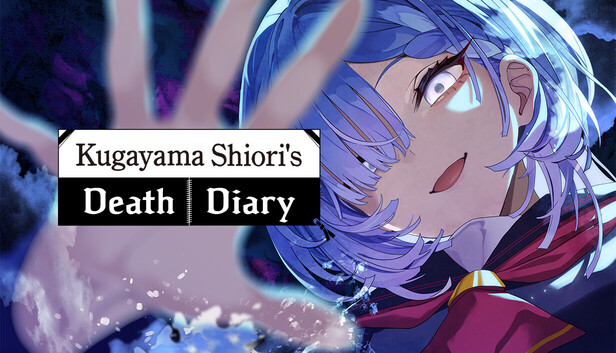
Kazuki Fumi wrote Kugayama Shiori’s Death Diary instead of Ono Wasabi, the writer behind most of Laplacian’s earlier catalog, and that switch alone signals how much of a departure this project actually is for the studio. Fumi brings a background in mystery writing from series like 9-nine- and Criminal Border into a story built specifically around unraveling how someone died.
A mostly silent protagonist, wandering through a local park, comes across a young woman hanging from a tree who’s already died there. She introduces herself as Kugayama Shiori, a ghost who remembers nothing about her own life except her name, and explains that she’s been trying to move on by repeatedly reliving the moment of her death, hoping each attempt might finally be the one that lets her go. Thrilled to have found someone who can actually see and hear her, she asks for help piecing together her missing memories and the real truth behind what happened to her.
Laplacian developed the game, directed by Hayashi Ryousuke with Pellet serving as art director and lead illustrator, releasing on Steam on April 29, 2026 for twenty four ninety nine with a twenty percent launch discount, followed by a Switch version that July. The game carries a CERO D rating, the Japanese equivalent of a seventeen and up classification, and supports English, Japanese, and Simplified Chinese text.
One production detail worth naming directly: Laplacian has been explicit that generative AI, specifically Adobe Firefly, was used to help produce select background assets, stating plainly that nothing is generated in real time during actual gameplay. It’s an unusually direct disclosure for a commercial visual novel to make, and worth knowing going in regardless of how a reader feels about that choice.
Shiori isn’t the only spirit haunting the town. Gyaruko-san drifts through the story as a far more carefree ghost, unbothered by her own past or the question of passing on, content to spend her afterlife wandering around and chatting with whichever other spirits she runs into. Ms. Librarian, by contrast, has lingered long enough in the world to become knowledgeable about death and the dead, and unlike the others, she’s kept her own memories intact from when she was alive.
Watching Shiori’s bond with the silent protagonist deepen almost entirely through her own half of their conversations gives the early hours real warmth, even before the mystery around her death starts pulling in other threads.
That mostly mute protagonist drives the interactivity throughout, speaking only occasionally through dialogue choices or brief inner monologue during scene transitions rather than carrying continuous spoken lines, spread across more than a hundred separate decision points ranging from major branching choices down to lighter, comedic interactions. It’s a real structural choice, not an oversight, and the story does eventually give it a narrative reason.
Where that choice creates real friction is early on. With no other characters established yet, several scenes amount to Shiori effectively carrying both sides of a conversation by herself just to keep things moving, which reads a little awkward before the cast has had time to fill out. Things ease up considerably once more characters enter the picture and Shiori finally has people around her who can actually respond in kind, but a touch more verbosity in those opening stretches would have smoothed a rockier start than the rest of the game earns.
What actually carries the story past that rough patch is how consistently it commits to its own tone. Despite covering suicide and death as its central subject matter, the writing stays deliberately light and matter of fact rather than somber, a real departure from the more grounded, dramatic register Laplacian’s earlier releases tend toward. Choices carry weight from the very start, including the option to simply walk away from Shiori entirely rather than help her at all, and the investigation into a string of separate incidents involving other women builds toward multiple distinct endings, several of which land as unsettling rather than comforting.
A real departure for the studio shows up visually too. The color palette leans hard into the otherworldly, isolating Shiori’s pale blue hair against washed out greens and browns for the ordinary, natural world surrounding her. The CGs carry a slightly grainy texture that reads closer to found footage horror than clean digital illustration, and a built-in blood filter lets a reader or streamer adjust how graphic the visuals get without stripping out any of the written content or horror elements underneath.
Music leans into the same unease, built more on repetitive patterns and drones than any clear, hummable melody, reinforcing the visuals’ mood rather than working against it.
Full Japanese voice acting rounds out the cast, with Nao Ojika voicing Shiori, Mayuko Kazama voicing Gyaruko-san, and Yuka Terasaki voicing Ms. Librarian.
An in-game Urban Legend Encyclopedia collects archive entries as more of the town’s ghostly residents and mysteries get uncovered, giving the investigation a tangible sense of forward progress beyond just the main plot advancing. A post-launch patch has already addressed a specific bug where certain CG variations weren’t registering correctly in the game’s gallery mode, now fixed for anyone who revisits the affected scenes with an existing save.
Verdict
Kugayama Shiori’s Death Diary pulls off a difficult balancing act, treating a heavy subject with real tonal confidence rather than either mining it for shock or drowning it in solemnity. The mute protagonist mechanic costs the story some of its early momentum before the cast fills out enough to carry it properly, but the atmosphere built through its color choices, grainy CGs, and unsettling score makes this one of the more distinctive entries in Laplacian’s catalog, helped along by a writer whose mystery background gives Shiori’s investigation real structural backbone.