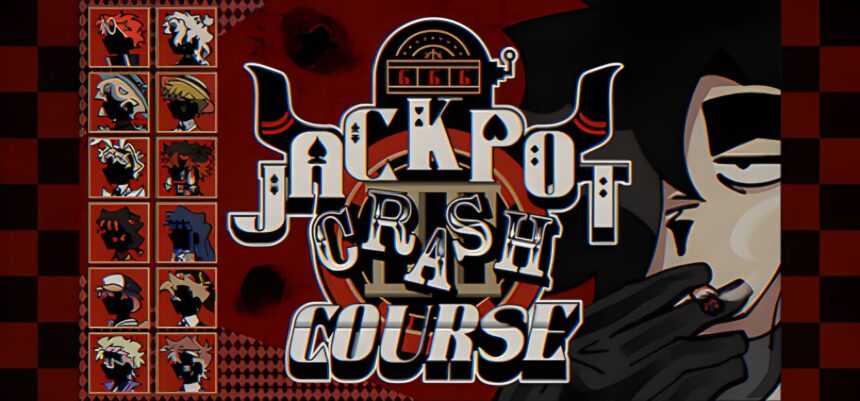
Mercy is usually treated as the safe moral answer in death-game stories. Jackpot Crash Course is more interested in what happens when being kind can make a bad situation even worse. Eddie enters a televised competition where every contestant is a criminal gambling for the possibility of a pardon, and the rules make survival inseparable from judgment. Helping somebody can create an ally, expose a weakness, or put another person in a position to die later. That uncertainty got under my skin more than the spectacle itself because I could never reduce another contestant to a simple question of whether I liked them. The show exists because Modos has pushed punishment to an extreme. Crime rates have climbed, prisons are overcrowded and underfunded, and incarceration has become so brutal that prisoners serving long sentences may die before they ever complete them. Private companies offer alternative forms of punishment, and Eddie ends up inside one of those systems as entertainment. Criminals are placed against one another in a casino-themed game show and told that proving themselves can earn freedom. The premise is grotesque enough on its own, but the more interesting question is whether a system built to turn punishment into spectacle was ever designed to reward redemption in the first place.
Chapter 1 opens by making the danger immediate rather than theoretical. A roulette sequence establishes that chance is not a decorative casino motif but something capable of deciding whether Eddie continues at all. From there, the chapter gives him more room to move through the environment, talk to the other contestants, investigate what is happening around the show, and decide which people deserve cooperation. The constant pressure comes from knowing that everybody around him is competing under the same basic threat. A friendly conversation is still happening between people who may eventually need one another to lose.
There are more than a dozen significant characters in this first chapter, which gives the social side enough density that I never felt as though Eddie was simply choosing between two obvious factions. Some contestants are immediately easier to trust than others, but Jackpot Crash Course rarely makes that first impression feel sufficient. One person may be useful without being likable. Another may be sympathetic but dangerous to keep close. Someone who behaves cruelly might still understand the game better than the person asking Eddie for compassion.
That is where the route structure earns its replay value. Chapter 1 contains three distinct story routes with exclusive interactions and events depending on the group Eddie aligns himself with. They are not just cosmetic rearrangements of one central sequence. Different people spend more time around him, different tensions come forward, and the social logic of the chapter changes with the route. Playing all three gives a much broader view of the cast than staying with one path and assuming the others merely fill in alternate scenes.
The full first chapter takes roughly three and a half to four hours per route rather than being something that can be exhausted in one short sitting. That length gives each route enough space to establish its own relationships while still keeping the overall pace tight. With around 90,000 words already in Chapter 1, the game has room for substantial dialogue without losing the forward pressure expected from a death game. The larger plan spans three chapters, so this first release is clearly building a much longer story rather than trying to resolve Eddie’s entire situation immediately.
What kept me engaged was deciding who among the contestants was actually worth trusting. The obvious temptation in a story like this is to assume mercy will always mark Eddie as the better person and eventually be rewarded. Jackpot Crash Course makes that assumption dangerous. Showing mercy when the game expects ruthlessness can create consequences severe enough that I stopped treating compassionate choices as automatic moral victories. That does not mean cruelty becomes the correct strategy either. It means the game forces me to think about what a choice does rather than what label I want attached to it.
That tension also keeps Eddie from feeling like a passive protagonist carried between predetermined set pieces. His relationships change according to how he treats people, and the routes create different opportunities to define what kind of player he becomes. He can cooperate, challenge, dismiss, or protect others, but none of those actions exist in a vacuum because the show keeps creating situations where social decisions have practical consequences. The game understands that the most effective death-game choices are not necessarily the ones with the largest immediate explosion. Sometimes the uncomfortable decision is simply whether to believe somebody.
The minigames add another kind of pressure without overwhelming the visual-novel structure. Casino mechanics, quick-time sequences, and skill-based challenges such as the shooting gallery force the player to do more than select dialogue answers. The transition works because the show itself is built around spectacle. A precision challenge feels like something the producers would actually stage for an audience, and mechanical failure therefore fits naturally into the fiction instead of feeling like a separate arcade section inserted for variety.
Exploration serves a different purpose. Moving through the available areas gives Eddie chances to uncover clues, interact with other contestants, and find material that would be easy to miss if the game were presented as one uninterrupted stream of dialogue. Pixel-art spaces give Modos and the show’s environment more physical presence than a sequence of static visual-novel backgrounds would have. The combination of exploration, minigames, sprites, and full-screen artwork keeps the chapter visually active despite the amount of text it contains.
The sheer quantity of art is one of the first chapter’s more surprising production strengths. There are more than 300 CGs alongside expressive character sprites, pixel art, and animation. That number sounds excessive until it becomes clear how broadly the game uses illustrations, including reaction shots, dramatic moments, gameplay sequences, and route-specific scenes rather than reserving full artwork exclusively for rare climaxes. The result is a story that often feels visually staged instead of merely narrated.
That matters for the game-show premise because presentation is part of the horror. The contestants are not suffering in private. They are being packaged as entertainment, and the bright casino imagery sits uncomfortably beside the fact that the people occupying it may die. The pixel work and vivid CGs make the show feel deliberately attractive even when its rules are ugly. I liked that contrast more than if the developers had made every room dark and threatening from the beginning. A death game designed for an audience should look like something an audience might actually want to watch.
Bell Kalengar’s soundtrack strengthens that atmosphere with more than twenty-five original tracks in Chapter 1 alone. Jazzier casino material can make the show feel almost playful before the music tightens when a scene becomes more dangerous. That shift works because the score is not constantly trying to tell me that everyone is doomed. It allows lighter scenes to breathe, then increases the pressure when Eddie’s circumstances demand it. Sound design also gives the minigames and spectacle more impact than text alone could manage.
RachelDrawsThis and Ekrix handle the story, development, and graphics, with Bell Kalengar responsible for composition and sound design. The finished first chapter released on May 8, 2026 for Windows and macOS after the first half had appeared earlier on itch.io in October 2025. That distinction matters because the current release is the complete Chapter 1, including both halves, rather than the partial version available during the earlier rollout. Chapters 2 and 3 are planned to continue the story later.
The game is free on both Steam and itch.io, which makes the scale of Chapter 1 especially striking. Approximately 90,000 words, three routes, more than 300 CGs, over twenty-five tracks, minigames, exploration, and a large cast would already be substantial for a paid first installment. Free access does not excuse unfinished storytelling, but Chapter 1 has enough material to feel like an actual opening act rather than an extended demo designed to sell a later purchase.
Mac users do need to be careful with compatibility. The available macOS build does not support macOS 10.15 Catalina or later, so anyone using a newer Mac cannot simply assume the listed platform support means the game will run. That limitation is easy to miss because the Windows version is straightforward by comparison.
The biggest risk for Jackpot Crash Course is scale. Chapter 1 introduces a large cast, multiple routes, an elaborate social system, a stylized setting, and a mystery about what the show actually wants from its contestants. Two more chapters now have to build on all of that without allowing the conspiracy to overshadow the people who made the opening work. The first chapter succeeds because I care about who Eddie trusts before I care about having every institutional secret explained.
It also benefits from refusing to turn every contestant into a puzzle piece whose only purpose is to reveal lore. The better scenes are the ones where Eddie has to decide how much another person deserves from him when neither side can afford complete trust. Those interactions make the larger system feel cruel because the contestants are not faceless criminals being punished abstractly. They are people forced to evaluate one another under rules designed to make cooperation dangerous.
By the end of the current chapter, that was the part I wanted more of. The spectacle, casino games, and mystery give Jackpot Crash Course its identity, but the social uncertainty gives it tension. I could handle not knowing exactly where the overall story was heading. What bothered me more was not knowing whether the person Eddie spared, challenged, or trusted would make that decision look compassionate, foolish, or fatal later.
Verdict
Jackpot Crash Course makes trust more frightening than roulette. Its three routes, huge visual presentation, and strong soundtrack give Chapter 1 impressive scale, but the real hook is deciding when mercy is worth the risk. For a free opening chapter, it already feels substantial enough to justify waiting for the remaining two.