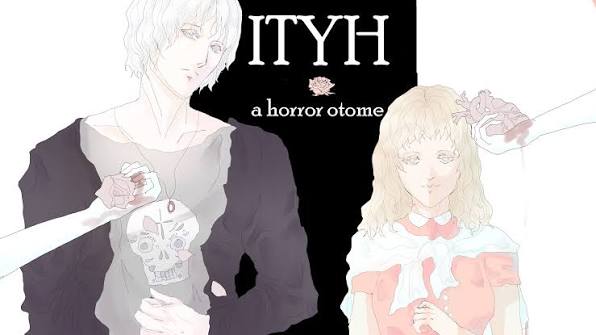
Chasing the quiet, brooding new kid at school is such a well-worn otome opening that this one gets to spend almost no time setting it up before pulling the rug out entirely. Camille Dubois wants transfer student Osgoode McCabe to notice her. He does. She ends up chained in his basement almost immediately after, and the rest of the game unfolds from there.
Released free on itch.io by solo developer Amiralo, who handled the story, art, and coding alone, ITYH is a horror otome in the most literal sense of that pairing. It uses the genre’s familiar romantic conventions as a delivery mechanism for something considerably darker than the format usually attempts. What separates it from a simple shock-value premise is how patiently it commits to building an actual relationship inside that setup rather than treating the captivity itself as the whole story.
That confinement plays out through a loop of mundane, repetitive actions, exercising, bathing, sleeping, with no clear sense of how much time is actually passing. The repetition does real, deliberate work simulating disorientation rather than just describing it. A recurring detail, marking days by counting how many times Osgoode has or hasn’t played piano somewhere in the house, becomes an unexpectedly effective piece of environmental storytelling. Losing that small, grounding ritual partway through landed with real weight for me specifically because the game had spent so long training me to rely on it.
Camille herself is where the game does its most quietly subversive work. Physical strength was never an option for her, but the writing lets her stay proud and strong-willed anyway, a little self-absorbed, occasionally reckless in pursuit of what she wants, and those flaws sit uncorrected rather than getting smoothed into easy likability. That specificity pays off once her circumstances force real growth, and by the time later endings roll around, watching her navigate an impossible situation with real agency rather than pure victimhood gives her arc a level of nuance the genre rarely attempts.
Osgoode comes from a dysfunctional family of brothers, each written with a distinct, specific habit, one fixated on romance novels among them, and that texture makes his own damage feel traced back to something concrete rather than generic brooding. The writing generates real sympathy for a character whose actions are unambiguously harmful without excusing what he’s actually done. I felt that tension most sharply in how differently his behavior read to me across different points in the story rather than settling into one fixed read of him.
Nine distinct endings give the game substantial replay value for something offered entirely for free, ranging well beyond simple happy-or-bad binaries into meaningfully different outcomes for Camille’s psychological state and her relationship with Osgoode specifically. A side character named Ivy was originally planned as a second full route before the developer cut it for falling short on writing and plot quality, along with a second axed route for another character, though traces of both still linger in the finished story. I’m staying quiet on what any specific ending actually resolves into, but the spread between them gave me real reason to sit with more than one before deciding how I felt about either lead.
Character art throughout carries real emotional range across the story’s shifting tones, credited entirely to Amiralo alongside beta readers CMK and Shiba List who helped shape the script. The music isn’t an original score. It draws from the royalty-free library Dova-Syndrome alongside classical piano recordings, including a complete Beethoven collection performed by Alfred Brendel, and that curated approach still reinforces both the horror and the quieter romantic beats without either undercutting the other. A walkthrough file comes bundled with the game itself for anyone who wants to see a specific ending without guessing blind.
The full script runs about 35,000 words, roughly two and a half hours depending on reading speed. Amiralo has released other sim dates before this one, Saccharine and Reverie among the more recent, alongside older Flash-based games that predate the current itch.io page entirely. The title itself, ITYH, stands for I Take Your Hand, a phrase that reads very differently once you’ve actually finished the story it’s attached to.
Verdict
ITYH: A Horror Otome succeeds at something difficult, building a believable, psychologically complex relationship out of a premise that starts as outright captivity horror, without losing sight of how damaged both people at its center actually are. Its slower, disorientation-driven pacing during Camille’s confinement is a deliberate choice rather than a flaw, and nine distinct endings give this free release real staying power well past a single playthrough. For anyone drawn to dark, morally complicated romance willing to sit with real discomfort, this holds up as one of the sharper entries the horror otome space has produced, even with a planned second route that never made it past the cutting room floor.