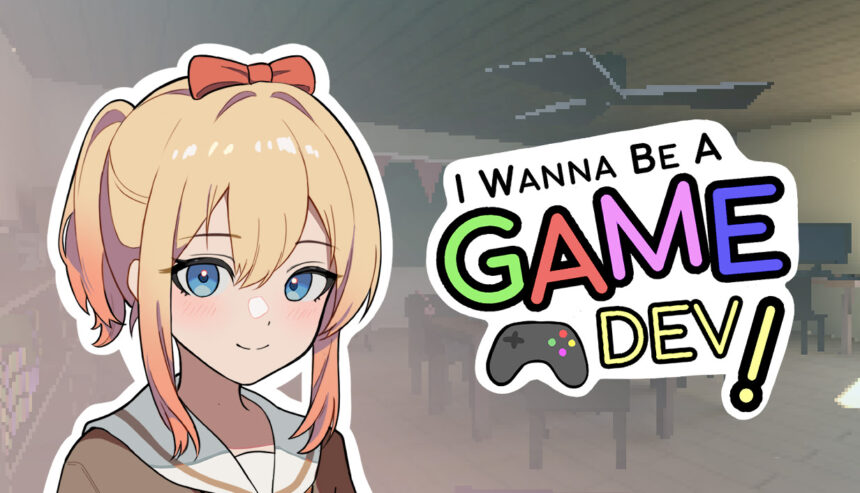
Choosing where to spend a free afternoon carries real weight in I Wanna Be A Game Dev! Walking to the arcade or the maid cafe in the game’s full first-person 3D world feels like an actual decision rather than picking an option off a menu. That freedom sits at the center of a story built around Neku’s final year of high school, chasing something bigger than just passing classes. He’s trying to build a real video game with the friends he’s spent years alongside before graduation scatters everyone in different directions. Between deepening relationships, showing up for classes, and finding time for exactly those kinds of afternoons, the game keeps circling back to whether finishing that passion project is even possible before senior year runs out.
Lyko Studio spent about two and a half years building this before releasing it free on Steam and itch.io in 2024, and the game has since crossed ten thousand players, a real milestone for a free release from a small studio still finding its footing.
Chloe Suzuki leads the game development club and the protagonist’s closest friendship in the cast, constantly pulling for programming help in a way that made her the real emotional center of the whole passion project even before the story explicitly says so. Amelia Lee arrives as a transfer student still honestly puzzled by why anyone cares about games in the first place, and watching that confusion soften over the course of the story gave her arc real movement.
Britney Summers brings an impulsive, occasionally rude sense of humor that keeps her from ever reading as a pushover, and Daniel Harrington’s absurd wealth as the school president’s son gives him a completely different set of problems than everyone else in the friend group has to deal with.
Emi Sato and Akari round out the wider circle of classmates Neku ends up spending time with, Emi in particular given her own recurring daily class question mini-events that let a reader get to know her outside the main passion project storyline. Neither is central to that main plot, but both are specific enough in their own scenes to keep the cast from feeling like it was just filling out a quota of stock high school archetypes.
Individual scenes stay short enough that the pacing never drags the way longer visual novel scenes sometimes do, and the humor throughout earned real laughs without undercutting how seriously the game takes its characters’ insecurities once the story turns more dramatic. The shift toward something darker underneath the game development comedy felt earned rather than tacked on for a late twist, growing naturally out of stakes the story had already spent hours setting up.
An expansion followed that December, free just like the base game, adding two more weeks of content on top of the base story, along with new investigation gameplay, new art and music, and the return of the full main cast. The developers themselves flag that expansion as carrying direct spoilers for the base game’s own ending, a warning worth respecting rather than working around here.
Lyko Studio has since confirmed a full sequel is in active development too, continuing the same protagonist’s story past where this game and its expansion leave off. A Steam reveal was originally planned for December 19th, marking the one year anniversary of the expansion’s own release.
Exploring the school and town in full 3D gave choosing where to spend an afternoon actual weight, and the game blends that 3D space with stylized pixel graphics elsewhere, a combination that stayed visually distinct from most other visual novels in the genre.
The game carries its own content warning for frequent cursing, references to sex and sexuality in dialogue, brief references to criminal acts and drug use, and some frightening moments, worth flagging plainly without dwelling on it further.
One early scene has Neku and Daniel teaching Amelia how to ski, a small, low stakes moment. It ended up telling me more about how this friend group actually cared for each other than any of the bigger dramatic beats managed on their own.
A card game spin-off called After School Duels puts the same cast into a deck-building race to finish their own game, and a separate soundtrack release gives the score its own life outside the story it was written for. Reaching graduation after watching that same group chase a shared creative goal against a ticking clock made the ending land with more weight than a free game usually earns the chance to deliver.
Verdict
Choosing where to spend an afternoon turns out to matter just as much as any bigger dramatic choice in I Wanna Be A Game Dev!, and that same care shows in how specific Chloe, Amelia, Britney, and Daniel all feel by the time graduation actually arrives. The tonal shift into darker territory late in Neku’s story lands because the comedy and warmth earlier earned it, and full 3D exploration gives every one of those smaller choices real texture instead of treating them as filler between plot beats. With a sequel already in development and a card game spin-off putting the whole cast to new use, Lyko Studio built something here worth sticking with well past the first credits roll.