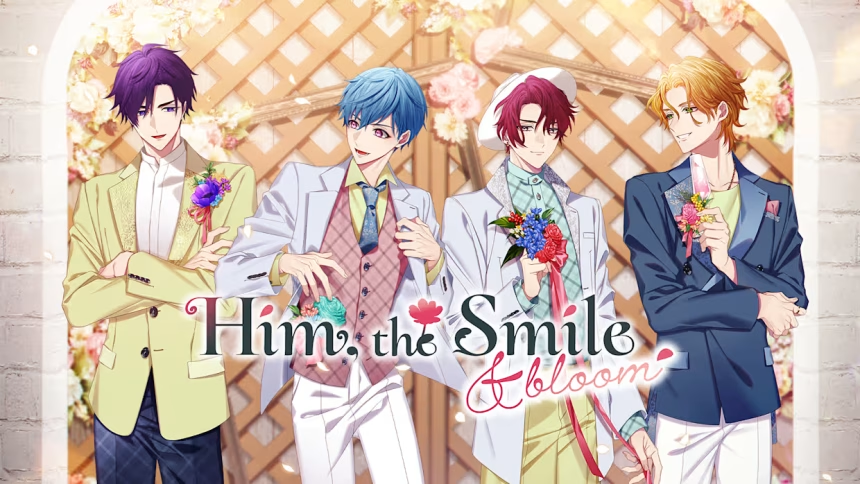
Fill Flower sits at the center of everything in this game. It’s a local shop that ends up connecting four separate romances rather than following one heroine chasing multiple men. Serina Aoki, a full-time employee at the shop, takes in college student Wataru Tori as a part-timer after a rainy-day encounter finds him nursing a bad breakup, and the two settle into a senpai-kohai dynamic across a five-year age gap. Ami Akashi works at the interior design firm hired to redesign Fill Flower and initially clashes with the shop’s resident prince, Ginnosuke Sugawa, over the plans themselves. Fuuka Haruyoshi has been quietly carrying feelings for the shop’s oblivious manager, her childhood friend Hokuto Ichige, for years. Miku Yukihara rounds out the cast with Tenya, whose route builds toward something patient and slow-burning rather than immediate.
Developer MintLip built this under the Japanese title Hanakare, adapting an original drama CD called Hanaemu Kare to & bloom that director Arai Natsumi first conceptualized before leading the full game project. EDIA and Team Entertainment Inc. published the Japanese release on Nintendo Switch on August 8, 2024, carrying a CERO D rating, before PQube brought it west to both Switch and Steam on February 27, 2025, rated ESRB 17+. PQube was upfront that the western release launched with an incomplete English script edit, with the fully polished version arriving as a post-launch patch rather than being ready for day one. The same core team, minus the artist, previously worked together on another otome title, Ayakashi Gohan, giving this project a real creative throughline even with a different illustrator attached.
Each chapter offers a single binary choice rather than a wide branching tree, and the payoff at the end of each route breaks from the usual good-ending, bad-ending format. Instead, every route closes with a snapshot of where that couple ends up down the line, whether that future turns out romantic or not. Reaching the strongest version of that outcome, referred to as the glow ending, unlocks bonus content and side stories on top of the main narrative. Across all four routes there are twelve endings total to track down, with additional DLC teased on the title screen for anyone chasing more. One real usability gap shows up here too. There’s no way to rewind past an already-made choice if you accidentally click through it, which stings given how much weight the game otherwise puts on each individual decision.
What actually distinguishes the four routes from each other is how differently each one approaches the basic idea of falling for someone. Wataru and Serina’s story leans into an age-gap dynamic that never treats the gap itself as the obstacle, focusing instead on two people separately guarded against getting hurt again. Ami and Ginnosuke start from professional friction rather than instant attraction, giving their slow burn a very different texture than the others. Fuuka and Hokuto’s arc carries the specific weight of watching someone you already know completely finally catch up to what’s been obvious to everyone else. None of the four routes reuses the same emotional shape twice, which keeps the game from feeling like one relationship dressed up in four outfits.
The flower motif isn’t just decoration either. An in-game encyclopedia unlocks the meaning behind any flower mentioned in the story, and the writing leans on that symbolism directly, letting characters communicate feelings through what they choose to give or notice rather than stating things outright. It’s a clever structural echo of the real historical tradition the whole game is built around, using flowers to say what these characters cannot quite manage in conversation.
That grounded approach comes with a real cost, though. Without any of the genre’s more common dramatic hooks, love triangles, external threats, big misunderstandings, a few of the quieter stretches in the middle of certain routes drift without much forward pull, relying entirely on tone and character chemistry to keep me invested. Anyone coming in wanting higher stakes is going to feel that lack directly, and it’s a legitimate trade-off rather than a minor quibble.
Character and CG artist Yuuya, also known for Café Enchante, Cupid Parasite, and 9 R.I.P., ties each heroine visually to her associated flower, giving the cast a cohesive aesthetic thread beyond just narrative symbolism, and the CG illustrations carry real detail throughout. Chibi-style bonus art breaking up heavier scenes comes from a separate artist, Zozo Hoshikura, better known for BL manga work, adding a lighter visual register distinct from Yuuya’s main illustrations. Where the presentation falls short is background variety. Scenes set outside the main character interactions repeat the same handful of generic locations often enough that it becomes noticeable, a real weak point in a visual package that’s careful almost everywhere else.
Voice acting covers all four male love interests fully, with Wataru’s actor, Kimura Ryouhei, anchoring one of the four routes, but the heroines themselves stay silent throughout, standard practice for a reader-insert protagonist in this genre even with the option to rename each one freely. That performance work carries more of the whole release than anything else in it, giving even the quieter, lower-stakes scenes real warmth that the writing alone doesn’t always manage on its own.
Music is a real mixed bag by comparison. Composer Yuzu Asai, whose other credits include Dynamic Chord, Blackish House, and Starry Sky, supports each scene’s mood competently. The score itself runs thinner than the rest of the production, though, without much variation across the many hours a full playthrough of all four routes demands.
Playing through the current Western release specifically, the localization reads cleanly and naturally throughout following that post-launch patch. That’s a real step up from what actually shipped on day one, worth knowing if you’re comparing notes with anyone who played the game in its first days on Steam or Switch.
Verdict
Him, the Smile & bloom succeeds at telling four real, distinct love stories instead of recycling one shape across a wider cast, using its flower shop setting and floriography theme to give quiet, grounded romance real emotional texture. The lack of dramatic stakes and the thin, repetitive backgrounds are real weaknesses worth knowing about, but the strong voice work from its four male leads and Yuuya’s character designs carry the package through its slower stretches.