
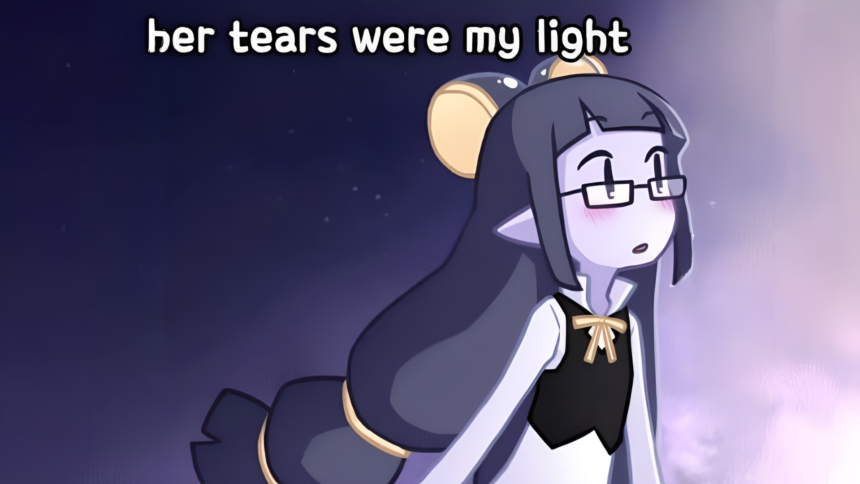
Time carries the weight of an entire creation-myth conflict in Her Tears Were My Light, able to move forward, rewind, or warp straight to any point she’s already lived through, and she spends most of the story using that power to protect Space, a lonely entity whose tears literally become stars scattered across the void. Something called Nil keeps pulling at that bond though, a force tied to nothingness itself that seems determined to separate the two of them for reasons that aren’t obvious at first. NomnomNami built the whole thing for the 2016 NaNoRenO game jam, a single month turnaround that shows in the story’s tight focus rather than in any lack of polish.
Time’s rewind and reset abilities aren’t just flavor text either, they’re baked directly into how the story actually plays, using Ren’Py’s own save and load functions in ways that put the mechanic literally in the player’s hands rather than just narrating it. Early attempts to protect Space from Nil are built to fail on purpose, and both Time and Nil carry the memory of those failed loops forward even as the timeline itself resets around them, which slowly shifts the story from a straightforward rescue into something closer to two people forced to keep meeting each other under worse and worse circumstances until one of them finally starts listening. I liked how that structure made failure itself part of the storytelling rather than a wall between me and the next scene, since every reset added context rather than just repeating the same beats with different dialogue.
Running roughly seven thousand words and playable in well under an hour, the game builds toward three distinct main endings, short enough to replay and see how differently each choice actually lands once Time starts bending her own timeline around. That runtime asks for very little and still manages to earn a real emotional arc inside it, which isn’t something I expected walking in in.
Space carries a specific kind of tragedy in all this, losing her memories every single time Time resets the timeline, which means every reunion between them plays out with Space meeting Time as though for the first time even as some deeper recognition clearly lingers underneath. Watching that recognition surface again and again, only to reset before it can fully take hold, gave the whole relationship a quiet ache that never needed a single raised voice to land. Nil complicates that dynamic further, since Time herself once shared something with Nil that got erased entirely, leaving her chasing a familiarity she can’t consciously place whenever the two of them speak.
None of that makes Nil a simple villain either. Underneath the attempts to pull Space away, Nil’s real motivation comes from being forgotten by someone she once meant something to, and that reframing turned what could have been a straightforward antagonist into someone I found myself sympathizing with by the story’s later stretches. Watching Nil’s own resentment slowly resolve into something closer to grief, without the story ever excusing the damage caused along the way, gave even a character built entirely out of cosmic-scale abstraction a real, specific kind of hurt to carry, and the game earns its ending on the strength of that reframing alone.
Character art and story both came from NomnomNami directly, with Emmit handling backgrounds and LydianChord composing the score, the three of them working alongside Basajaun Games on what marked the pair’s second collaboration together. The illustration work leans soft and expressive, giving three characters built from abstract cosmic concepts real faces and body language to work with rather than leaning on abstraction as a crutch, and Emmit’s backgrounds carry enough quiet detail in the empty space around Space herself that her loneliness reads visually before a single line of dialogue explains it.
LydianChord’s score carries individual themes for Time, Space, and Nil each, and the soundtrack goes as far as reworking those same themes into higher-intensity versions for the story’s more tense confrontations, a small touch that gave even purely instrumental moments a sense of whose emotional stakes were actually on the table in a given scene. Every line stays purely text, no voice acting present anywhere, which suits a project built around a single month’s worth of development time and keeps the focus squarely on the music doing that emotional signaling instead.
Every character across the cast loves women, and the story never treats that as something worth explaining or justifying, just the baseline reality of the universe it’s built. That matter-of-fact approach let the romance between Time and Space carry all its weight through the actual relationship rather than through any acknowledgment of who’s allowed to love whom, which fits a story already operating on the scale of cosmic personifications rather than everyday social friction.
Content stays light for most of the runtime, hand-holding and kissing carry what little physical intimacy the story has, with nothing more explicit anywhere in the experience, though one illustration late in the story leans hard into unsettling body-horror imagery that stands out sharply against the softness of everything around it. That single jarring image did more to sell Nil’s threat as something actually dangerous than any amount of dialogue could have managed on its own.
One small mechanical detail stuck with me longer than I expected, Time’s power technically covers moving forward through the timeline just as easily as backward, yet the story leans almost entirely on rewinding rather than skipping ahead. That imbalance reads as a character choice rather than a design oversight, someone more comfortable revisiting what already happened than pushing toward what hasn’t, and it quietly reinforces exactly the kind of person Time turns out to be underneath her power.
The download version adds a real bonus in an in-game photo studio alongside a gallery stocked with developer commentary, letting players pose Time, Space, and Nil against different backgrounds and effects once the main story wraps, small extras that reward sticking around after the credits roll rather than just padding out a menu. Localization has carried the game well beyond its original release too, with translations spanning more than twenty languages by this point, Spanish, Basque, French, German, Italian, Portuguese in both Brazilian and European variants, Polish, Russian, Ukrainian, Korean, Japanese, Chinese in both simplified and traditional form, Thai, Vietnamese, Turkish, Malay, Indonesian, Hungarian, Dutch, and Hebrew among them, and the Basque version specifically, translated by Gabriel Fiallegas Medina, went on to win the 2023 ETIV-UVIGO Award for Best Basque Videogame.
Built with Ren’Py alongside LMMS, Clip Studio Paint, and FL Studio, the game runs on HTML5 in browser as well as native Windows, macOS, and Linux builds, and it’s priced as pay-what-you-want on itch.io, so there’s essentially no barrier standing between anyone curious and actually trying it for themselves.
Verdict
Her Tears Were My Light takes an ambitious idea, turning time, space, and nothingness into three characters caught in an actual love story, and pulls it off with real emotional precision despite a jam-length runtime. Space’s recurring amnesia and Nil’s quietly sympathetic heartbreak give a short story more weight than its scope should technically allow, and a soundtrack built around individual character themes only deepens that effect. It’s a tiny, sincere game that earns every one of its seven thousand words, and the sheer reach of its fan translation effort says almost as much about what it accomplished as the story itself does.