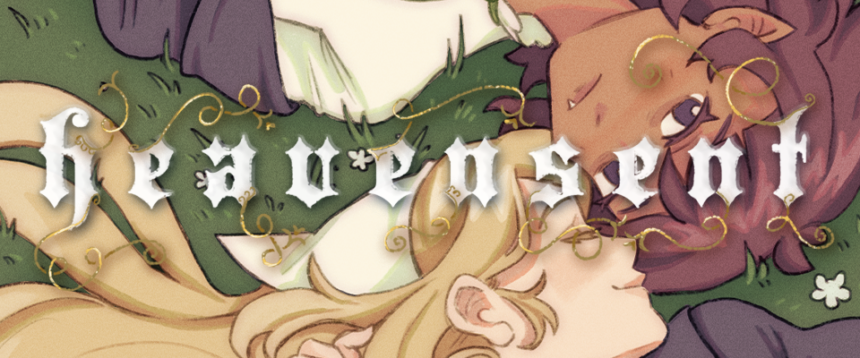
A place built around supervision can still miss the thing that matters most. Rules can dictate where someone sleeps, when she eats, what she wears, and who sits beside her, while the danger growing underneath all of that goes unnoticed. That contradiction gave the story its tension for me long before anything openly threatened to break. heavensent places Odette inside a Catholic boarding school for young ladies in 1930 after a traumatic incident changes the direction of her life. She arrives carrying a secret that turns ordinary school routines into practical problems. Odette has recently become a vampyre, and trying to preserve the appearance of the girl she used to be means hiding changes in her body and appetite from everyone around her. Even Auriame, the roommate closest to her, begins without understanding what Odette has become.
I liked how much of the pressure comes from the setting rather than from complicated supernatural rules. A boarding school leaves very little room to disappear. Meals happen around other people. Bedrooms are shared. Classes keep the same students in one another’s company. Odette cannot simply retreat until her condition becomes easier to manage, so the ordinary routines around her start carrying more tension than they would in a less restrictive setting.
That becomes especially important once Auriame moves closer to the center of the story. She has secrets of her own, which keeps the relationship from becoming a simple arrangement where one troubled girl is understood by someone completely stable. Both of them are withholding things. Both have reasons for deciding how much the other person is allowed to know. I reached the epilogue still thinking about which of them was actually more dangerous to fall for, and I appreciated that heavensent did not reduce that question to an easy answer.
Zoe changes the atmosphere around them without needing the same kind of mystery. Odette spends time with her circle partly because they share so many classes, and I found that mundane starting point convincing. School friendships are not always built because two people consciously decide they belong together. Sometimes proximity makes the decision first. Having a relationship begin from something that ordinary also makes the stranger parts of Odette’s life feel more intrusive when they begin pressing against it.
The game keeps that movement tight. Six chapters and a small epilogue contain roughly 20,000 words, and I never felt as though the early chapters were delaying the real story simply to establish everyone. The friendship dynamics, Odette’s condition, and Auriame’s guardedness are already pulling against one another while the setting is still being established. For something short enough to finish in around a sitting, that efficiency matters.
Its length also makes sense once the production history is taken into account. Elise, working as imcoffeecats, created heavensent for the 2025 Toxic Yuri VN Jam and handled the writing, art, programming, and sound design alone. It was her first completed visual novel. That never made me lower my expectations for the finished game, but it did make the consistency of the presentation stand out more.
Character design is where that consistency impressed me most. Everyone attending the same school could easily have produced a cast of near-identical uniforms differentiated mostly by faces and hair. Instead, the way each girl wears those clothes says something before the dialogue has to.
Auriame keeps her uniform neat and presents herself carefully, including the small bandana tied to the cleaning duties that occupy some of her time. That detail also quietly connects with the possibility of a future in the convent. Zoe throws the same uniform in the opposite direction, removing her jacket and tying the sleeves around her shoulders in a way that immediately gives her a more confident social presence. Odette looks less composed, with rolled sleeves and a sloppier presentation that fits someone whose nightmares can interfere with sleep.
Those distinctions worked for me because they do not need a character biography attached to every sprite. I could see something about the girls before the writing explained it. In a short visual novel, visual shorthand like that saves space without making the characters feel simplified.
The 1930 setting receives similar attention. Elise originally considered placing the story much earlier, around the Regency period, before moving it forward because the historical research would be more manageable. The finished setting feels chosen rather than merely decorative, with the school architecture, clothing, religious environment, and character designs supporting one another instead of pulling from several vaguely old-fashioned periods at once.
That historical framework also changes the supernatural premise. Odette is not hiding something in a world where she can easily search for explanations, disappear into a city, or maintain relationships from a distance. Her circumstances keep her physically and socially contained. The school therefore becomes more than a background for vampyre fiction. It is part of why secrecy becomes difficult.
The art carries a surprising amount of that atmosphere for a solo jam project. The character work is soft and expressive, while the school itself has enough visual identity to make its spaces feel connected to the period. Elise experimented with a more painterly sprite style during development before choosing an approach she could realistically complete across the whole project. I prefer the consistency that decision produced to a handful of much more elaborate assets surrounded by visibly unfinished ones.
Audio follows the same practical thinking. The music and sound effects come from curated libraries including TK’s Free Sound FX, DOVA-SYNDROME, and Freesound rather than from an original score composed specifically for heavensent. For a project where one person was already handling the script, artwork, code, and sound implementation, that choice never bothered me. Nothing about the way those resources are placed made them feel casually dropped in after the rest of the game was finished.
More importantly, the audio never needs to compete with what the story is already doing. Quiet scenes remain quiet enough to let the writing carry them, while changes in mood receive support without every uncomfortable moment being announced in advance. I noticed the selection less as a collection of individual tracks than as part of the atmosphere around Odette and Auriame, which suited a story this compact.
The supernatural side is also more restrained than I initially expected from a vampyre story. Odette’s condition matters because of what it does to daily life and relationships, not because the game wants to spend its limited length constructing an encyclopedia of vampyre rules. Hunger becomes uncomfortable precisely because it has to coexist with friendship, routine, and the expectation that Odette continue behaving normally.
That balance is what made the later chapters work for me. The story does not need a sprawling mythology when the immediate problem is already intimate enough. Odette is sharing hallways, classes, meals, and a room with people who do not fully understand what is happening to her. Auriame is close enough to notice changes while still carrying private burdens of her own. The danger comes from how little physical and emotional distance exists between them.
There are rough edges consistent with a first solo visual novel made under a jam schedule, but the short structure prevents most of them from becoming exhausting. What stayed with me was not the scale of the production. It was how efficiently the game turned its limitations into pressure. A small cast, a contained school, six chapters, and one increasingly difficult secret are enough.
Passing one thousand downloads after release gives heavensent a measurable milestone, but the more interesting achievement is that the game feels complete before it feels large. Elise built exactly enough room for Odette and Auriame’s relationship to become uncomfortable, tender, and difficult to classify without surrounding them with material that would have weakened that focus.
Verdict
heavensent worked for me because almost everything pushes Odette and Auriame closer together while giving me more reasons to worry about what that closeness means. The Catholic boarding school setting makes secrecy difficult, Odette’s vampyre condition turns ordinary routines into sources of pressure, and the careful costume and environmental work gives the 1930 setting more specificity than I expected from a first solo jam project. The curated audio is practical rather than distinctive on its own, and some roughness remains around the edges, but neither outweighed how focused the story felt. By the time I reached the epilogue, I was still wondering which girl posed the greater danger to the other. For a visual novel this short, leaving me with a question that uncomfortable was enough.