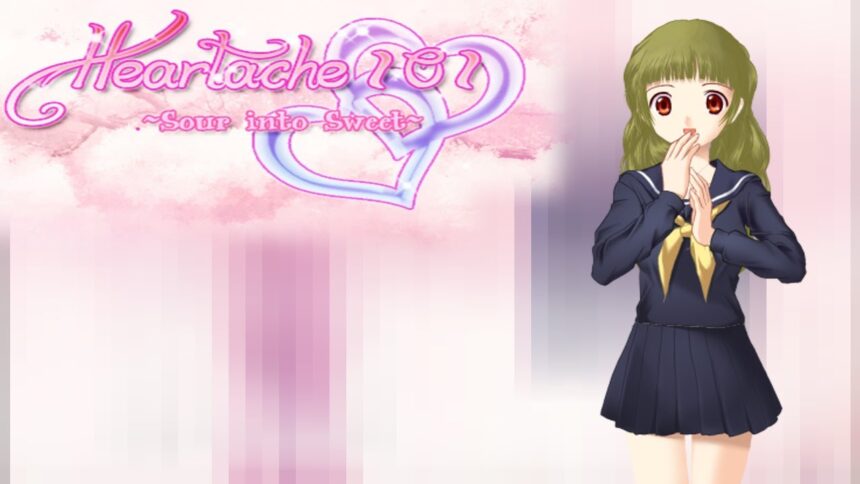
Most dating simulators ask whether two people are compatible. Heartache 101 ~Sour into Sweet~ starts with a different question entirely: what happens when romance stops being something you pursue for yourself and becomes something you have to win? In this game, the romance, the characters, the artwork, even the soundtrack could all be replaced. It wasn’t content with asking players to date its cast. It wanted them to build their own.
That ambition feels surprisingly modern for a freeware RPG Maker XP project first released in 2011 by flowerthief. On the surface, Heartache 101 looks like another high school dating simulator. Kazuhiko and his childhood friend Miki Nakajima make a wager after admitting neither of them has much experience with romance. They have 101 days to find a partner and keep the relationship alive until the deadline. Whoever fails loses. It’s a lighthearted premise that could easily have carried a straightforward visual novel, but Heartache 101 spends just as much effort building systems as it does writing romance.
The most obvious example is its character creator. Every girl in the game follows the same framework players have access to, making it possible to create completely original romance routes with custom portraits, dialogue, schedules, events, and personalities. The included scripting language pushes that idea even further by allowing entirely new story events to be written from scratch. Downloading characters made by other players effectively transforms the game into an ever-expanding community project rather than a static release. Looking back today, it feels remarkably forward-thinking for a small freeware title.
That flexibility also explains several of the game’s creative decisions. Instead of relying on elaborate CG artwork, Heartache 101 tells nearly every scene through standing character sprites. Initially that feels like a limitation, but it also makes community-created characters blend naturally with the official cast. The same philosophy extends to the soundtrack, which players are encouraged to replace with their own music instead of treating the included tracks as untouchable. Rather than presenting one definitive experience, the game quietly assumes every player might eventually build a different version of it.
Even the core gameplay resists the conventions of most dating simulators. School life unfolds across a board game map where dice rolls determine movement between classrooms, clubs, and events. Luck matters, but so does planning. Deciding where to spend limited turns became almost as important as choosing dialogue options. The routine is broken up further by part-time work, where earning money means completing arcade-style minigames instead of clicking through another conversation. One borrows ideas from Pac-Man while another shifts toward stealth, giving ordinary school life an unexpected amount of variety.
The dating itself benefits from that unpredictability. Miki’s competitive personality constantly reminds Kazuhiko why the wager exists in the first place, while characters like Tsubasa Onishi gradually shift the story away from competition and toward genuine emotional investment. Tsubasa’s analytical personality contrasts nicely with Miki’s impulsiveness, making the choice between routes feel like choosing between completely different kinds of relationships rather than simply selecting a favorite design.
Not everyone is interested in helping Kazuhiko succeed, either. One of the more enjoyable surprises was discovering characters willing to actively sabotage his progress. Riho, in particular, complicates the social side of the game by spreading rumors before Kazuhiko has much opportunity to defend himself. Those moments stop the dating mechanics from becoming a comfortable optimization exercise because reputation can be damaged just as quickly as it is earned.
Of course, the game’s age is impossible to ignore. The interface feels clunky by modern standards, the presentation lacks the visual flourish later visual novels would come to expect, and certain systems inevitably become repetitive over multiple playthroughs. Yet those shortcomings almost become part of Heartache 101’s identity. It feels less like a polished commercial release and more like an enthusiastic sandbox built by someone constantly asking, “What else could a dating sim let players do?”
Perhaps that’s why the romance itself ended up becoming almost secondary for me. I enjoyed several of the routes, but I spent just as much time imagining what other people had created with the game’s editor. Few visual novels encourage that kind of curiosity. Most ask players to uncover every ending the developers wrote. Heartache 101 asks something far stranger: what if the best routes haven’t been written yet?
Verdict
Heartache 101 ~Sour into Sweet~ succeeds less as a conventional dating simulator than as one of the most ambitious freeware romance sandboxes of its era. The relationship writing is enjoyable, the board game structure keeps everyday life engaging, and the cast provides enough variety to support multiple playthroughs, but the true achievement lies in how willingly the game hands creative control back to its players. More than a decade later, that design philosophy still feels surprisingly ahead of its time.