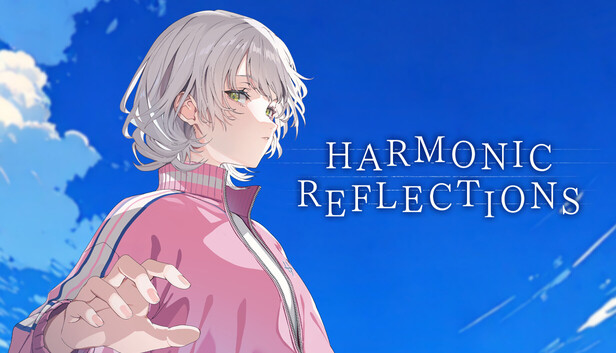
Losing the ability to do the one thing you used to love doesn’t just take away a skill. It tends to take away a piece of how you understood yourself in the first place. HARMONIC REFLECTIONS hands that exact loss to Aruto Mozumi, a high school senior who can no longer hear the sound of a piano after some past event he doesn’t fully remember. His younger brother Tokio, meanwhile, grows into a real piano prodigy right in front of him. Aruto works part-time jobs to help fund Tokio’s lessons and competitions after their father’s death, burying himself in that work rather than dealing with feelings he can’t confess to a classmate he’s cared about for a long time. Then a mysterious girl claiming to have memories of the future walks into his life and changes everything.
Laplacian built this from Ono Wasabi’s own novel Kioku no Kenban, and the game’s road to release ended up almost as complicated as Aruto’s own story. The original English version leaned on machine translation with human supervision, and after real criticism about that choice and the use of AI-assisted background art, Laplacian commissioned a full human retranslation that’s now the standard version most players will encounter. Choices steer Aruto’s relationships across a love triangle, branching toward one of two possible endings by the story’s close.
Aruto buries his own grief under a schedule packed with part-time work, and that avoidance read as a real coping mechanism rather than a simple case of a protagonist too busy to notice his own feelings. Eri Tachibana, one of only two friends Aruto’s let himself keep, brings a bright, physical energy as captain of her school’s karate club that stands in sharp contrast to how carefully Aruto holds himself back from everyone around him. The girl who claims memories of the future pulls at that same restraint from an entirely different angle. She’s unsettling enough in what she seems to already know about Aruto that I found myself questioning her motives well before the story gave me a reason to.
Watching Aruto slowly move past a trauma he can’t fully name gave the story real weight even during its quieter, work-focused stretches. I won’t say how his memory or his hearing for the piano eventually resolve, only that the story earns whatever answer it lands on rather than rushing to explain everything at once.
Character art holds real emotional specificity scene to scene, expressive enough that Aruto’s flat affect around other people never once read as the art simply failing to convey feeling. Background assets in at least the original release drew on Adobe Firefly’s AI tools during production, a detail Laplacian was upfront about alongside the machine translation controversy that led to the eventual retranslation.
Music matters more here than in most visual novels given the premise, and the score’s shifts between the sound Aruto can and can’t hear did real work reinforcing exactly how disconnected he’d become from something that used to define him.
Reaching whichever ending my choices led to left me thinking less about the supernatural mystery around the girl from the future. I thought more about how much of Aruto’s healing had already happened quietly in the background while I was busy watching the love triangle play out. HARMONIC REFLECTIONS runs short, but it uses that shorter length to stay focused on one specific, well-developed cast instead of spreading itself thin.
Verdict
HARMONIC REFLECTIONS uses a boy who’s lost both a memory and the sound of a piano to tell a quiet, focused story about grief and moving forward, and Aruto’s work-buried avoidance gives that story real emotional honesty. Eri’s warmth and the mystery girl’s unsettling foreknowledge give Aruto two genuinely different pulls to navigate, even if the game’s own bumpy translation history is as much a part of its story as anything in the script.