
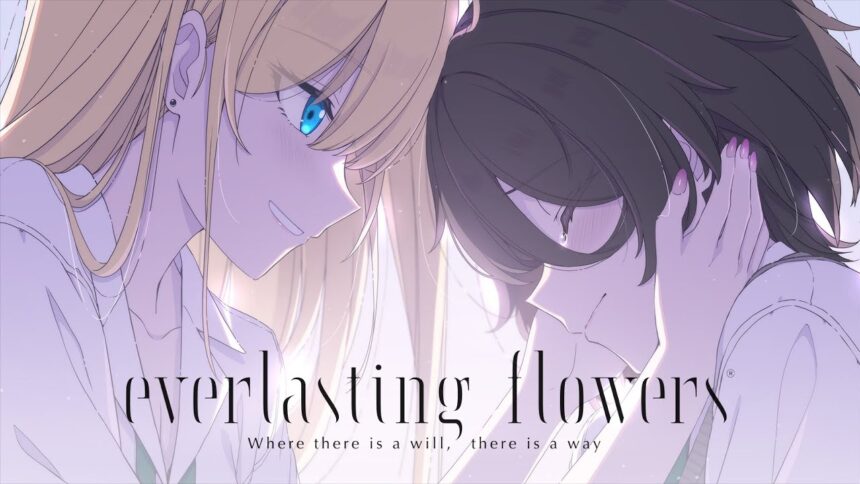
Sprite spent over a decade earning its reputation on long, dense stories like Aokana, so watching the studio pivot toward something it calls a Filmic Novel, short, CG-heavy, built around a six-hour runtime instead of a forty-hour one, caught my attention before I even opened Everlasting Flowers – Where there is a will, there is a way. Whether that pivot actually pays off turned out to be a much more complicated question than the game’s own framing wants you to believe.
Mina Sakashita barely leaves her room for nearly a year after being ostracized at her prestigious all-girls school, and I felt that isolation land early, not through anything dramatic but through how small her world gets, stopping first at the school gates, then the front door. Her parents eventually slip a form under her door suggesting a temporary summer job at a lodge far from home, and she agrees mostly to be somewhere nobody knows her. What she finds once she arrives is stricter than I expected. She’s made to wear her old school uniform and has her phone confiscated the moment she checks in, cut off completely from anyone outside the lodge.
Ran Seino meets her there, bleach-blonde and outgoing in a way that reads at first like everything Mina isn’t, though I came around on her faster than I expected to. She’s a child of a wealthy family who has spent her life doing exactly what her parents laid out, and the story spends its short runtime pulling that surface confidence apart, showing a girl just as unmoored as the one she’s supposedly helping.
Marketing screenshots lean hard into yuri imagery for this one, and I want to be upfront that the actual relationship stays soft and mostly platonic. Anyone coming in expecting a girls’ love story specifically is likely to leave disappointed, though a story built around friendship and reinvention is still a perfectly valid thing to spend six hours on.
Transience is the theme the story keeps circling, the idea that Mina’s summer at the lodge isn’t a reset button so much as a pause, and that real change asks for more than temporary escape. I found that structural choice clever on paper, using the story’s own short runtime to reinforce its point about impermanence instead of working against it, but the execution didn’t fully back up the ambition for me. Mina’s internal monologue swings between passages that land with real relatability and stretches that spell out emotional beats I wished the story trusted me to infer on my own, and more than once her growth arrives right after another character explicitly tells her what she needs to hear, rather than through anything she works out herself.
Three more characters round out the small cast, and Michiko, the lodge’s owner, gets the most interesting shape of the three, coming off strict on the surface with a couple of scenes that let real warmth through. Her granddaughter Himari won me over almost immediately, and I kept wanting more of her scenes with Mina and Ran than the story actually gave me. Sanami Tachibana, a friend of Ran’s who mostly shows up to deliver backstory, does what the plot needs of her without ever quite becoming her own person the way Himari does.
Over 700 CGs carry the visual side of this, though a fair number of those are variants of the same setup, a character glancing a different direction, a slightly different framing of the same room, rather than 700 fully distinct scenes. Suzumori returns as lead artist and art director after working on Aokana, with Jun Azami handling backgrounds, and together they lean into panning, camera-driven shots instead of the static portrait-over-background format most visual novels default to, which actually changes how the quieter scenes feel to sit through. A bright, white-heavy palette runs through most of the lodge scenes specifically, giving the whole thing a washed-out stillness that fits the transience theme better than I expected a color choice to.
Elements Garden handled the score again under composer Ryutaro Fujinaga, working alongside sound director Takatoshi Hamano and audio production house Magic Capsule, and the piano-and-strings soundtrack carries scenes the writing alone doesn’t always earn on its own merits. Riko Azuna performs the opening theme Convallaria, written by Ceui, who also sings the ending theme with the same composition team behind it, and both tracks frame the story with more emotional clarity than several of its own mid-game scenes manage.
Reina Ueda voices Mina and Lynn voices Ran, and the cast around them includes Chiwa Saito, known for roles like Sailor Uranus in the Sailor Moon Crystal cast, as Sanami, with Miyu Tomita, recognizable to a lot of people as Nezuko’s voice in Demon Slayer, playing Himari, and Tomoko Miyadera rounding out the cast as Michiko. Everyone here is fully voiced outside of Mina and Ran’s internal monologues after the prologue, and the polish shows, none of the performances feel like they’re reaching outside the actors’ usual range.
Frontwing handled the English localization, with Matthew Carolan and Roman Lempert credited as translators, Maneesh Maganti as editor, and Joshua Renner, Willeke Bloem, and William Fu on quality assurance, and I ran into almost nothing in the way of typos or awkward phrasing across the whole playthrough. Honorifics stay intact from the Japanese script, which helps the smaller, close-knit cast feel like they actually know each other. Sprite first announced the game back in August 2023 as a follow-up to Aokana and Love, Elections & Chocolate, originally targeting a June 27, 2024 release before pushing it to August 29, 2024 on PC, PS4, and Switch, with NekoNyan publishing in the West and RIGHTWAY handling Japanese distribution. A PS4 limited edition went further, packing in a two-disc soundtrack covering the OP, ED, and full BGM list, plus a 76-page visual book with manga content, color art, an exclusive short story, and a cast interview, the kind of physical package that suggests Sprite still treats this shorter format with the same care it gave its longer catalog.
What holds Everlasting Flowers back for me in the end is how little of it actually surprised me. A story doesn’t need constant twists to work, and this one mostly doesn’t try for any, but the handful of real standout scenes between Mina and Himari, or Mina and Ran during the quieter lodge evenings, aren’t quite enough on their own to carry a story this predictable across a full six hours. The ending lands somewhere gentle and earned rather than dramatic, and I appreciated that restraint even as I wished the road there had a few more surprises along the way.
Verdict
Everlasting Flowers is a real visual and audio showcase, a confident format pivot from a studio that built its name on much longer work, but the writing underneath doesn’t consistently earn the emotional weight its presentation keeps reaching for. Mina’s arc leans heavy-handed more often than it should, Ran’s more interesting edges get undercut by scenes that feel built to serve the plot rather than her character, and the story’s predictability keeps its best moments from adding up to something bigger. A beautiful, tightly made short story that doesn’t quite have the character work to match its own ambition.