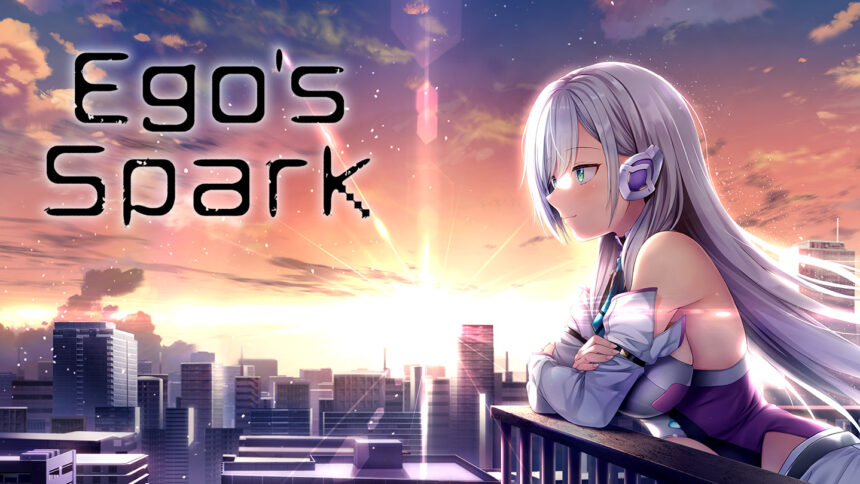
Hajime and Ego spend most of Ego’s Spark trying not to become the couple their circumstances have already arranged for them. That resistance is what made the story work for me. She was built specifically to satisfy other people and hates being reduced to that function. He spent years as a successful host selling manufactured intimacy and has little interest in recreating that relationship at home. Put them together and the obvious romantic setup becomes something much pricklier: two people who understand intimacy primarily as labor, trying to figure out whether anything genuine can grow out of an arrangement neither wanted.
Hajime Honda is twenty-six, unemployed, broke, and days away from losing his Tokyo apartment after his host-club career collapses. A grocery run makes things worse when he crashes into E-5, a prototype android from Select Electronics who has already fled the laboratory that created her. The accident damages one of her antennas, leaving Hajime responsible for a repair bill he has no realistic way to pay. The solution is a two-week beta-testing contract. He lives with E-5, provides the company with useful data, and receives enough money to keep himself afloat. Somewhere in the middle of arranging all that, he gives her the name Ego.
I liked that the name matters more than Hajime realizes when he chooses it. E-5 begins from the belief that existence is defined by function. She has sister models, specifications, intended uses, and a company that sees her as the newest product in a line. “Ego” gives her something none of those categories do: an identity that belongs specifically to her. The story never needs a dramatic Pinocchio moment where a machine suddenly announces that she has become human. Her individuality appears in smaller ways, especially every time she reacts differently from what her purpose says she should want.
Her relationship with physical intimacy makes that conflict impossible to ignore. The damaged antenna leaves her dependent on close contact to maintain her charge, turning something she already resents into a practical necessity. Ego’s irritation keeps those scenes from feeling like wish fulfillment, while Hajime’s background gives him his own reasons to dislike the arrangement. The script treats the situation less like a fantasy and more like an awkward contract both characters would rather renegotiate if either had a better option.
That shared resentment gives their banter teeth. Ego is cold, blunt, and perfectly willing to insult Hajime when she thinks he deserves it. He gives back enough that their conversations rarely settle into one character dominating the other. Kirika Waou’s performance is especially good at preserving Ego’s flat, mechanical delivery while letting irritation, embarrassment, and affection leak through it. The changes are small, which makes them more convincing. By the time her emotional responses become harder to dismiss as bugs, I had already been hearing them develop for hours.
Hajime is more important to the story than his faceless presentation suggests. His years at Platinum Black left him deeply familiar with the difference between being desired and being cared about. That makes him unusually well suited to Ego, even when neither of them recognizes it immediately. He does not need her to perform humanity for him because he already knows how hollow a convincing performance can be. Treating her like a person therefore feels less like the story congratulating him for basic decency and more like an extension of what he has learned from his own work.
The game is at its best when it keeps the focus that narrow. Ego’s Spark does not spend much time expanding its android technology into a giant science-fiction setting. Select Electronics, Ego’s sister models, and the implications of artificial companionship exist mostly to sharpen the relationship in front of me. I wanted a little more of that surrounding world, but the restraint keeps the story from abandoning Hajime and Ego for a larger argument about artificial intelligence.
Visually, the same concentration applies. Ego receives most of the attention, with expressive sprites and polished CGs carrying the romantic progression. Hajime remains unseen, and the small pool of backgrounds makes the apartment and nearby streets very familiar by the second half. Goro the dog occasionally adds a bit of warmth without pretending to be more important than he is. Nothing about the visual direction is especially adventurous, but Ego herself is drawn well enough that the limited scope rarely hurts scenes centered on her.
The music is similarly restrained. It supports the shifts between comedy, awkwardness, and the quieter emotional material without becoming memorable on its own. I noticed the voice acting much more, particularly because Ego’s delivery changes so gradually. Hajime being unvoiced creates a slight imbalance when so much of his personality comes through the writing, but it also keeps the focus tightly on the character whose sense of self is changing.
The English script has occasional small errors, though none changed how I understood a scene. More importantly, the localization preserves the rhythm of the arguments between Hajime and Ego. Their relationship depends on sarcasm and clipped responses as much as tenderness, so overly stiff English would have flattened exactly what makes them enjoyable together.
There are no route decisions to manage. Ego’s Spark is a kinetic novel with one path and one ending, which fits a story this concentrated but also exposes its biggest weakness: it ends quickly. The Steam release promises a little over two hours, and even taking my time, the relationship reaches its final stretch before it has exhausted what makes these two interesting. Auto mode, read skipping, and separate audio controls make the presentation comfortable, but there is little reason to replay once the single story is finished.
That brevity bothered me because the emotional progression works. Ego begins by filtering herself through what she was manufactured to do, then gradually discovers that usefulness and desire are not the same thing. Hajime understands the distinction from the opposite direction. He spent years being wanted professionally without treating that attention as love. Watching those two perspectives meet is much more interesting than the simple question of whether an android can develop feelings.
The all-ages version keeps that focus intact. A separate adult edition expands the physical side of their arrangement, but I never felt that the version I played was missing the emotional logic of the relationship. The important part is not what their bodies are capable of doing. It is that both characters begin by treating intimacy as a function and end up having to decide whether they want something that cannot be reduced to one.
Verdict
Ego’s Spark works because Hajime and Ego both distrust the kind of intimacy the story forces them to share. Their prickly two-week arrangement turns into a surprisingly thoughtful romance about function, desire, and being wanted for more than what you provide. The presentation is modest and the ending comes too soon, but the central relationship gives this short kinetic novel more emotional weight than its familiar android premise suggests.