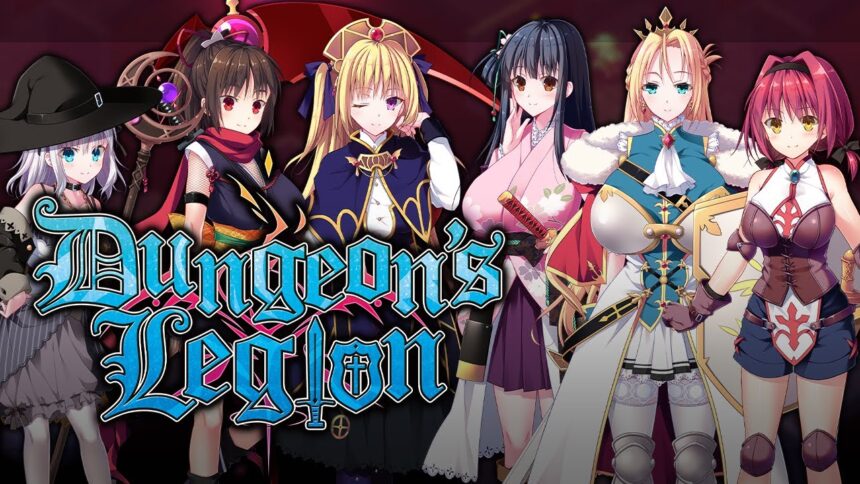
Every fantasy world needs somebody at the bottom of the stairs waiting to lose. Heroes need a dungeon to conquer, monsters to cut through, and something powerful enough at the end to make the victory feel earned. Dungeon’s Legion hands me the other side of that arrangement and asks how good I am at making sure the hero never gets there. The protagonist is reincarnated as a Demon Lord by the Goddess of Chaos and placed in command of the Forces of Chaos against the Forces of Order. The dungeon begins with little more than a handful of goblins, so most early progress comes from turning something barely defensible into a place capable of surviving repeated attacks. That growth gave the premise more substance for me than simply playing the villain for novelty.
Unit placement and traps form the backbone of each defense. I spent as much time thinking about where something should stand as I did about what to upgrade, because a strong unit in the wrong corridor could be less useful than a weaker one positioned properly. Watching a layout I had spent an hour arranging finally hold against an incoming wave felt earned rather than automatic.
That trial-and-error rhythm is where Dungeon’s Legion worked best for me. A failed defense usually left something concrete to rethink. Maybe a corridor needed more protection. Maybe I had invested too much in the wrong unit. Maybe a heroine I had been trying to develop was not yet carrying enough of the load. The game makes improvement visible because the next attempt gives those adjustments an immediate test.
Captured heroines add the most interesting wrinkle to that loop. Defeating certain opponents does not simply remove them from the field. Once captured and trained, they can become part of the same dungeon they previously entered to destroy. That reversal gives recruitment more weight than a normal character unlock because I remember exactly what each woman represented before she joined me.
Asuka was the first one who made that system click. She approaches the dungeon with the confidence of a ninja who expects to win, and I lost to her twice before finally bringing her over to my side. That felt like more of a victory than either of my successful defenses that session. The satisfaction came from seeing a character who had repeatedly broken through my setup become part of the roster I was building.
Reina lands differently. Where Asuka carries herself like someone with nothing to prove, Reina enters with a stronger sense of mission and duty tied to the divine conflict around the Demon Lord. Seeing the two of them occupy the same dungeon roster gave the heroine system more personality than I expected from a game built around one repeating defense loop. They do not feel interchangeable simply because both eventually become useful.
Red Souls keep those choices connected to the rest of the game. The same resource can be spent strengthening monsters or developing heroines, so every investment carries an opportunity cost. I liked that tension because recruitment never exists in a separate character-management bubble. Choosing to pour resources into a captured heroine can mean leaving part of the ordinary monster roster weaker for a while.
Research adds another layer to that progression. Enchantment development eventually opens access to the Dice of Fate, which folds additional heroines into the same broader system rather than making them feel detached from the rest of the roster. That keeps the character side and the strategy side moving together instead of turning one into a bonus attached to the other.
Difficulty options also change how much freedom the loop gives me. Easy provides enough room to get comfortable with the systems, while HELL becomes much less forgiving. The first time I switched upward, sloppy placement stopped being something I could simply overpower. That change made the same dungeon feel different without needing an entirely new set of mechanics.
The strategy is not endlessly deep, but it does reward paying attention. A stronger heroine is not automatically the answer to every problem. A better monster is not useful everywhere. Progress comes from understanding what the dungeon actually needs at that moment and spending resources accordingly. That kept me engaged longer than a simple stat-grind would have.
The interface is straightforward enough to support that loop, though repeated management can become tedious. Dungeon’s Legion asks me to move through placement, upgrades, research, heroine development, and roster decisions often enough that any extra friction becomes noticeable over time. I sometimes wanted to get back to the next defense faster than the menus allowed.
Its character scenes are lighter and shorter than the strategy sections surrounding them, which suited the structure. The game does not stop for long stretches of dialogue every time somebody new joins the roster. Instead, the heroines receive enough personality to make recruitment feel distinct before the dungeon systems take over again.
That balance matters because the writing is not trying to carry the whole experience by itself. Dungeon’s Legion gets most of its momentum from the change in status between enemy and ally. Someone who begins as a threat becomes a resource, then gradually becomes one of the characters I rely on when the next attack arrives.
There is no voice acting, so those heroine interactions depend entirely on text and character art. I did not miss voices as much as I expected to, mainly because the exchanges stay short enough that the silence never dragged. The quicker pace helps the story material fit between defensive planning rather than interrupting it.
The character art does more of the personality work as a result. Heroines are visually distinct, and fully developing them can unlock outfit customization. That is a small feature compared with the dungeon systems, but it still gives progression another visible layer. A character who once entered as an enemy gradually becomes someone I have invested in, trained, and altered as part of my own roster.
The adult-content distinction around the release does not change the core of the game I was interested in. The dungeon defense, recruitment, heroine training, research, difficulty settings, and roster building all function as the main experience, and those systems were enough to determine whether the game held my attention.
What surprised me most was how much satisfaction came from changing the meaning of a character rather than simply defeating her. Heroes begin as problems measured by how far they can get through my defenses. Once captured and trained, some of them become part of the answer to the next problem. That transformation gives progression a face in a way ordinary monster upgrades do not.
I do wish the writing pushed that reversal further. Turning members of the opposing side into defenders for the Demon Lord creates room for more character conflict than the game usually explores. Most of the time, Dungeon’s Legion is more interested in keeping the defend-capture-train loop moving than in stopping to examine every implication of it.
That focus is not necessarily a weakness. When the loop is working, the game rarely keeps me away from the dungeon long enough to lose track of what I want to improve. A failed defense gives me something to fix. A victory gives me more room to develop the roster. A newly trained heroine can change what I try next. The individual systems are simple, but they keep feeding one another.
Verdict
Dungeon’s Legion gets more mileage out of playing the villain than the premise alone would suggest because its best moments come from turning yesterday’s threat into tomorrow’s defender. Placing units, spending Red Souls, researching upgrades, and training captured heroines all feed the same progression loop, so recruiting someone like Asuka feels like a real milestone instead of a menu unlock. The interface can make repeated management slower than I wanted, the absence of voice acting keeps the production modest, and I wanted more from the character consequences of converting enemies into allies. Even so, the defend-capture-train structure held up across a full run, especially once higher difficulty started punishing careless layouts.