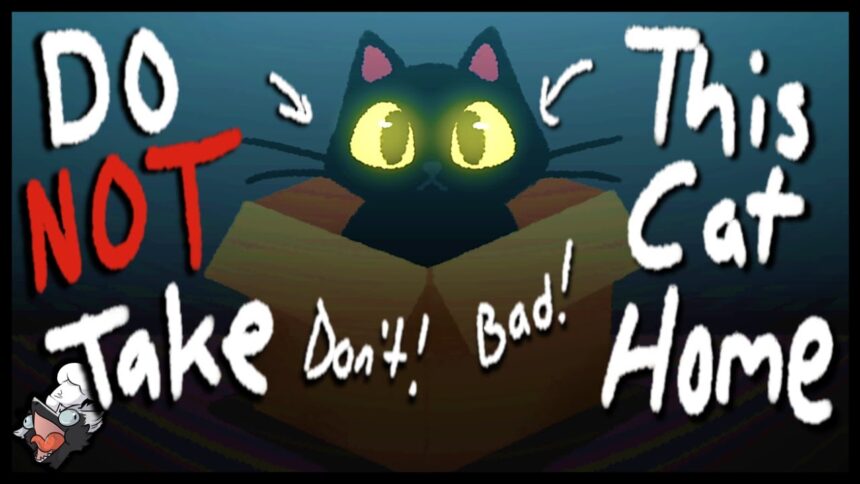
For the past few years, free horror visual novels on itch.io have leaned hard on shock value as the whole point, a jump scare or a gross-out twist standing in for anything more substantial underneath. This one sets its sights on something more ambitious, using that same shock-value premise as sustained metaphor instead of an end in itself. For the first time in a project this scale, a cute stray animal in a cardboard box becomes the entry point into dozens of branching paths about codependency and isolation. The game stays refreshingly upfront that most of those paths end badly, sometimes very badly, for anyone soft-hearted enough to bring this particular stray inside. That structural ambition keeps the whole experience engaging from start to finish, even when some of the pacing around it doesn’t quite match the strength of the central idea it’s built on.
Solo developer Pixeliminal built Do NOT Take This Cat Home as a first project, handling the writing, illustration, and original score all personally, the score itself the first one Pixeliminal had ever composed for a game, by their own account on the project’s itch.io page. The Cat itself sits at the middle of everything that actually matters here, and its true nature reveals itself as something closer to an eldritch entity feeding specifically on isolation and loneliness than a simple horror monster. That’s not just an incidental detail either. The protagonist’s own desperate lack of connection is what the Cat actually preys on, and the game uses that dynamic as a deliberate, sustained allegory for abusive relationships, with the Cat displaying real manipulative, controlling patterns dressed up in feline cuteness. Even the choice to keep the protagonist unnamed throughout reinforces that reading, letting the isolation sitting at the center of the story stay general enough to feel like it could belong to anyone at all rather than one specific, distant character.
Escaping its orbit, in the paths that allow for escape, opens the door to real friendships and, fittingly, an actual, ordinary pet cat, giving the story’s darkest threads a real thematic payoff rather than treating the horror as shock value alone. Exactly forty distinct endings branch out from that central premise, considerably more than most free itch.io horror titles attempt, and the game backs that scale with a handful of deliberate structural choices that reinforce the story’s themes mechanically rather than just narratively. Scrolling back through already-read dialogue gets disabled at key choice points. The option to load a save disappears entirely once you reach the game’s final ending sequence. Both decisions stick you with whatever you’ve already chosen rather than letting you second-guess your way to a better outcome. An earlier carnival minigame, built around a simple timing mechanic, quietly trains you for a nearly identical timed sequence that resurfaces during the true ending, a small piece of mechanical foreshadowing that rewards paying attention early. Reaching that true ending specifically requires having freed every other person the Cat was preying on first, which means the game’s single most rewarding path is also structurally its most demanding one to actually earn.
Chasing every ending does ask for real patience. Reaching a slightly different decision point deep into a given run often means sitting through a meaningful stretch of previously read text again first. A fair number of those forty separate paths land on outcomes similar enough to each other that the density starts to feel like real diminishing returns well before you’ve seen everything the game has to offer. Pixeliminal has since acknowledged getting a little carried away with the sheer ending count in retrospect. A later comment says any future multi-ending project would tie those branches more tightly to theme rather than volume for its own sake, honest self-assessment that lines up closely with exactly where the pacing here starts to strain. The late reveal that much of the story plays out inside an illusory Lotus-Eater Machine adds an interesting wrinkle to how much of the Cat’s apparent power was ever real versus manufactured. The game leaves that ambiguity deliberately unresolved, though, which won’t satisfy anyone looking for a clean answer to exactly what the Cat is. That refusal to fully explain itself stays consistent with how the rest of the story handles its own central metaphor throughout, more interested in how isolation actually feels from the inside than in building out a fully coherent supernatural rulebook to justify any of it.
Presentation clears a bar most free, solo-developed debut projects rarely reach. Individual tracks stick close enough to their specific scenes that the repetition never once pulled me out of whatever moment was actually happening. That’s an impressive result for a first-ever attempt at scoring anything at all, especially given how many distinct emotional registers forty separate endings ultimately demand from one composer working entirely alone. The prose itself carries real, deliberate vocabulary choices without tipping into overwrought excess, giving even the story’s more grotesque detours a controlled, considered voice rather than reading like shock value dressed up in fancy language. Illustrations throughout carry that same restraint, leaning on suggestion and mood over explicit gore even in scenes clearly building toward something disturbing, letting quiet implication do far more work than graphic detail ever really could.
Verdict
Do NOT Take This Cat Home succeeds by using its shock-horror premise as real cover for a thoughtful, sustained allegory about abusive relationships and isolation, giving its forty endings real thematic purpose beyond pure creative cruelty. A first-time developer’s debut, it punches well above expectations with a carefully composed original soundtrack and prose that earns its own careful craft, and the true ending in particular lands with real, earned weight after everything leading into it. Chasing all forty endings does demand real patience through repeated text and diminishing returns on some outcomes, and its central ambiguity about the Cat’s true nature stays deliberately unresolved. For anyone ready for disturbing content with real thematic weight underneath, though, this remains a striking, well-crafted piece of free indie horror.