The alignment screen tells me more about the protagonist than most visual novels would ever bother tracking. Good and Evil sit on one axis, Tactful and Defiant on another, and hundreds of dialogue choices gradually move her somewhere between those extremes. The interesting part is that these values are not hidden numbers waiting to unlock an ending. Other characters notice them. Narration can change with them. A protagonist who has spent hours being considerate does not think about tragedy in quite the same way as one I have consistently pushed toward selfishness or cruelty. In a story where nearly everyone is lying about something, deciding what kind of person is doing the lying became almost as important as figuring out who could be trusted.
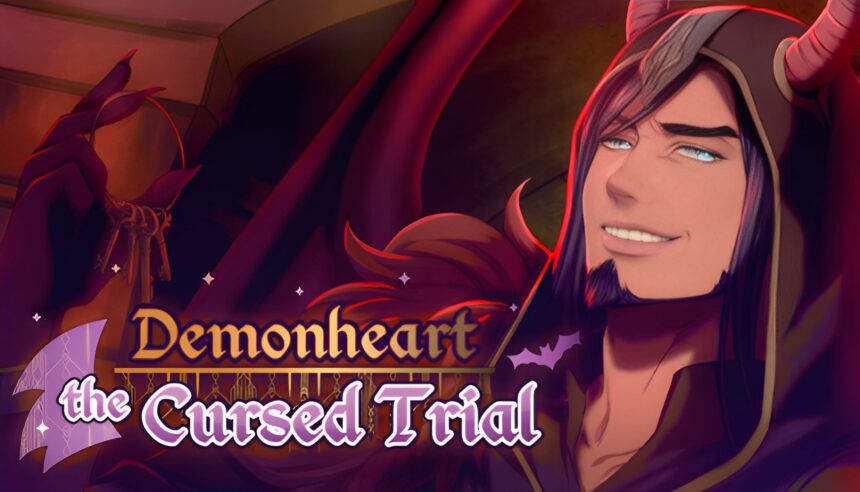
Demonheart: The Cursed Trial begins by taking trust away almost completely. The customizable heroine wakes after being abducted alongside seven strangers, a city guard, royal soldier, witch, bard, librarian, and two criminals, all imprisoned by an Infernal force for reasons none of them understand. A demonspawn eventually supplies the important part: demonhearts are hidden among them, people cursed with demonic hearts and regeneration who are hunted wherever their nature becomes known. The protagonist already knows something the others do not. She is one of them. Once mysterious deaths begin reducing the group, every attempt to investigate becomes dangerous because proving she knows too much can be almost as threatening as failing to discover who is killing people.
That secret gives the murder mystery its best tension. The protagonist is not an innocent detective standing outside the suspicion surrounding everybody else. She has legitimate reasons to lie, redirect attention, and judge how much truth another person can safely handle. Playing her as Good does not remove that problem, and pushing her toward Evil does not magically make survival easy. I liked that the alignment system complicates the same predicament instead of functioning as a separate morality minigame. A tactful heroine can hide behind diplomacy, while a defiant one can make confrontation part of her identity, and characters gradually build their impressions of her around those accumulated choices.
Ran and Kaisar make that uncertainty much harder once attraction enters the equation. They are the two full human male love interests, but neither feels positioned as a perfectly safe refuge from the captivity plot. Their intentions remain bound up with a group where everyone has incomplete information and every person has reasons to conceal something. What kept me guessing was not simply who might be responsible for a death. It was whether growing affection from Ran or Kaisar represented genuine intimacy or another vulnerability the heroine was allowing someone to exploit. Romance becomes risky because trusting someone emotionally and trusting them with the truth about being a demonheart are not the same decision.
That distinction is exactly what dark romance needs if the surrounding mystery is going to matter. A conventional otome can make getting closer to someone feel automatically productive, because affection usually represents progress toward the desired route. The Cursed Trial keeps reminding me that intimacy can create leverage. Learning something personal about Ran or Kaisar gives the protagonist another reason to care, but it also makes whatever they are withholding more dangerous. Likewise, choosing a flirtatious answer can feel completely different when the person receiving it might later decide whether she deserves protection, suspicion, or something worse.
The game leaves smaller openings outside those two central routes as well. Vita, another human captive, receives flirtation options, while the demonspawn can also be approached with a degree of romantic or provocative interest even though neither becomes a full equivalent to Ran or Kaisar. Those possibilities suit a dialogue system built around defining personality rather than simply selecting a route from a menu. Nearly every conversation offers some degree of control over what the heroine says, so attraction can emerge as part of how I am shaping her rather than existing only after the game officially declares a romance path.
Lamb’s writing benefits from having enough space to let those relationships and suspicions accumulate. The finished story exceeds 160,000 words across seven chapters, making it Rolling Crown’s longest visual novel to date. That length sounds potentially excessive for a captivity mystery, but the chapter structure prevents the entire experience from becoming one continuous interrogation scene. Each section can push the murders, romances, lore, and interpersonal grudges forward before the next stage of the trial changes what everyone knows. By the time the final chapter begins branching toward its seven main endings, earlier choices have had enough time to establish a version of the heroine rather than merely assigning her a last-minute outcome.
There are also earlier bad endings, which fit a story where survival is never supposed to feel guaranteed. I prefer that to reserving every consequence for the finale. If the premise says the protagonist is trapped with dangerous people and supernatural forces while hiding something that could get her killed, then the possibility of failing before the last chapter should exist. Those endings give individual decisions teeth without requiring every mistake to become a permanent game-over trap.
The journal helps keep the larger Demonheart mythology manageable while the mystery expands. New information about the world accumulates alongside the protagonist’s immediate problem, allowing the story to connect this trial to a setting that existed long before these eight captives were brought together. The series itself has unusually deep roots. Lamb originally developed Demonheart as a Neverwinter Nights module years before Rolling Crown turned the setting into standalone visual novels and RPGs. The Cursed Trial takes place in that established universe, but its captive cast and central mystery are constructed so that prior knowledge is not required.
That history is useful because the game can treat demonhearts, demonspawn, Infernal powers, and the surrounding dark-fantasy rules as pieces of a functioning world rather than inventions created solely for one locked-room mystery. Returning players can recognize connections, including Raze, while newcomers can learn what matters through the present cast. The balance is important. Too much dependence on earlier entries would make every revelation feel like homework, while ignoring the wider setting would waste the advantage of returning to a universe Lamb has been developing for more than a decade.
Visually, 6nii9’s character work gives the captive group enough individual personality that eight people rarely blur together despite spending so much time trapped around the same conflict. The designs need to communicate suspicion, attraction, and threat through repeated conversations, and the expressions do a considerable amount of work once alliances start shifting. Separate background art gives the confinement more variety than a single dungeon cell would allow, while romantic CGs and other special illustrations reward major character moments without breaking the darker visual tone. The official artbook eventually became substantial enough to collect character concepts, sketches, sprites, expressions, and finished illustrations alongside development material.
The sound presentation grew alongside the episodic release. The final version adds partial voice acting throughout all seven chapters, using voiced lines to establish character personalities without attempting to perform the entire 160,000-word script. Steven Kelly also returned as Raze, linking the character aurally to his earlier appearances in the series. That selective approach fits the scale better than sporadic full scenes surrounded by hours of silence would have. Music and sound effects remain largely supportive, building atmosphere around confinement, investigation, and confrontation without taking attention away from a game whose main mechanical activity is still choosing how the heroine speaks.
That emphasis on dialogue is where the alignment system proves it is more than a marketing feature. Lamb has explained that certain characters react directly to the heroine’s dominant traits, and even her internal narration can shift accordingly. A protagonist pushed toward kindness does not merely receive a “Good” label on a menu. Her interpretation of suffering can differ from an Evil version of the same character. Those changes make replaying another alignment feel more meaningful because I am not simply selecting rude dialogue instead of polite dialogue. I am gradually producing a heroine whose worldview is different.
The system also avoids forcing personality into one binary. Good does not require Tactful, and Evil does not require Defiant. That allows combinations such as compassionate aggression or calculated selfishness to emerge naturally, and those combinations fit the story’s social pressure particularly well. Survival may require lying even when the heroine wants to help someone. Defiance can be admirable in one scene and dangerously reckless in the next. The trial creates situations where personality traits stop behaving like obvious virtues or flaws.
Rolling Crown initially released the complete first chapter as a demo in June 2023 before bringing the first three chapters into Steam Early Access that November. Additional chapters arrived over the following year and a half, with Chapter 7 completing the story in March 2025. The game then left Early Access on May 27 after the remaining polish arrived, including partial voice acting across every chapter, a Mac version on Steam, and the official artbook. That long release cycle could have left the finished game feeling stitched together from updates, but the seven-chapter framework suits the escalating trial well enough that the episodic origin feels structural rather than accidental.
The extra DLC sits firmly outside anything necessary to understand the plot. The artbook offers behind-the-scenes material, while Kaisar’s Muzzle does exactly what its name suggests by adding an optional cosmetic muzzle to his main sprite without changing his CGs. It is a deliberately silly addition beside a game built around murder and betrayal, but that contrast feels appropriate for a series that has never treated darkness as a reason nobody can make a joke.
What stayed with me was how romance never becomes an escape from the mystery. Ran or Kaisar can become emotionally important precisely when trusting either of them feels most dangerous. The heroine’s own secret ensures she has no moral high ground from which to demand complete honesty, because she is entering every close relationship while concealing something that could change how the other person sees her. I kept wondering whether affection was genuine because the story gives everyone enough reason to manipulate one another that sincerity becomes difficult to recognize even when it is actually present.
That makes the trial work on two levels at once. There is the obvious question of who is responsible for what is happening to the captives, but underneath it sits the more personal problem of whether someone who survives by hiding part of herself can ever know when another person is being honest with her. Demonheart: The Cursed Trial does not need romance to interrupt the murder mystery. It uses romance to make the mystery less comfortable.
Verdict
Demonheart: The Cursed Trial is at its strongest when its romance and murder mystery become impossible to separate. The protagonist begins with the largest secret in the room, and hundreds of dialogue choices let me decide whether she protects it through kindness, cruelty, diplomacy, open defiance, or some unstable mixture of all four. Ran and Kaisar work because neither romance automatically feels safe, leaving genuine attraction tangled up with the possibility that either man still knows more than he is saying. The seven-chapter structure gives those suspicions room to develop across more than 160,000 words, while seven main endings and earlier bad outcomes make the heroine I built matter beyond a few cosmetic dialogue changes. 6nii9’s character art, partial voice acting, and the wider Demonheart mythology give the trial enough personality to sustain that length. What kept me invested was never simply discovering who could be trusted. It was realizing that the heroine had given everyone around her equally good reasons to wonder the same thing about her.