Trust feels expensive in Dead Wishes because almost everyone has something they want from you. The protagonist begins with very little room left to maneuver, grieving both parents, facing eviction, and running out of money fast enough that almost any offer of stability can look reasonable for a moment. The game keeps exploiting that desperation by placing them in situations where kindness, attraction, dependence, and manipulation are difficult to separate cleanly. What kept me reading was not simply wondering who was dangerous. It was noticing how often my judgment of somebody changed halfway through a conversation, when a gesture that looked caring suddenly started feeling like leverage.
That instability is built into the route structure. Dead Wishes has twelve character routes, split evenly between six men and six women, and each path can push the protagonist into a completely different life. One route can pull them toward organized crime, another toward people willing to kill, another toward honest work, another toward caring for two dysfunctional sisters, and another toward religion. The common thread is desperation rather than profession or setting. The protagonist starts from the same vulnerable position, but the person they reach for changes what kind of world opens around them.
That gives the game much more range than a conventional dating sim where twelve characters would mostly mean twelve variations on courtship. Romance is present, but some routes are as interested in dependency, fear, coercion, or survival as they are in affection. Even when somebody appears warm, funny, or protective, the game rarely lets that first impression settle into certainty. Lucien’s friendliness and flirtation can feel comforting precisely because the protagonist needs comfort so badly. Ophelia answers kindness with a sharper tongue, making affection harder to read. Festus can move from genuine advice to crude humor in the same stretch of conversation, which leaves his sincerity difficult to separate from performance.
Those contrasts matter because Dead Wishes never asks me to evaluate the cast from a safe distance. The protagonist is already emotionally and financially compromised, so every relationship arrives with an imbalance built into it. Someone offering food, shelter, work, or affection is not just being generous to a person in ordinary circumstances. They are offering something the protagonist may genuinely need to survive. That turns small acts of kindness into much more complicated decisions than they would be in a lighter romance.
The game also understands that danger does not have to look dangerous immediately. Some characters are easier to distrust on sight, while others make themselves useful or sympathetic before the darker parts of their routes surface. That unevenness is one of the strongest parts of the experience. I never felt as though the cast had been divided neatly into obvious safe choices and obvious bad ones. A person can be manipulative and still occasionally tender. Someone else can be genuinely kind while still carrying problems the protagonist cannot solve for them.
The protagonist’s they/them pronouns leave gender open, which fits a game built around putting the player into twelve very different relationship dynamics without prescribing one fixed identity. The protagonist is still far from blank. Their grief, depression, financial instability, and isolation shape how every route begins, and those circumstances matter more than giving them a rigid personality profile. Dead Wishes works because the player is not selecting love interests from a position of comfort. Every route begins with somebody already close to breaking.
Choice density reinforces that vulnerability. More than 350 decisions are spread across the game, feeding into more than 35 endings. Many choices are small enough that they do not announce themselves as obvious route switches or morality tests. A response can simply change the temperature of a conversation, make another person more receptive, or close off an opportunity that only becomes important much later. That makes the game feel less like a flowchart I am solving and more like a series of interpersonal judgments I may not understand until after the consequences arrive.
The routes also overlap enough that finishing one can change how another reads. Subplots and character connections move across different stories, so information that looks incidental in one path can gain weight later. That structure rewards completing more than a favorite route or two because the larger picture is deliberately fragmented across the cast. Dead Wishes is at its best when a detail I had already seen becomes more disturbing after another route gives it context.
Anise turns that idea into progression. Her route stays locked until the first ending has been collected for every other character, making her less like another option on the opening menu and more like the final piece of the larger structure. By the time she becomes available, the player has already seen enough of the game’s people and recurring threads to understand that her role reaches beyond a standalone romance. I liked having that route held back because it gives completing the rest of the cast a purpose beyond simple completionism.
The scale behind all of this is substantial. Dead Wishes runs beyond 250,000 words, which gives twelve routes enough space to establish radically different situations without forcing every character through the same shared plot. That amount of material does create unevenness. Some paths feel fuller or more naturally paced than others, and with this many characters there are inevitably relationships I wanted to spend longer with. Still, the variety prevents the game from feeling repetitive even when its central questions about trust and survival return repeatedly.
The horror is not decorative. Violence and gore appear directly, while the game also deals with sexual assault, alcohol abuse, self-harm, and suicide. Sexual content is present without becoming explicit pornography. Those subjects fit the psychological tone because many routes are less concerned with sudden scares than with placing the protagonist inside relationships or circumstances that gradually become unsafe. The content can get genuinely ugly, and the game does not pretend every route is secretly wholesome once enough affection points have been collected.
That darkness makes the moments of actual tenderness more effective. When I began believing somebody might genuinely care about the protagonist, I still had to decide whether that feeling was based on what the character had actually done or simply on how badly I wanted one relationship to be safe. Dead Wishes repeatedly made me question that distinction. A kind gesture can be sincere and still create dependence. A cruel remark can come from someone who cares. Affection and harm are allowed to coexist in ways that make the relationships uncomfortable rather than cleanly categorized.
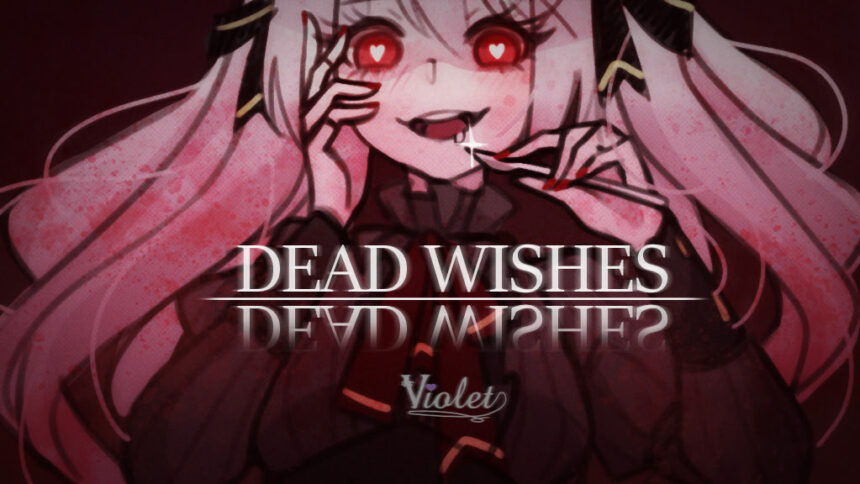
AO’s artwork carries much of that ambiguity. The twelve central characters have distinct silhouettes, expressions, and visual identities, which is essential when the game is asking the player to keep such a large cast emotionally separate. The character art can move from attractive to unsettling without needing a complete stylistic break, so a familiar face can become threatening through expression alone. The game includes 36 CGs, giving major route moments dedicated illustrations without overwhelming the text-driven structure.
Sabrina handles the writing, programming, backgrounds, and music, while AO handles sprites, CGs, promotional artwork, merchandise, and additional production work. That two-person foundation gives Dead Wishes a surprisingly cohesive feel despite how widely its routes spread. The backgrounds do not draw attention away from the characters, but they give each route enough environmental identity that the different lives the protagonist can fall into do not all feel as though they are happening in the same few recycled rooms.
Partial voice acting adds personality without trying to perform the entire 250,000-word script. Select lines are voiced across the cast, enough to establish how a character sounds without turning speech into the main presentation layer. With twelve routes and such a large script, full voicing would have changed the scale of the project dramatically. The limited approach works because the writing remains strong enough to carry long stretches by itself.
VIOLET began as a two-person collaboration between Sabrina and AO, and Dead Wishes became its first major visual novel. A Kickstarter in 2018 raised $6,347 against a $2,500 goal from 404 backers, reaching roughly 250 percent funding and three of four stretch goals. The full game released on December 27, 2018 after an earlier demo had introduced the project before the campaign. It is available on Steam and itch.io for Windows and macOS, with the itch.io build also listing Linux support.
The finished version is not especially interested in rewarding the player for finding one perfect relationship and ignoring the rest. Its interlocking subplots, locked Anise route, large ending count, and free strategy guide all point toward a game meant to be explored broadly. That works in its favor because the central appeal is not discovering which of twelve people is objectively the best partner. It is seeing how radically the protagonist’s life can change depending on who gains their trust while they are at their most vulnerable.
By the end, I was less interested in labeling characters as trustworthy or untrustworthy than in understanding what trust meant in each route. Some people deserve more patience than their first impression suggests. Others benefit from exactly the kind of generosity that puts the protagonist in danger. Dead Wishes keeps those possibilities close enough together that I rarely felt completely secure in my own reading of somebody, and that uncertainty is where its horror and romance fit together best.
Verdict
Dead Wishes turns twelve routes into twelve different tests of trust rather than twelve variations on the same romance. Its huge choice count, interlocking stories, and willingness to let affection become dangerous give the game real tension, even if some routes are stronger than others. The uncertainty around who actually means well is what makes the whole structure work.