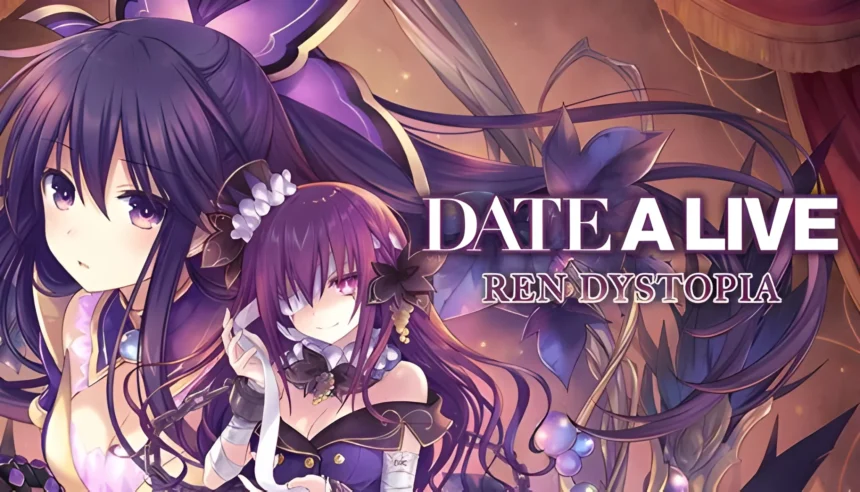
Ren works because she understands that granting somebody exactly what they want can be much crueler than simply hurting them. She first reaches Shido through a dream, her eyes hidden beneath bandages and her manner calm enough to make the encounter more unsettling than openly threatening. By morning, a strange container marked with a snake has appeared beside him. Opening it gives Ren access to the wishes of the people around him, and from there DATE A LIVE: Ren Dystopia keeps finding increasingly elaborate ways to turn desire against the person doing the wishing. Ren clearly enjoys the damage, too. She is not a reluctant antagonist carrying out some tragic obligation. Her delight in watching people walk into their own wishes is what gives the game its energy.
That confidence helps because Ren Dystopia wastes almost no time teaching the basics of Date A Live. Shido Itsuka already lives in a world where Spirits can trigger catastrophic spacequakes, military forces would rather destroy them, and his particular solution is to make them fall in love with him so he can seal their powers with a kiss. By this point, Tohka, Origami, Yoshino, Kotori, Miku, the Yamai sisters, Natsumi, and the rest of the group already have established relationships with him and with each other. The game includes a Library with character profiles and terminology, which is useful when I needed a reminder, but I would not use Ren Dystopia as an introduction to the series. Too much of the humor depends on knowing why these personalities clash, and too much of the emotional material assumes I already care about the people involved.
That is especially true because this follows the events surrounding Natsumi and Origami and continues the visual novel continuity after Rio-Reincarnation. It feels less like the beginning of another self-contained side story and more like being dropped into another week with a cast that has already accumulated years of history. I liked that lack of ceremony. Characters tease one another without pausing to explain why the joke matters, and Shido reacts to familiar habits as someone who has actually lived with them rather than as a protagonist conveniently rediscovering everyone for my benefit.
The nine routes use Ren’s wish-granting box to expose different parts of that cast. Each heroine’s desires create a variation on the same basic warning about getting exactly what you ask for, but the fun comes from how differently those wishes spiral. Some become ridiculous almost immediately. Others take longer before the consequence becomes obvious. Date A Live has always been comfortable jumping between romantic comedy, supernatural danger, and absurd escalation, so a magical wish turning someone’s personality problem into an entire crisis rarely feels out of place.
The routes are compact, usually around one or two hours each, which keeps the premise from wearing itself out. I never had to spend several hours waiting for one heroine’s wish to finally go wrong after the danger was already obvious. The trade-off is that individual paths can feel slight compared with a full-length character route. Some situations end just as I was settling into them, and the repeated structure becomes more noticeable once several heroines have gone through their version of opening the box.
Choices help keep those paths from becoming completely passive. Ren Dystopia has more than fifteen endings, and reaching the better outcomes is not always a matter of choosing whichever response sounds most obviously affectionate. I had to pay more attention than I expected because a seemingly harmless answer can push events toward a bad conclusion. The shorter route length made retrying much easier to accept. Missing an outcome rarely meant replaying hours of unrelated material just to test one alternate response.
Seeing the bad outcomes also fits the larger structure rather than feeling like failure states I should automatically ignore. Each route reveals another piece of what Ren is doing and why the same wish-granting mechanism keeps producing such different disasters. The later material depends on having worked through that broader picture, so completion feels tied to understanding the antagonist rather than simply filling an ending gallery. By the time Ren’s own concluding material opens, the box has stopped being a convenient plot device and become a pattern I understand well enough to fear.
Ren remains the strongest part of that progression. Rie Takahashi gives her a playful menace that makes even casual lines feel dangerous, and the visual design supports the same contradiction. The bandaged eyes, restraints, theatrical clothing, and almost playful posture make her look simultaneously imprisoned and completely in control. She can stand beside characters whose designs are much brighter and still dominate the scene because nothing about her reads as ordinary.
Her personality is just as important. Ren does not need to spend every scene screaming threats or explaining her motives to feel like the villain. She enjoys testing people. More importantly, she understands the difference between what somebody says they want and what receiving that wish will actually do to them. That makes her a natural antagonist for Date A Live because this series has always built romance around emotional desires that characters do not necessarily understand themselves.
The existing cast gives her plenty to work with. Tohka’s straightforwardness, Origami’s intensity, Natsumi’s insecurity, Miku’s theatrical personality, Yoshino’s gentleness, and the Yamai sisters’ exaggerated contrast already create strong comic combinations before Ren interferes with anything. The dialogue is at its best when several of them are placed together and allowed to bounce off one another. I laughed more at the smaller exchanges than at some of the larger wish-driven jokes because the cast chemistry feels practiced.
Natsumi also benefits from being fully incorporated into this lineup rather than treated like a novelty addition. Her presence reflects where the wider story has reached, and Origami similarly feels shaped by events that happened before this game began. That continuity is another reason the Library cannot completely replace prior familiarity. A profile can tell me who someone is. It cannot reproduce the experience of understanding why a particular change in behavior matters.
The romantic-comedy material translates naturally to the visual novel format because Date A Live already spends so much time on conversation, dates, embarrassment, and group banter. Action is where the format struggles more. When the story shifts into combat, static character art and effects cannot create the same energy as an animated battle. The fights communicate what is happening, but I felt the loss of motion immediately whenever a scene depended on speed or impact rather than dialogue.
Tsunako’s character art carries almost everything around those limitations. Portraits use breathing movement, changing expressions, and subtle motion in hair and clothing, giving scenes more life than completely static sprites would have managed. The effect is small enough that I stopped consciously noticing it after a while, which is probably the best compliment I can give it. Characters simply feel less frozen while speaking.
The CGs are strongest when the game reaches a major emotional or comedic beat, although some familiar visual material and recurring assets make the production feel less fresh than Ren herself. The interface wisely stays out of the way. Route selection, the Library, saves, and normal reading functions are easy to navigate without competing with the character art for attention.
The Japanese voice cast remains one of the presentation’s biggest strengths. Returning characters sound immediately familiar, and the performances carry a surprising amount of comedy through timing alone. Even small menu interactions receive voiced touches that make the game feel more polished than a text-only continuation would have. Ren’s performance stands out because Takahashi can make her sound amused, curious, and threatening without dramatically changing volume.
The soundtrack uses a lot of synthetic texture, moving easily between playful comedy and more ominous supernatural material. It rarely demands attention on its own, but it understands how quickly Date A Live can change tone. A ridiculous group conversation can give way to something threatening without the musical transition feeling as abrupt as the narrative shift might sound on paper. The Deluxe Edition soundtrack contains twenty-seven tracks, which gives a good sense of how much material is supporting those changes in mood.
Fan service is present but relatively restrained compared with how aggressively this kind of game could lean into it. Revealing outfits appear, and the series never forgets that much of its appeal comes from putting Shido around a large cast of attractive women, but Ren Dystopia spends more of its time on wishes, banter, and route consequences than on trying to turn every scene into sexual comedy. That balance helped the darker parts of Ren’s story retain some weight.
The true conclusion is where the repetitive route structure finally pays for itself. Ren’s story needs the player to understand what she has been doing across multiple wishes before the emotional side of her character can properly land. I will not spoil how that final material resolves, but the ending left me with more sympathy than I expected for someone who had spent so much of the game enjoying other people’s distress. The bittersweet tone works precisely because the earlier routes establish her first as someone I enjoyed disliking.
That payoff also softened my frustration with reused material. Nine routes built around variations of one supernatural mechanism inevitably repeat certain rhythms, and there were moments when I could feel the game preparing another version of a structure I had already seen. What saved it was the cast. A wish filtered through Natsumi does not feel the same as one filtered through Origami because the personalities underneath are already so different.
The original Japanese release arrived on PlayStation 4 in September 2020, with Idea Factory International bringing the English PC version to Steam in September 2024. Idea Factory, Compile Heart, and Sting developed the game, with Tsunako returning as the character artist. The English release also includes Traditional Chinese text alongside the Japanese and English interfaces, while Japanese audio carries the performances.
Ren Dystopia is therefore difficult for me to recommend in isolation. Not because the story is inaccessible at a mechanical level, but because so much of its pleasure comes from recognizing how familiar characters react when Ren starts interfering with them. This is a continuation built for people who already know why Tohka being Tohka is funny, why Origami behaving differently matters, and why Shido keeps trying to save Spirits instead of treating them as enemies.
For that audience, the game knows exactly what it is. It is another chance to spend time with an established cast, watch their worst wishes become temporary disasters, and slowly peel back the personality of a new Spirit who fits into the existing chaos far better than I expected. Ren could easily have felt like an antagonist invented solely to justify another set of character routes. Instead, she becomes the reason those routes are worth seeing.
Verdict
DATE A LIVE: Ren Dystopia is strongest when Ren turns familiar characters’ wishes against them and lets the established cast chemistry do the rest. The nine routes can become repetitive and combat lacks the energy of animation, but the lively presentation and bittersweet final payoff make this a rewarding continuation for anyone already invested in Date A Live.