
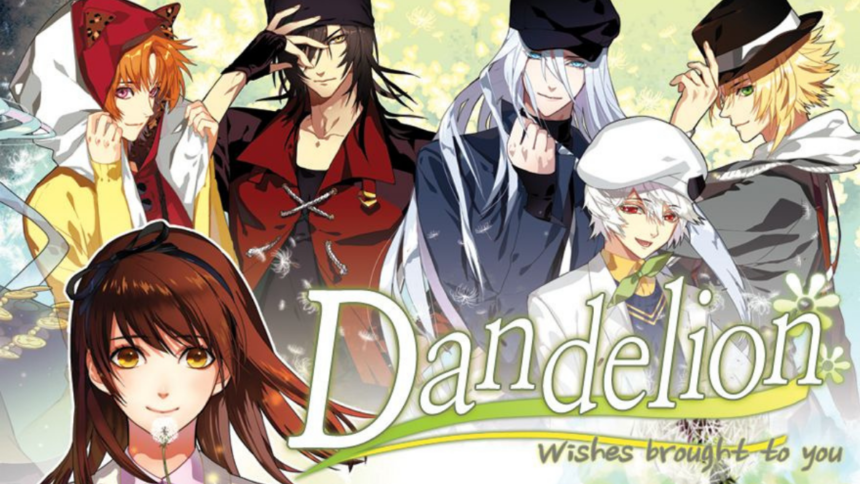
Dandelion – Wishes brought to you – starts with Heejung waking up to a basket of abandoned cats and rabbits she never asked for and can’t explain. She keeps them anyway, and months of care later, all five turn into young men with animal ears who tell her, calmly, that they’ve been playing a game neither of them fully understands, and that making her happy is somehow the point of it.
Heejung herself shoulders most of the game’s real weight before any of the five ever show up as people. She’s twenty-one, studying a major her mother picked for her, holding herself to a standard of perfect that was never really hers to begin with, and her father has stayed largely out of the picture since her parents’ divorce, leaving her mother’s expectations as the only real authority left shaping her choices. I found myself more invested in watching her loosen that grip on herself than in any single romance the game was offering, and that says something about how well the setup earns her exhaustion before asking me to root for anyone else. That arc reads less like a typical otome heroine’s journey toward a partner and more like an actual coming-of-age story, one that treats finding her own sense of direction as the real goal and romance as one possible outcome of getting there rather than the entire point.
Jisoo plays lazy and loud on the surface, but he’s the one most willing to bend the game’s own rules to protect Heejung, driven by a sick sister he’s quietly hoping to save. Jiwoo runs in the opposite direction, prickly and self-important, a romance novelist by hobby who’s convinced he understands love better than anyone in the room until Heejung keeps proving him wrong. Jiyeon plays up his own cuteness on purpose, working an act that reads as younger than his actual attitude, closer to a street-smart delinquent underneath than the harmless kitten he performs for Heejung’s benefit. Jihae carries guilt from a past he won’t talk about early on, a lost love he still blames himself for losing, and that guilt sits under his exchanges with Heejung whether the conversation calls for it or not. Jieun stands apart from all four of them, soft-spoken almost to the point of stillness, carrying himself with a quiet authority that the others treat as something close to deference, and watching Jihae stay fiercely protective of him specifically, even while pursuing his own arc with Heejung, hinted at a history between the two of them the game never fully explains outside his own route.
Two stat systems run underneath every scene, one tracking Heejung’s femininity, beauty, art, stress, and pressure, the other tracking relationship points with each of the five men individually. Building the wrong combination locks you into a route you didn’t mean to start. I ended up restarting my first playthrough once I realized how much I’d been splitting my attention instead of committing to one relationship early. Replaying afterward kept revealing scenes I’d missed the first time through, which made every route feel like its own separate read rather than a reskin of the last one.
Cheritz built this as their first commercial release, localizing the original Korean game into English by the end of 2012 after its home debut that August, and later bringing it to Steam in 2014 at a thirty-dollar price point. The Korean release also shipped a separate Premium Package exclusive to that market, bundling a drama CD, the full soundtrack, and a thirty-two page booklet covering the game’s systems, its cast, and staff commentary, none of which made it into the international version. Team Bubble Booster composed and directed that soundtrack, a roughly fifty-five minute score that leans into a quiet, a little melancholy register even under the game’s lighter scenes, giving even routine at-home stat-raising moments a mood that never felt purely mechanical.
The character art gives each of the five a distinct silhouette even before the animal ears register as more than decoration, and that consistency carries through cleanly into the backgrounds too, the same locations reappearing across both ordinary scenes and full CGs without ever looking mismatched between the two.
Every major character is voiced in Korean, drawing on a cast that includes Mira Yoo, Kyungmyung Lim, Nakyoon Choi, Seongil Lee, Myungjun Kim, Kyungtae Lee, Nayoung Kim, and Minjae Gang, with the English version keeping that original cast intact under translated text rather than replacing it. Hearing Jiwoo’s irritation land in his own language while reading his lines in mine made his tsundere routine funnier than text alone would have managed.
Each of the five routes comes with both a good and a bad ending, and the bad ones don’t soften anything for the sake of comfort, reaching territory dark enough that Cheritz’s own Steam listing files the game partly under psychological horror alongside its romance tags. Reaching one changed how I read every scene that led up to it on a second attempt, watching the same early dialogue take on a very different weight once I already knew where a particular combination of choices actually led. Cheritz followed this game a year later with Nameless, built on the same core stat-and-romance system but swapping the cast entirely, dolls coming to life in place of pets, a structural choice that told me the studio trusted this core mechanic enough to build a second, unrelated story on top of it rather than treat Dandelion as a one-off experiment.
Verdict
Dandelion – Wishes brought to you – uses a strange premise, pets that grow into people, to tell a story that cares more about Heejung learning to want something for herself than about which animal-eared man she ends up choosing. The dual stat system takes some getting used to and the bad endings don’t pull punches, but five distinct routes, right down to Jieun’s quiet authority and Jihae’s guarded loyalty to him, and a Korean voice cast that sells every register keep the whole thing feeling worth the restart.