Postwar rubble makes surprisingly good scenery for a mystery, half rebuilt streets and unfinished business standing in for the kind of unease no obviously haunted house ever quite manages. A city still deciding what it is going to become next is already primed for secrets, long before a single body turns up.
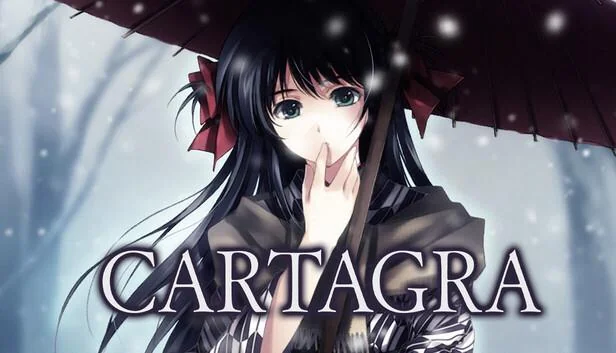
A face that should not still be walking around town is what pulls Takashiro Shugo back into work in CARTAGRA, Innocent Grey’s postwar mystery about a missing woman, a string of killings, and the twin sister left holding both. Shugo, a former police officer scraping by on odd jobs for his old boss Arishima Kazuma, is sent to look for Kozuki Yura, the woman he loved before the war took him away from her, only to find her twin Kazuna standing in the doorway instead, with her father already certain Yura is dead.
Kozuki Keiichiro does not actually want his daughter found. What he wants is for Kazuna to stop asking, and Shugo’s investigation exists mostly to give her something to believe in while the search quietly goes nowhere. Kazuna does not accept a hollow effort for long, though, and once she inserts herself directly into Shugo’s work, the case stops being a formality and starts intersecting with the Ueno Serial Murder Case already consuming the rest of the city.
What surprised me most going in was how much attention gets paid to people who could have stayed pure scenery. A brothel worker, a local gang leader, a wealthy classmate of Shugo’s sister, characters like that usually exist to hand over one piece of information and disappear, and here most of them get enough backstory that losing track of any of them started to feel like a real loss rather than a checklist item.
Shugo’s own household supplies some of that depth too. His younger sister Nana pieces together information almost independently of him for most of the game, which becomes one of the story’s more interesting tensions once you realize how much she already knows and is not telling him. Aoki Toji, a local gang leader, and Ujaku, who runs the Yukishiro, the brothel where Shugo lives without paying rent between jobs, round out a supporting cast that gets treated like people with their own reasons for being there rather than furniture, and I caught myself looking forward to Ujaku’s scenes specifically despite how little she actually has to do with the murders. Rin, a worker at that same brothel, is voiced by Yoshizawa Yua, an actress whose credits stretch from Little Busters! to a returning role in Kara no Shoujo itself, a small continuity thread for anyone who plays both games back to back.
Art direction goes to Miki Sugina, the same artist who would go on to define Kara no Shoujo’s look, and this remastered version upscales the original artwork considerably, with refined sprites, backgrounds, and character art replacing the far lower resolution of the 2005 original. The postwar setting benefits from that clarity, since so much of the atmosphere depends on small details in cluttered, lived-in rooms rather than dramatic set pieces, and I kept pausing on backgrounds just to take in how much clutter was telling its own quiet story.
MANYO composed the score, a name attached to most of Innocent Grey’s catalog since this game started the studio, and the soundtrack for this remaster carries the title Manie -Rebirth-, a reworked version of the original music. The theme song, Purgatory, is performed by Haruka Shimotsuki, and its slow, mournful arrangement sets the tone before a single line of dialogue plays. Shugo himself was not voiced at all in the original release, which was typical for silent protagonists at the time, but this remaster recorded new lines for him specifically to make the whole game fully voiced, closing a gap that stood out for years to anyone who played the earlier version.
Where the mystery runs into real trouble is in how it delivers its own answers. Major revelations, including the one anchoring the true ending, arrive mostly through Nana relaying what she already figured out off screen, rather than through Shugo working anything out from clues actually put in front of the reader. That reliance frustrated me every time it happened, since the pleasure of detective fiction usually comes from solving alongside the protagonist, and here I mostly sat back waiting for someone else to explain it to me instead.
Endings range wildly in tone, some outright horrific and others landing close to happy, and the differences between them go well beyond which heroine ends up with Shugo. Nana’s own ending in particular tips into something far more obsessive and unsettling than anything the main branch prepares you for, and I will not describe what actually happens in it beyond saying it is the darkest turn the story is capable of taking.
The erotic material here plays a secondary role to the mystery and horror rather than driving the plot, consistent with the rest of Innocent Grey’s catalog. This was the studio’s first release, made in 2005 before Kara no Shoujo picked up several of its settings, character types, and cast connections, which is why Cartagra gets treated as that game’s predecessor rather than a fully separate story. The version I played is this year’s HD remaster, published on Steam by MangaGamer with English and Simplified Chinese text over the original Japanese voice work, and it is built from an existing console port rather than the original PC release, which is also why there is no way to access the uncensored text some older releases offered. That absence did not bother me much given how little the mystery leans on it, though it is worth knowing going in.
The included epilogue, Sacrament, gives nearly every character still standing by the end a proper send off, which matters more than it sounds like it should after a story willing to let so many of its cast die badly along the way. I felt real relief reading through it after finishing one of the harder routes, less because it resolved any remaining mystery and more because it finally let a few of these people just be okay for a while.
Verdict
CARTAGRA works best as atmosphere and character study rather than as a fair-play mystery, using a postwar Tokyo still bruised from the war to make even its background figures feel lived in while a hollow favor spirals into a real serial murder case. Nana’s information heavy role and her own considerably darker ending stand out as the story’s most memorable turns, even as that same reliance on her off-screen deductions is exactly what undercuts the true ending’s payoff. This remaster’s upscaled art, refined MANYO score, and newly complete voice cast represent the most polished this specific version of the story has ever looked or sounded, even if the underlying mystery construction shows its age as Innocent Grey’s first release. As an atmospheric, character-driven predecessor to the stronger Kara no Shoujo, it is still worth the time for anyone drawn to darker mystery horror willing to look past its structural rough edges.