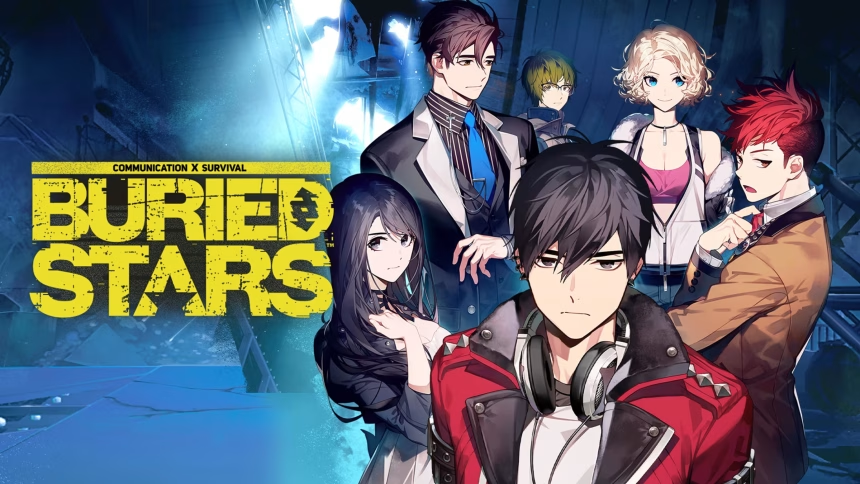
Reality television depends on a strange agreement between performer and audience. Everyone knows the camera changes how people behave, yet the whole show still asks viewers to believe they are watching something unfiltered. BURIED STARS takes that artificial intimacy and traps everyone inside it after the stage itself comes down. The collapse happens during the live finale of a survival audition show, leaving five contestants and members of the production staff trapped beneath the wreckage. Han Do-yoon enters that situation already carrying a public image he never chose for himself. He plays bass in the indie band Masquerade, but advancing alone in the competition has earned him the label of “traitor” among viewers who know only the version of events presented to them. That gap between public persona and private reality becomes one of the game’s most important pressures once the survivors lose physical contact with the outside world but remain exposed to its judgment.
The smartest part of that setup is that isolation never actually means silence. Everyone still has access to Smart Watches and Phater, the fictional social network surrounding the show, so public speculation keeps reaching them even while they are trapped. Reading Do-yoon’s feed while the survivors were stuck underground felt uncomfortably familiar. People outside had incomplete information, but that never stopped them from deciding who was lying, who deserved sympathy, and who should be blamed.
Phater is not just atmosphere. Posts can provide information, reinforce existing rumors, or make an already unstable situation harder to manage. The survivors know that strangers are talking about them in real time, which means every private fear still exists beside the public version of that fear. BURIED STARS understands that social media does not need to invent a problem to make it worse. Sometimes it only needs to flatten a person into the easiest interpretation available.
That is where the Communication Phases become more interesting than a normal dialogue system. I choose topics to raise with individual survivors, and those conversations can improve or damage Do-yoon’s rapport with them while affecting his own mental state. The same subject can land differently depending on who hears it and when. That made conversation feel less like exhausting every option in a menu and more like deciding whether Do-yoon should risk pushing someone who was already close to breaking.
The game then pulls away from those conversations for investigation periods inside the collapsed structure. Searching the wreckage provides clues and context that later feed into debriefing sequences, so the mystery does not move forward through dialogue alone. I liked having those phases interrupt each other because the story is constantly asking for two kinds of attention. I needed to understand what the physical evidence suggested while also deciding how much I trusted the people standing beside it.
The Smart Watch keeps slipping into both halves of that experience. Beyond Phater, it handles communication functions and personal settings, including calls between survivors who are sometimes physically close enough to speak without technology. I’ll admit that never stopped feeling a little absurd. At the same time, the device fits a story about people who have spent so much time performing through screens that another mediated conversation barely feels unusual to them.
Juyoung is where the game’s refusal to reduce its cast to television archetypes becomes especially clear. She has struggled with anxiety and compulsive behavior, but BURIED STARS does not treat those struggles as shorthand for weakness. The version of her that viewers imagine from the show is incomplete, and accusations that she performs vulnerability for sympathy become another example of how easily a public identity can turn hostile once strangers decide they understand it.
Gyu-hyuk faces a different distortion. As the son of a famous singer-songwriter, he has been branded the “Silver Spoon,” with the implication that his position comes from inherited privilege rather than talent. Spending more time with him gradually complicates that label instead of simply replacing it with an equally neat counter-image. The more the story reveals about him, the less useful the show’s version of him becomes.
Hyesung and Inha respond to the pressure in almost opposite ways. Hyesung is deeply attached to Phater and the machinery of information surrounding the competition, while Inha is blunt enough to say what she thinks without much concern for whether the timing is comfortable. Together they worked for me less as a matched pair of supporting characters than as two different reactions to the same disaster. One keeps looking outward. The other keeps cutting directly into whoever is nearby.
Even Do-yoon’s own reputation works differently once the group is sealed off from the audience that created it. People who actually know him recognize a more considerate personality than the cold betrayer presented by the show, but that does not erase the damage of hearing the accusation repeated outside. His public image has enough force to affect him even when the people physically around him know better.
The presentation reinforces that distance between performance and reality. Detailed 3D environments depict the collapsed set while expressive 2D characters occupy those spaces, creating a look that sits somewhere between a staged graphic novel and a visual novel performed inside a physical model. The wreckage never feels like a decorative backdrop. Narrow passages, damaged rooms, and unstable spaces give the conversations a sense of confinement before the script has to remind me that nobody can simply leave.
That claustrophobia did more for the trapped premise than dialogue alone could have. A conversation between two people changes when the background keeps showing how little safe space they actually have. The bright character art also creates an effective contrast against the ruined environment, especially for people whose polished television appearances now exist in a place where maintaining that presentation has become almost meaningless.
The soundscape carries a similar contrast. Mazorski and beggarprince composed the score, moving between suspense, melancholy, and quieter character material without making every scene feel like part of the same thriller register. “Be Honest,” performed by Yoo SuBin, becomes the most direct expression of the game’s obsession with image and concealed truth. Mazorski composed the song, while the lyrics were written by Mazorski and scenario director Sooylbae.
Both Korean and Japanese voice tracks are available, and the performances carry a great deal of the character tension. Hearing Do-yoon’s exhaustion come through in either language made clear how much of his personality sits between the actual words. The same is true across the rest of the cast. Characters who have spent an entire television season being simplified into recognizable types sound much less tidy once fear, irritation, resentment, and affection start bleeding through the performances.
The script does not always match that naturalism in English. I found a few exchanges stiffer than the acting underneath them, as though the localization stayed slightly too close to the original sentence structure when a more natural English rhythm would have helped. It never stopped me from following the story, but the gap became noticeable precisely because the performances were doing so much to make the characters sound like people rather than exposition delivery systems.
Where BURIED STARS becomes more demanding is in how it handles its endings. The first full path forces a Bad Ending before the route toward the True Ending becomes available. Getting steered into that ending the first time felt like a gut punch because I had already spent so long trying to manage relationships, sanity, evidence, and suspicion. The game uses that failure as part of the larger structure rather than treating it as a disposable mistake.
I will not go into what causes that ending or what changes afterward. The important part is that seeing the larger structure later reframes the first attempt rather than simply replacing it. Information that felt complete on the initial run stops looking complete once the mystery opens further, and that made the repeat material easier to accept than it would have been in a game asking me to replay everything for a slightly different epilogue.
That structure also puts more weight on rapport than I initially expected from a murder mystery. Communication is not a decorative social system attached to the investigation. Who trusts Do-yoon, how stable he remains, and what he learns through those relationships can matter alongside the physical evidence. The game never lets me treat people as clue dispensers without consequence.
For me, that is what separates BURIED STARS from a mystery that happens to use a reality show as scenery. The show has already trained everyone to package themselves before the building collapses. The disaster simply removes the stage while leaving the personas intact. Every conversation becomes partly about survival and partly about deciding whether the person speaking is the contestant, the private individual underneath, or some mixture neither side completely controls.
Verdict
BURIED STARS works because the collapsed television set is only the physical version of a problem the characters were already living with. Do-yoon, Juyoung, Gyu-hyuk, Hyesung, and Inha all enter the wreckage carrying public identities that become harder to maintain once survival replaces performance, while Phater makes sure the outside audience never stops interfering. The Communication Phases give those relationships mechanical weight, the investigation keeps the mystery moving beyond conversation, and the forced Bad Ending makes the eventual larger picture feel earned rather than handed over. The English localization occasionally sounds stiffer than the Korean and Japanese performances deserve, but the cast, 2D-over-3D presentation, social-media pressure, and mystery itself gave me enough reason to keep digging after the first ending went wrong.