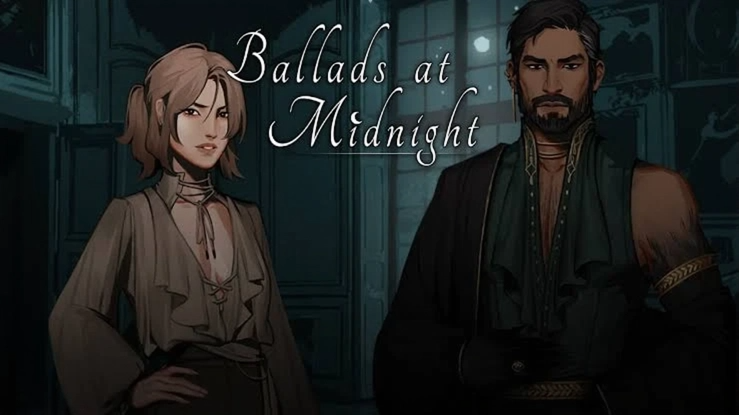
Surviving in Ballads at Midnight means singing a ballad every night, at midnight, for one hundred nights straight, the exact bargain Abigail strikes to keep herself alive inside a manor she can’t otherwise leave. Ballads at Midnight builds its entire opening around exactly that arrangement, sending a sarcastic traveling bard named Abigail to an abandoned castle as punishment for a crime under Illuvia’s laws. She’s sentenced to be fed to the Crown’s supposedly ruthless pet vampire. She arrives ready to fight for her life, only to find the vampire Lucius isn’t hungry at all. He’s just unbearably bored, and what he actually wants from her turns out to be a deal rather than a meal.
Synstoria built the whole thing during the NaNoReNo 2022 game jam in a single month, later expanding it with extra content and more voiced lines for a full re-release that July.
Ayael directed the project and handled UI design and programming, Arrapso provided sprite and background art, and lead writer Wudgeous worked alongside co-writer Notafish and editor Jeneara to build out the script, with Rowanty scripting and Eliana Zebro directing the audio side of production.
The original jam release actually shipped with one ending greyed out entirely, a Secrets ending the team didn’t have time to properly proofread and script within the jam’s own deadline. The July follow-up finished that ending with roughly ten thousand additional words, added twenty five new lines of voice acting, a new cut-in graphic from artist Luciam, a new music track, fifteen new Steam achievements, and an OpenDyslexic font option for accessibility. Publisher Abiding Bridge helped bring the finished version to Steam.
More than forty two thousand words make up the story across roughly three to four hours. Three clearly marked endings branch off depending on whether Abigail tries to escape Lucius early, settles into something closer to happiness with him, or ends up uncovering secrets about the world that neither of them saw coming.
Abigail’s sarcasm reads as a real survival instinct rather than a personality quirk bolted onto the character. It stays sharp enough that even Lucius comments more than once on how unimpressed she seems to be by a vampire who’s supposedly meant to terrify her.
Lucius plays against that expectation just as hard, gentle in a way that undercuts every warning Abigail was given about him. Watching two people built to distrust each other slowly stop doing that gave the enemies to lovers arc real weight instead of just going through the expected motions.
The story touches on real trauma underneath its castle set romance, including allusions to child abuse that the game handles as backstory weight rather than material to dwell on for shock. The choices steering Abigail toward one of the three endings each land on a distinctly different note depending on how much of that shared history she and Lucius are willing to face.
Arrapso’s sprite and background work gives both leads real presence against a setting that reads closer to the 1700s than a stock medieval castle. Ayael’s UI design wraps the whole thing in an elaborate decorative frame that stays consistent throughout every scene. Character names above the dialogue box shift depending on how the relationship between Abigail and Lucius is developing at that point in the story, a small touch that quietly tracked their growing closeness without ever calling attention to itself.
Shar Joyner composed the score under Eliana Zebro’s audio direction, and two original bard songs tie directly into Abigail’s own identity as a musician rather than feeling like generic background music dropped into a fantasy setting. Megan Youmans and Eric Navarro voice Abigail and Lucius respectively across the game’s partial voice acting, and hearing Lucius’s exhaustion with his own immortality come through in Navarro’s delivery added a dimension the text alone couldn’t quite reach.
Finishing the game rewards a reader with a small touch on the main menu itself, Abigail and Lucius shown reunited there once the credits roll. Synstoria’s own catalog extends past this one project too, with Wudgeous’s separate Herotome and the studio’s own Imperial Grace both carrying the same kind of banter driven writing into different settings entirely.
Watching a relationship built entirely out of forced proximity slowly turn into something neither character expected made the eventual reveals hit harder than a shorter jam game usually earns the right to deliver. For something built in a single month, Ballads at Midnight commits fully to its castle bound romance instead of treating the time limit as an excuse to cut corners.
Verdict
A hundred nights of ballads is the whole bargain keeping Abigail alive in Ballads at Midnight, and that specific, concrete stake gives the enemies to lovers arc with Lucius somewhere real to build from instead of just coasting on genre expectation. A full production team, Ayael’s direction, Arrapso’s art, Wudgeous’s writing, and original songs from Shar Joyner, gives a month long jam game presentation most short projects never bother chasing. Three distinctly different endings and a July update that finished the ending the jam deadline cut short reward paying attention to how much of the past these two are willing to face together.