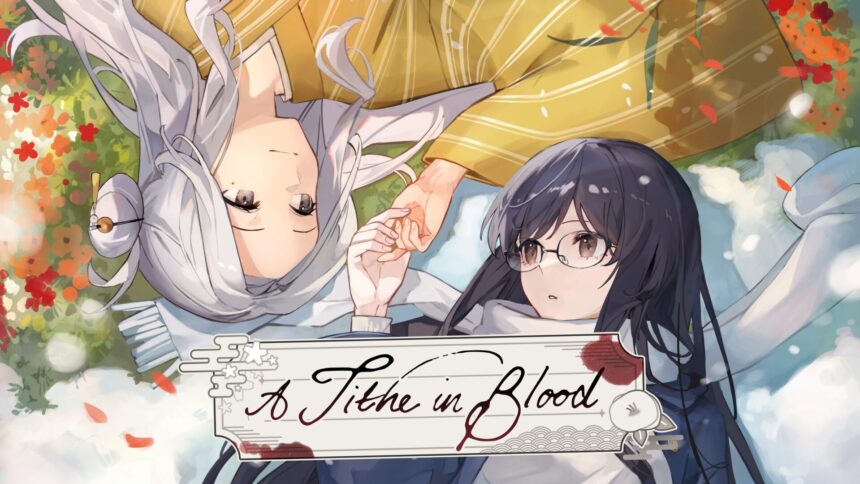
Grief has a way of making escape look like recovery. Somewhere else, some other time, some version of life untouched by what happened can start to feel more inviting than the present. A Tithe in Blood takes that temptation literally, then spends the rest of its story making sure I never forget that escape has a price.
Honoka Asakawa is a quiet university student in snowy Hokkaido whose life has been flattened by personal tragedy. While studying Italian literature, she encounters writings about blood magic, a supposedly lost form of magic available even to someone without the abilities of a conventional mage. Experimenting with it sends her somewhere extraordinary: a sealed version of Sapporo preserved from the Meiji era, where she meets Yasue, a powerful mage who has remained trapped there for a century.
That contrast between the two worlds immediately became one of the things I liked most about the story. Modern Sapporo reflects Honoka’s isolation, while the world surrounding Yasue feels like an escape from everything waiting for her back home. Kobuta’s character designs and artwork give the historical setting a warmth that makes Honoka’s attraction to it easy to understand. The danger is that I could also understand why she might begin wanting the escape too much.
Yasue is crucial to making that pull believable. She is cheerful and welcoming in ways Honoka isn’t, and their personalities complement each other without making their connection feel like an instant cure for grief. Yasue has her own history and her own reasons for being trapped inside this preserved piece of Sapporo, so the relationship never felt to me like a simple story about one damaged person meeting someone capable of fixing her.
Instead, their growing closeness becomes tangled up with the magic allowing Honoka to reach her. The story makes clear that using blood magic carries serious consequences, and Honoka’s repeated return to the sealed world gradually becomes inseparable from what she is trying to escape in the present. I liked how uncomfortable that made the romance at times. Something genuinely meaningful is growing between these women, but the circumstances allowing it to exist are dangerous enough that I could never completely relax into the warmth of their scenes together.
That tension is where A Tithe in Blood worked best for me. The story deals directly with grief and depression without reducing Honoka to either one, and the supernatural premise gives those emotions a physical shape without making them feel less human. I could understand why Yasue’s world became important to her while still recognizing that disappearing into it wasn’t going to make everything waiting in modern Sapporo disappear with her.
Suriko’s script runs approximately 70,000 words, and the game is completely kinetic, with no choices or alternate routes interrupting the story. That linear structure suits the material. I wasn’t being asked to find the correct path through Honoka’s problems or select the responses that would produce the best relationship outcome. I simply had to follow the consequences of the path she was already taking.
The lack of choices also makes the darker stretches feel especially relentless. Once the story begins tightening around Honoka, there is no route change or lighter alternative waiting behind another decision. I occasionally wanted more breathing room as a result. The consistency of the darker tone is clearly intentional, but there were moments when another quiet or ordinary scene would have made the heavier developments hit even harder.
Visually, the contrast between locations helps keep the story expressive despite its linear structure. Kobuta handled the character designs and art, with additional illustration work elsewhere in the production, and the combination of snowy contemporary Hokkaido with the sealed historical setting gives the game two distinct visual identities without making them feel like separate stories. Yasue’s traditional clothing and surroundings particularly reinforce how far Honoka has stepped outside her own time whenever she returns.
Claire DeLuca composed the fully original soundtrack, and I liked how naturally the music could move between intimacy, unease, and the quieter loneliness surrounding Honoka. The score rarely needed to announce what I was supposed to feel. It was most effective when it simply sat underneath a conversation and allowed the emotional distance between the two worlds to speak for itself.
A Tithe in Blood is also fully voiced in Japanese despite its scenario being written originally in English. Toka Itsuki voices Honoka and Mami Fujita voices Yasue, with Haruka Sugita, Haruka Okamura, Jenya, and Yuki Kyoka among the wider cast. I never found the combination of English text and Japanese performances distracting. If anything, hearing Honoka’s guardedness against Yasue’s brighter presence made the differences between them even clearer.
Studio Élan describes this as a darker work than its usual material, and that distinction matters. The game contains serious themes surrounding grief, depression, blood, and violence, and some visual material can be reduced through its preferences. I appreciated knowing that before going in because the romance does not erase the darker story developing around it. I won’t get into what eventually caused Yasue’s world to be sealed or how the consequences surrounding Honoka’s use of magic develop. Those answers belong to the story. What mattered more to me was how effectively the game complicated something that initially looked comforting. Honoka finds someone who makes her feel less alone, but reaching that person is tied to the very behavior pulling her further away from the life she still has.
Verdict
A Tithe in Blood makes its supernatural romance compelling by refusing to separate comfort from consequence. Honoka’s growing relationship with Yasue gives genuine warmth to a story otherwise shaped by grief and isolation, while the sealed Meiji-era Sapporo offers an escape beautiful enough that I understood why returning to ordinary life became increasingly difficult. The completely linear structure and consistently heavy tone occasionally left me wanting more room to breathe, but Suriko’s focused 70,000-word script, Kobuta’s artwork, Claire DeLuca’s score, and full Japanese voice acting give that darkness a remarkably cohesive presentation. What stayed with me most was the contradiction at its center: Honoka finds something worth reaching for precisely where continuing to reach for it carries the greatest cost.