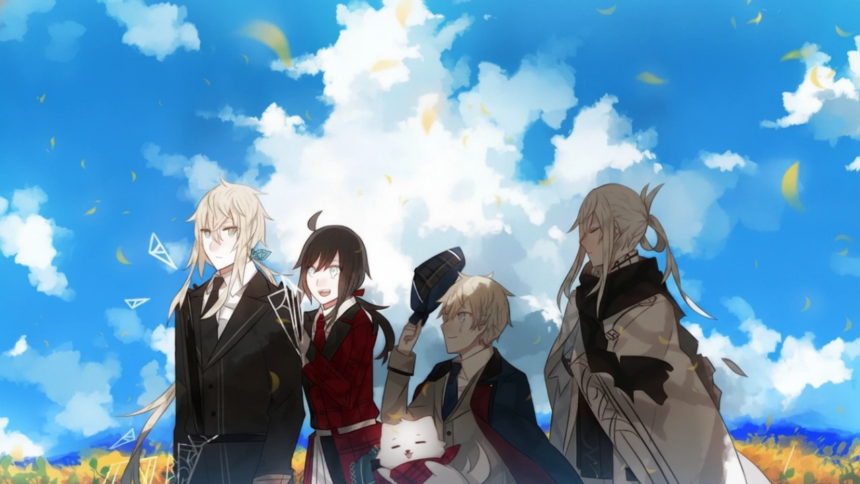
Batensan’s Moon Observatory series is built around thirteen worlds named after months, plus one final nameless world beyond them, each watched over by a half-immortal Magician who cares for the people living there. Magical Otoge Anholly is the second entry in that series, following an earlier game called Magical Otoge Ciel, and it narrows all of that scope down to a single frozen town and the one person left in it.
Anholly is the only person still living in the frozen town of Solvalis. Rather than accept the resignation of Seihuo, a dying ice spirit who’s already made peace with the idea of fading away, she decides she’s going to find a way to save him whether he wants her help or not. Talking someone out of giving up on themselves is a much harder task than talking them into anything else, and the stakes of getting it wrong here are about as high as they get.
Batensan built this solo for the NaNoRenO 2016 game jam, releasing it free with no demo needed given how short the whole thing runs, short enough to finish in a single sitting. There’s only one actual path through the story, but the dialogue options along the way still let a reader shape how Anholly approaches her attempt to change Seihuo’s mind.
Anholly’s bubbly optimism reads as a real coping mechanism rather than a static personality trait, since the story makes clear she’s putting on more cheer than she actually feels given her own tragic circumstances. Seihuo plays almost entirely against her energy, cold and sarcastic on the surface while clearly thinking through far more than he lets on, and watching that guarded exterior slowly crack under Anholly’s persistence gave their dynamic real charge.
Riov, Anholly’s only friend since childhood, brings a quieter kind of maturity that’s undercut by an obvious lack of social skills. Veltaire arrives as a polite, mysterious outsider whose reasons for visiting Solvalis stay deliberately vague.
Death and dying sit at the center of the story, and the game handles that weight without ever depicting anything graphic, choosing instead to let the emotional stakes hold the heaviness rather than any explicit imagery. The tongue-in-cheek humor running through earlier scenes never once undercuts how seriously the story takes its own central loss once that loss becomes real. Whatever Anholly’s attempt to save Seihuo actually costs her, the game earns every bit of the weight it asks a reader to sit with by the end.
Batensan’s own art holds the same visual identity that made the previous Moon Observatory entry recognizable, detailed enough in Seihuo and Anholly’s expressions that their back and forth read clearly even in the quieter, more understated scenes. There’s no voice acting anywhere in the experience, which tracks for a solo jam project this size, and the writing carries that emotional load entirely on its own.
The series has since continued past Anholly too, with a third entry called Iris picking up the same world watching, half-immortal Magician concept and a fourth planned entry called Melanie still to come. Watching Anholly’s determination hold up against a character who’d already resigned himself to an ending made every small crack in Seihuo’s resistance feel earned rather than rushed toward for the sake of a tidy runtime.
Verdict
Thirteen named worlds and a whole mythology sit behind Magical Otoge Anholly, but none of that scale gets in the way of a story this tightly focused on one girl refusing to let a resigned dying spirit give up. Batensan’s own art keeps Anholly and Seihuo’s back and forth expressive throughout, and Riov and Veltaire round out a small cast that makes this short jam game feel more complete than its runtime would suggest. For a free game built during a single game jam, it delivers more emotional weight than its short length and lighthearted opening tone would suggest going in.