Marisugawa Arue missed the exam that would have kept her out of this mess entirely because she was hospitalized at the worst possible moment. That single stretch of bad luck reshaped everything that came after for a girl who’d already grown up poor, sharing a home with her mother and younger brother on whatever she could scrape together.
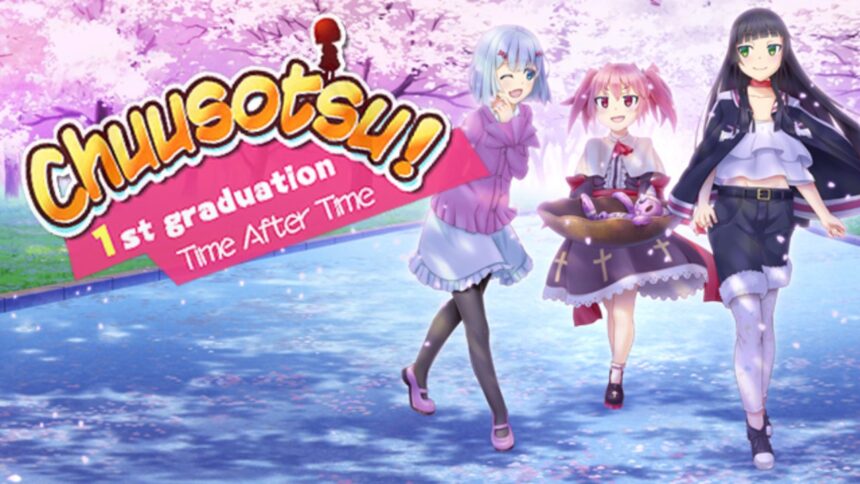
Chuusotsu! 1st Graduation: Time After Time drops Arue straight into life as a chuusotsu once that exam failure catches up with her. That’s a designation under the Global People’s Federation’s P3 law for anyone lacking the Authorization Seal that ranks every citizen’s career, intelligence, and physical traits. Her Authorized Power level sits at a bare five, low enough to brand her a failure by the law’s own standard. The only way back involves a government relief program that puts her in a small rent-free apartment alongside two other chuusotsu, Arara and Koiro.
Studio Beast developed the original as an all-ages release, and Fruitbat Factory funded the English localization through a Kickstarter campaign, one that hit stretch goals for bonus event CGs and offered a limited fifty dollar physical Collector’s Edition to backers along the way. It plays as a kinetic novel with no choices to branch the story, running an estimated fifteen to twenty hours depending on how much of a short bonus scenario about a background character a reader chases down in the options menu. Dual English and Japanese text runs alongside full Japanese voice acting throughout, Takeda Eruru behind Arue, Ohyama Chiroru behind Arara, and Inukai Ao behind Koiro, with Amakawa Milk voicing a further character tied to that same bonus scenario.
Arara lives almost entirely inside her own head, convinced she’s some kind of destined savior locked in pursuit of something she calls the World Dominator, and that conviction never once wavers no matter how little the world around her seems to care.
Koiro carries a very different kind of history, having walked away from her old life as the strongest gang leader in her hometown, known there as the Beachside White Rabbit before she traded that reputation for a rabbit-print jacket and a spot in Arue’s apartment. Taciturn and intimidating enough to scare off most people on sight, she turns out to be pure hearted and more than a little airheaded underneath it, quick to declare herself an ally of justice against whatever small injustice happens to cross her path that day.
Arue spends most of her energy trying to keep the group focused and moving toward whatever goal she’s decided matters most that week, a habit that put her at constant odds with Arara’s total fixation on the World Dominator instead. Koiro tries to referee between the two of them, though her attempts at moderating rarely land with much success. Watching all three of them stay committed to their own specific obsessions, even while living under the same disqualifying label, gave the group dynamic a lived-in, believable friction.
Underneath the colorful, goofball surface, the story builds toward real social commentary about people society treats as disposable once they stop fitting a productive mold. I found myself more invested the longer that commentary stayed present without ever being stated outright. Whatever conflict eventually pulls the three of them apart, the philosophical questions the story keeps circling, about what actually makes a life worth living, felt earned rather than tacked on for prestige.
Koiro’s CG artwork stands out as some of the strongest in the game, detailed enough to carry real weight during the story’s more emotional turns. It never once clashes with the otherwise bright, colorful visual tone the rest of the presentation leans into.
Reaching the story’s single ending after watching all three girls wrestle with a label none of them chose for themselves left me thinking about how much of their worth had been decided by a law none of them had any say in passing. On top of the main story and its hidden bonus scenario, the release also comes bundled with a separate soundtrack correction and a digital artbook, giving anyone who finishes the story somewhere further to look.
A direct sequel called Chuusotsu! 1.5th Graduation: The Moving Castle picks up after this story wraps, running about two hours and following Arue as she prepares for her first doujin event. There, an arrogant manga artist bets her that a seal-less chuusotsu like her won’t sell a single copy of her own work. That bet pits Arue’s dreams directly against a belief that profit is the only thing that actually matters, and a new character named Monami joins the story alongside her as that conflict plays out.
Verdict
Arue’s single missed exam ends up mattering more than anything else in Chuusotsu! 1st Graduation: Time After Time, and the real social commentary about being written off by society builds slowly enough underneath the colorful surface that it never once feels forced. Arara’s delusions of being a destined savior and Koiro’s buried gang-leader past give the cast real range even where their backstories stay thinner than Arue’s own, and Koiro’s CG work carries the story’s bigger emotional turns well. A direct sequel already exists to pick up where this one leaves off, proof these three still had more story worth telling once the credits rolled.