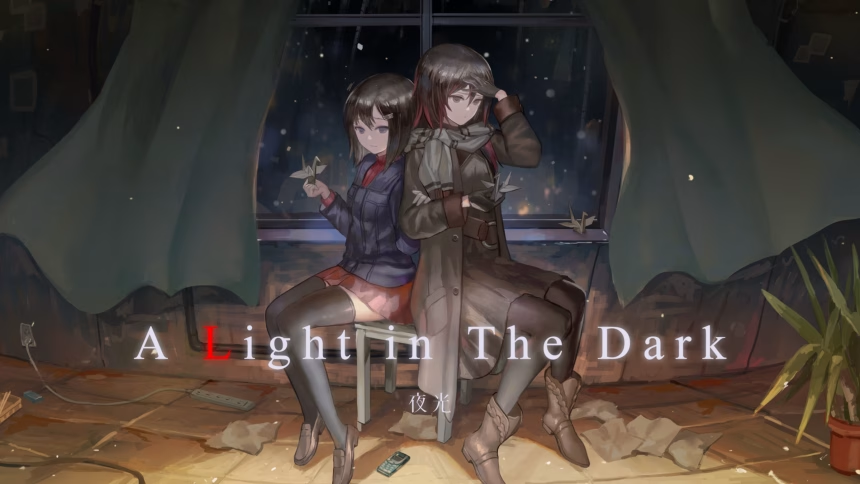
A Light in the Dark draws its class conflict directly from real disparities in Taiwan, and that grounding shows in how specifically the story treats what separates its wealthy hostage from the sisters holding him rather than reaching for a generic rich-versus-poor setup. Forced proximity drives the entire story, waking Hao-Chen Jiang up with his hands and legs tied in a room he’s never seen before. Two sisters have kidnapped him, demanding ransom from his wealthy, CEO father. What starts as a straightforward hostage situation slowly turns into something else entirely. The days Jiang spends tied up force him and his captors to confront assumptions about each other’s lives that neither side had any real reason to question before.
CreSpirit, better known for the metroidvania Rabi-Ribi, teamed up with fellow Taiwanese studios Storia, developers of Dong-jin Rice-hime, and Narrator, developers of Companion, to build something much quieter and more contained than any of their prior work.
Sekai Project published the game after running a Kickstarter campaign in February 2018 that raised just over $32,500 from 927 backers against a $28,000 goal. That was enough to fund an epilogue stretch goal and cover the English localization, but not the Japanese voice acting stretch goal further up the list. That voice work came later instead, added specifically for a Fall 2022 console release on PlayStation 4 and Switch, with the same audio arriving as a free update on PC.
Character designs came from NuDa, with CanKing handling the game’s illustrations, and between them the art keeps the tone atmospheric and tense without ever needing more than one location to sell it.
Composer Oli Jan built a thirteen track score around ambient electronic textures and tense, emotional melodies, underscoring the story’s isolation without ever pushing the drama harder than a given scene actually needed.
An official novelization followed a month after release, filling in additional story detail beyond what the game itself covers. A free update a year later added an entirely new ending for players who’d already finished the original release, one the developers themselves said they hadn’t been fully satisfied with at launch.
Gameplay alternates between examining the room for anything useful toward an escape plan and answering the sisters’ questions through time-limited dialogue choices that shift how much they trust him. Managing a stamina meter throughout kept every decision feeling like it actually cost something. A full playthrough runs about two and a half hours, short enough that I went back through it twice just to see how differently a more hostile Jiang would have been treated.
Jiang starts out reading exactly like the sheltered, wealthy student his cram school routine would suggest, though watching that routine unravel under captivity gave him room to become someone more specific than his backstory alone implied.
The older sister holds open disdain for Jiang and everything he represents, sharp enough in her hostility that I believed every threat she made even when I suspected she didn’t want to follow through on the worst of them. The younger sister softens that hostility from the opposite direction, and the gap between how each sister treated their captive said as much about their own relationship as it did about Jiang.
Underneath the hostage plot, the story keeps circling back to how differently wealth and desperation shape a person’s choices, and it does that without ever flattening either sister into a simple villain or Jiang into a simple victim. Six distinct endings wait at the far end of that structure, five of them landing on some version of resolution and one marking an outright bad outcome, and the choices steering Jiang’s answers during captivity shape which of them a given playthrough actually reaches.
Nearly the entire story plays out inside that one dilapidated room, with a cast that barely extends past Jiang and the two sisters holding him. That narrow focus gave the whole experience an intimacy closer to a stage play than the wide, multi-location structure most visual novels default to.
Kubo Yurika’s read of the older sister sold her hostility without ever losing the hint of restraint underneath it. Ichinose Kana matched that with a gentler read for the younger sister, making their sibling dynamic clear even in scenes where the script itself stayed quiet about it.
Watching two people who started the story as captor and hostage slowly start seeing each other as something closer to equals made the eventual choice between endings feel like it actually mattered. A Light in the Dark stays short on purpose, and that restraint kept the story from padding out a premise this contained with material it never needed.
Verdict
Real class disparities in Taiwan sit underneath A Light in the Dark’s kidnapping premise, and that grounding is what keeps Jiang and his two captors from ever flattening into simple stereotypes across six possible endings. Oli Jan’s score and a cast confined almost entirely to one room give the story a stage-play intimacy most visual novels never bother chasing, and Kubo Yurika and Ichinose Kana’s later-added voice work gives the sisters real distinction on top of that. It’s a short, deliberate story that earns every minute of its two and a half hours.