Rei wakes up assuming he must be a Phiroid whose production went unfinished, since he can find no trace of emotion in himself and his right hand turns out to be mechanical underneath a missing layer of synthetic skin. Harmonia sets that discovery inside a much larger collapse, a future where humanity peaked at ten billion people before pollution, war, and a birth rate crushed by unions between humans and emotional androids called Phiroids sent civilization into a slow decline. Somewhere in the middle of that decline, Rei collapses from exhaustion after walking the ruined landscape searching for the emotions he’s missing, and wakes up cared for by a girl named Shiona in a small town who assumes he’s simply human. The story follows him slowly learning how to feel something again in a world that’s mostly forgotten how.
Key built this as their second kinetic novel after Planetarian, directed and written by Kai, whose earlier work for the studio includes CLANNAD and Angel Beats!, alongside co-writer Tsuzuru Nakamura.
It released in English on Steam on September 23, 2016, before its own Japanese release that December, an unusual order for the studio at the time. A Nintendo Switch version followed in Japan in October 2022, and a Full HD Edition arrived on PC in April 2024 with a retranslated script that cleaned up a few points of confusion from the original release.
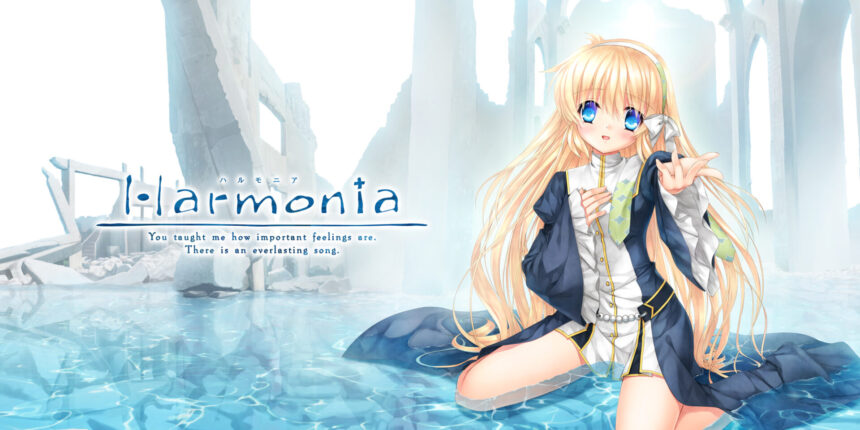
No choices exist here to branch the story, and the interface breaks from Key’s usual full-width dialogue box by pushing text off to one side of the screen while keeping character sprites fully visible on the other. That layout let me take in more of Itaru Hinoue’s art at once than a standard text box would have allowed.
Rei’s flat affect never reads as a personality flaw so much as a real condition the story takes seriously, and watching small, specific moments chip away at that numbness gave his arc real texture instead of a simple before-and-after switch.
Shiona meets that numbness with a patience that never tips into saintliness. She’s invested enough in Rei’s slow recovery that her own care for him started to feel like its own quiet act of defiance against a world that’s stopped bothering to feel much of anything.
Tipi rounds out the small cast as a third figure Rei eventually crosses paths with, a girl living alone in the town’s library who most of the townsfolk keep their distance from despite knowing she’s there. Her own presence in the story gave Rei’s slow emotional education a second perspective to learn from, one quieter and more guarded than Shiona’s open warmth.
Learning how the Phiroids’ capacity to love actually reshaped human society, marriages forming between android and person until birth rates collapsed and empathy itself started to erode, gave the post-apocalyptic backdrop a real sense of cause. It never felt like decorative scenery for a robot protagonist to wander through.
Rei’s own story connects back to that wider collapse in a way that recontextualizes everything quiet and understated that came before it, once that connection actually lands.
Itaru Hinoue’s character designs hold a real warmth in the faces especially, work she’s said was some of her most satisfying at Key before this ended up being her final contribution to the studio. The background art leans on a dusty, brown-toned filter meant to sell the post-apocalyptic setting. I understood the intent, but that same filter sat over nearly every scene long enough that it started working against the atmosphere rather than for it by the later chapters.
Shinji Orito and Ryo Mizutsuki composed the bulk of the score with additional contributions from Tomohiro Takeshita, leaning heavily into piano, strings, bells, and synth. That atmosphere did more for the story’s quieter emotional scenes than the muted background art ever could. Ayaka Kitazawa performs the theme song Todoketai Melody, with lyrics by Kai himself, and Haruka Shimotsuki’s insert song Towa no Hoshi e turns up at a moment specific enough that I’ll leave its context out of this review entirely. Ryo Nishitani voices Rei, Kaori Mizuhashi voices Shiona, Misaki Kuno voices Tipi, and Kenta Miyake rounds out the main cast as Madd. Full voice acting gives even Rei’s flattest early line reads a specific, deliberate emptiness that text alone wouldn’t have carried as clearly.
Reaching the single, fixed ending after watching Rei slowly relearn how to care about another person left me thinking about how much of that same numbness the story’s version of humanity had let itself sink into without ever noticing. Harmonia runs short even by kinetic novel standards, but Key built it dense enough with real feeling that the brevity read as focus rather than a shortcut.
Verdict
Rei’s slow relearning of emotion says something specific about a world that let its own capacity for empathy quietly rot away, and Itaru Hinoue’s character work, her final contribution before leaving Key, gives that story real warmth even when the background art works against it. A score from Shinji Orito and Ryo Mizutsuki and a full voice cast led by Ryo Nishitani and Kaori Mizuhashi carry the quieter scenes especially well. The single fixed ending and a dusty visual filter that overstays its welcome keep this from being flawless, but the short runtime never once feels like it’s wasting a reader’s time.