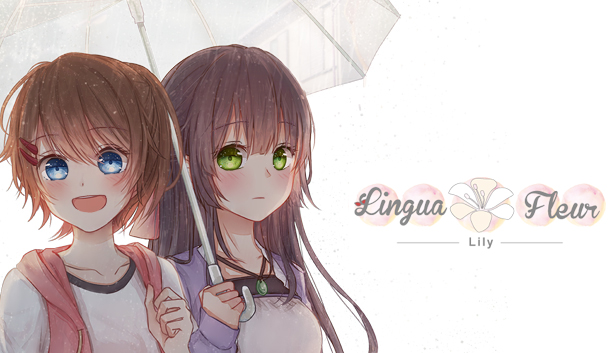
Lingua Fleur: Lily carries a literal meaning in its original Chinese title, 花語:百合, which translates to Flower Language: Lily, tying the story directly into the language of flowers where lilies traditionally symbolize purity and renewed devotion, themes that run straight through Yuyi’s own arc.
An arbitrary pairing sits at the center of the whole story, putting the quiet, isolated Yuyi Wu next to the outgoing, energetic Yile Lin during a physical education class neither of them chose. Yuyi arrives at school every day carrying a secret she’s kept hidden even from the mentor who guided her through middle school, and Yile’s persistence slowly starts pulling that secret toward the surface.
Narrator and Storia, the same Taiwanese studios behind A Light in the Dark, built the whole thing as a kinetic novel with no choices to make.
It released March 30, 2019, running past sixty thousand words across somewhere between six and seven hours depending on reading pace. I appreciated not having to second guess which option might close off a scene I wanted to see, since the story unfolds exactly the same way no matter how many times a reader sits down with it.
Yuyi holds herself to an exacting standard in nearly everything, an excellent student who spent years perfecting her coursework, her cooking, even her own temperament, with sports standing out as her one obvious weak spot. She grew up hoping to find a connection like the ones she reads about in her favorite otome comics, and watching reality keep falling short of that hope shapes a lot of her early guardedness.
Yile pulls in the opposite direction entirely, a rising volleyball star who leans on Yuyi for academic help just as often as Yuyi leans on her for company, passionate enough that she doesn’t always stop to think a plan through before acting on it. Her energy works precisely because it never once tips into pushiness, patient in a way that let Yuyi open up on her own timeline instead of being forced into it.
Yuyi’s relationship with her former middle school mentor, referred to throughout as Sis Tutor, sits underneath the main friendship as its own quieter thread. It made clear just how long Yuyi had been holding this particular weight alone before Yile ever showed up.
The story treats the psychological toll of hiding a core part of yourself, in this case Yuyi’s own sexuality, from a community that would reject it as seriously as it deserves, without turning that struggle into melodrama for its own sake. The party invitation Yuyi receives partway through forces her past back into the present, and the buildup to that moment earns the tension it’s clearly been saving up the whole story.
Character sprites hold real detail in a clean, drawn style, and the backgrounds around them stay simple enough that nothing ever competes with the two leads for attention. CGs show up rarely, seven of them across the whole story, but the ones that do land exactly where the story needs a beat to breathe rather than getting scattered around to pad out the presentation. The developers later refurbished the original character art specifically to prepare for a planned After Story DLC, bringing the illustrations more in line with how much the cast has aged in story since the original release. That refurbish also reflects how much the illustrator’s own style had grown in the years since.
Oli Jan composed the bulk of the score alongside Sorane, and the original tracks between them stay understated rather than reaching for anything bombastic, which fit a story more interested in quiet conversations than dramatic swings. A handful of short animations punctuate key scenes too, adding just enough motion to keep the more emotional beats from feeling static.
Full Chinese voice acting covers Yuyi, Yile, and the rotating cast of minor characters who drift in and out of their college life. Hearing Yile’s warmth against Yuyi’s more guarded line delivery sold their dynamic faster than the text alone managed.
Watching two people build trust slowly enough to feel earned, rather than rushed to hit a runtime, made the ending land with more weight than a kinetic novel this length usually gets the chance to earn. Where that ending lands still leaves room for more of Yuyi’s story to be told, which tracks given the After Story content already in the works.
Verdict
A title that translates directly to Flower Language, Lily gives Lingua Fleur: Lily’s central symbolism away before the story even starts, and Yuyi’s arc toward accepting her own sexuality earns that symbolism rather than just borrowing it for flavor. Yile’s patient energy against Yuyi’s careful guardedness carries the friendship at the center of it, and Oli Jan and Sorane’s understated score paired with full Chinese voice acting carry the quieter moments as well as the bigger ones. A refurbished art style already in progress for a planned After Story suggests this university friendship isn’t finished being told yet.