Ecout’s real weakness is not that he believes Otis. It is that he still wants to believe the institution employing him can be salvaged. That optimism gives Ovine Replica its sharpest tension. The Master Order Trained Hire has already shown him enough cruelty to justify walking away, yet he keeps looking for a version of the job that resembles the justice he thought he signed up to deliver. Then Otis offers him something far more dangerous than reassurance: the ability to make a wish powerful enough to stop accepting the world as it is.
Ecout Kanovos joins the MOTH after growing up poor, hoping authority might finally give him enough stability to do some good. Instead, his work exposes him to a version of Enonoia where state power and justice barely resemble each other. People disappear. Riots simmer. The city’s problems feel too large for one recruit, but the uniform still gives Ecout a reason to imagine he might change something from inside.
Otis destroys that comfortable middle ground. Ecout frees him from a state prison and discovers a strange young man with an animal-like appearance who promises to repay the favor by granting any wish. The offer sounds absurd until refusing it starts looking almost as irrational as accepting it. Ecout already knows ordinary methods are failing. Otis simply gives him a way to stop pretending patience will necessarily fix anything.
Their dynamic works because Otis never feels like a benevolent genie waiting for the correct heroic request. He is too opaque for that. There is always some distance between what he says, what Ecout wants to hear, and what I suspected the offer might actually cost. At the same time, Ecout is hardly an innocent being tricked into wanting power. The more frustrated he becomes with MOTH and with Enonoia itself, the easier it is to understand why the possibility of forcing change becomes attractive.
That made my choices feel less like tests of whether I trusted Otis and more like tests of how long I trusted Ecout. On my first run, I reached an ending that immediately made me wonder what a more cautious version of him would have done with the same opportunities. Replaying changed enough of the path that I stopped thinking of the choices as decorative detours. Different decisions reveal different sides of Ecout’s motives and push his relationship with Enonoia toward meaningfully different conclusions.
The city benefits from staying slightly out of reach. Ovine Replica constantly mentions riots, abductions, inequality, and institutional violence without turning every problem into a scene Ecout personally witnesses. That restraint makes Enonoia feel larger than him. He is one recruit moving through a place already destabilizing under pressures that existed before the story began. I liked that sense of scale because it makes his desire to fix anything feel both understandable and dangerously arrogant.
It also prevents the story from giving me an easy answer about whether Enonoia deserves reform or destruction. MOTH is clearly compromised, but destroying an institution and repairing the society around it are not the same thing. Otis’s power can bypass the slow mechanisms Ecout once believed in, yet the ability to force an outcome does not automatically make that outcome just. The game is strongest when those possibilities remain uncomfortable rather than neatly moralized.
The atmosphere leans more toward unease than constant horror. Much of the story is still conversation, observation, and Ecout slowly realizing that the people and systems around him are not behaving according to the rules he expected. When violence does appear, it lands harder because the game has spent so much time letting tension build through political instability and distrust. Blood and occasional gore are present, along with profanity and sexual themes, but the story never becomes a showcase for shock imagery.
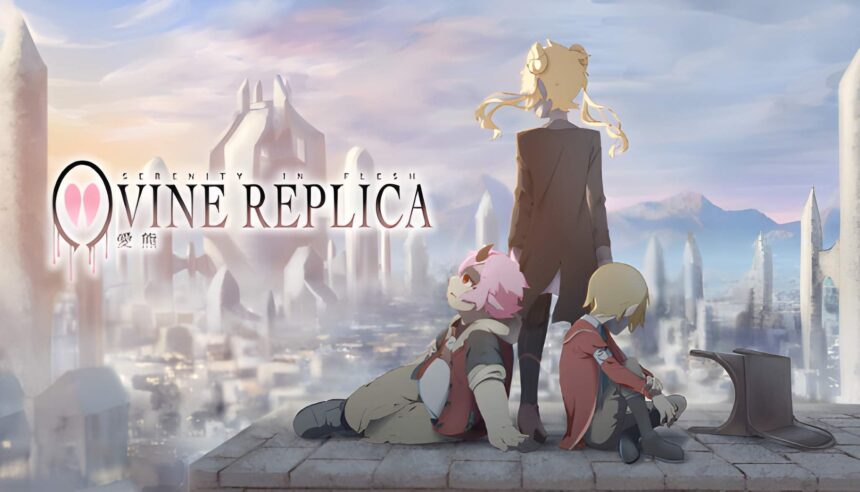
Aiyuu’s artwork gives that unease a distinctive shape. The event CGs arrive at major moments rather than constantly interrupting the text, which makes them feel like punctuation instead of decoration. Character designs fit the slightly foreign quality of Enonoia without making every resident look deliberately bizarre. Otis stands out immediately, but the rest of the cast still belongs to the same world around him.
The current version is noticeably more polished than the earlier presentation. The interface has been rebuilt, new CGs have been added, and the gallery gives the artwork a proper place outside the story. Controller support also makes the reading flow smoother than I expected, especially when moving through repeated scenes while checking alternate choices. None of those additions change what Ovine Replica fundamentally is, but they make the finished version feel much more deliberate.
Matthew L. and Strung split the soundtrack, and I noticed the music most when a scene changed emotional direction. The score can make Enonoia feel distant and almost dreamlike before tightening into something harsher when Ecout loses control of a situation. It supports the game’s mixture of fantasy, conspiracy, and urban unrest without trying to overwhelm scenes that already depend heavily on dialogue.
There is no voice acting, which keeps the presentation firmly text-driven. That suits Otis particularly well. I had to decide how much warmth, mockery, or threat to read into his words instead of having a performance settle the question for me. For a character built around uncertainty, that ambiguity helps.
Ovine Replica is also short enough that its branching structure remains manageable. A single pass takes around an hour, but seeing the different outcomes stretches the experience considerably because the meaningful choices are not all packed into one obvious final decision. The game expects replay rather than disguising one linear story behind a few temporary deviations.
Its biggest limitation is that the wider unrest sometimes feels more suggested than fully inhabited. Enonoia has enough political tension to support a much larger story, yet Ecout’s immediate perspective means some of its most interesting problems remain beyond his reach. Otis can also stay frustratingly unreadable for long stretches. I wanted more access to whatever sits behind his confidence, especially once his power became central to Ecout’s decisions.
Neither issue ruined the story for me because Ovine Replica works best as the beginning of something larger. It is Part I of The Enonoia Saga, with Ursine Science continuing and concluding the conflict from another perspective. That broader structure suits a first entry centered on a man convinced he might still understand how his city should be fixed.
By the end, I was less interested in whether Otis’s wish was inherently dangerous than in why Ecout was ready to use it. The supernatural power gives him possibilities, but the anger, disappointment, and desire for control were already there. Otis does not create Ecout’s disillusionment. He gives it somewhere to go.
Verdict
Ovine Replica works best as a story about reform curdling into desperation. Ecout’s faith in MOTH gives Otis’s wish real temptation, while the branching choices make different versions of that desperation worth seeing. Enonoia and Otis could both use more depth, but the uneasy art, strong score, and political tension make this a compelling opening to the Enonoia Saga.