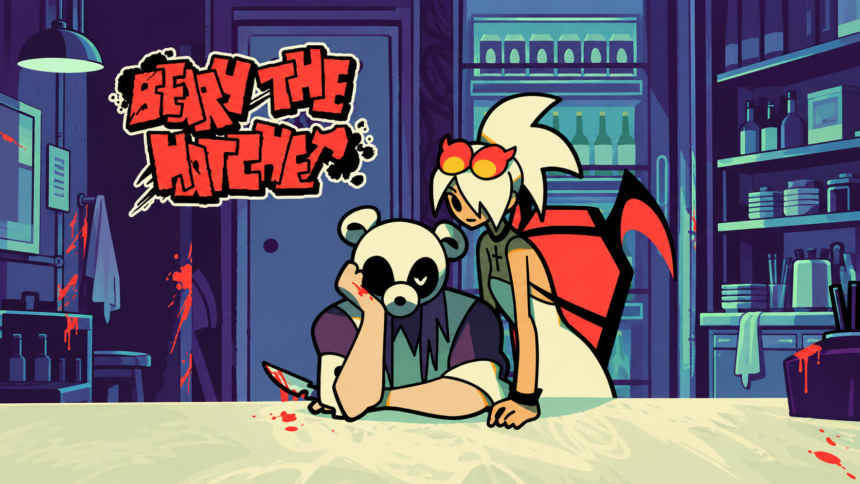
The funniest thing about Grizz is how little emotional energy she has left for the fact that there is a body in the backroom. Murder should be the largest problem available to her, yet she reacts to it with the same exhausted irritation I would expect from someone realizing a coworker called in sick five minutes before a holiday rush. Pearl immediately destroys even that fragile sense of normality. She recognizes the Bearwater Grizzly Killer standing behind the counter and responds not with fear, but with the enthusiasm of someone meeting her favorite celebrity. Watching Grizz’s flat exhaustion collide with Pearl’s absolute delight gave their partnership its rhythm before I cared whether either of them was going to survive the shift.
That mismatch carries Beary the Hatchet through a premise that could easily have exhausted itself after the first joke. Halloween night in 199X has already gone badly before the player really gets control. Grizz has killed someone during her retail shift and needs to keep the corpse hidden in the backroom until closing time, all while continuing to deal with customers as though nothing unusual has happened. Pearl discovering her identity should make the situation worse, but instead she volunteers herself into the problem with the enthusiasm of a true crime obsessive who thinks she has just been handed the greatest night of her life. The game keeps returning to that contrast between something horrifying and something mundanely inconvenient, letting retail work and murder compete for Grizz’s attention with almost equal urgency.
The customer interactions are what stop that setup from becoming a conventional visual novel about two characters talking beside a body. I still have to work. Customers need items, the store has to be searched, and whatever is happening on the sales floor cannot simply be ignored because there is something much worse hidden a few rooms away. Finding what people want gives the shift a practical rhythm, but it also creates pressure because every errand means moving through the store instead of staying near the secret I am supposed to protect. The tension comes from having to behave like an employee when every instinct says the retail routine should have stopped mattering several crimes ago.
That structure also makes the store itself important. Beary the Hatchet uses RPG Maker MV with the MV3D plugin to create a 2.5D space rather than presenting the location as a sequence of flat visual-novel backgrounds. Walking around shelves, counters, and back areas gives the shift a sense of physical geography, and the pixel work from Hamboree fits naturally into that depth. I always knew there was a real place connecting the customer-facing floor to whatever Grizz desperately wanted nobody to see. The later timed chase sequence makes especially good use of that space, and it raised my pulse much more than I expected from a game whose strongest weapon until then had mostly been deadpan comedy.
The visual direction is equally committed to making the characters pop against that environment. Kirvia served as head artist, with Legoplex credited for character design and additional artists contributing pixel work, props, layouts, color, and interface material. Grizz and Pearl benefit most because their designs communicate the same mismatch their dialogue does. Grizz reads as somebody who wants to keep the night under control with as little additional effort as possible, while Pearl has the kind of energy that makes restraint feel physically impossible. The game uses dozens of sprites and more than thirty CGs across a relatively short runtime, so expressions and staging change often enough that the comedy rarely has to rely on text alone.
Chromatic aberration adds another layer to the look. Bright scenes can take on a deliberately distorted fringe by default, helping the store feel slightly unreal even before events spiral further out of control. The effect can be disabled in the options, which was a sensible choice because the visual noise is part of the style rather than something every player will want constantly in front of them. Beary the Hatchet is already busy with pixel animation, 3D depth, colorful character art, and Halloween lighting, so the option to remove one layer of distortion prevents the aesthetic from becoming mandatory punishment.
Brandon and Courtney keep the central duo from existing in an empty workplace built solely around their joke. Brandon especially functions as the kind of customer whose refusal to leave things alone becomes dangerous in a situation where curiosity is the last trait Grizz needs from anyone walking through the door. Courtney helps keep the shift socially populated, which matters because a completely deserted shop would make hiding the body too easy and undermine the absurdity of still having a job to perform. Neither needs the same amount of attention as Grizz or Pearl. Their value comes from reminding me that the retail world has not politely stopped because the protagonists are having an unusually criminal evening.
Pearl remains the real destabilizing force. A normal accomplice would help Grizz reduce the number of problems in front of her. Pearl often feels delighted simply to have problems worth participating in, which makes every conversation slightly dangerous even when she is technically useful. Grizz’s annoyance works because she cannot match that energy and has no interest in trying. Their scenes became funnier the longer they spent together because the joke develops past “serial killer meets fan” into two people whose emotional responses to the exact same crisis never quite synchronize.
The writing has enough restraint to let that relationship develop inside a game that only runs around one to one and a half hours. Head writer mokadevs also handled programming, while Sheep wrote the customer interactions, and the complete script passes ten thousand words without feeling oversized for a jam project. Dialogue moves quickly, jokes rarely need paragraphs of setup, and tasks interrupt conversations before the game can become too static. I never felt the runtime dragging, which is important because extending this particular premise too far would have risked turning Grizz’s exhaustion into actual player exhaustion.
Rom M’s original score and sound work help control those tonal shifts. The soundtrack can sit under a relatively ordinary customer exchange and then pivot quickly once the possibility of discovery becomes more immediate. I liked that the quieter aisles never felt completely safe even when nothing obvious was happening. The music understands that the comedy only works if the underlying situation remains dangerous, so it never allows the body in the backroom to disappear entirely from the atmosphere.
The ending structure gives the short game more room than the runtime initially suggests. Three main endings sit alongside more than ten unique Game Over cards, making failure something the team clearly expected players to encounter rather than an accidental state outside the real experience. Those Game Overs fit the tone because a badly managed shift deserves a punchline of its own. At the same time, the main endings let Grizz and Pearl’s dynamic reach somewhere more substantial than the opening setup advertises. I will not say which one landed hardest for me, only that the payoff made the relationship feel more considered than a one-joke jam pairing.
Technical roughness is the clearest reminder of how quickly the project was assembled. Rendering a 3D presentation through RPG Maker MV can be demanding, and the combination of MV3D with the rest of the visual effects can lead to performance problems on weaker hardware. That friction suits neither the timed material nor a game that otherwise moves so briskly. Beary the Hatchet is at its best when the player is reacting quickly to retail tasks and escalating trouble, so slowdown can interfere with the exact pacing the design depends on.
Even with those rough edges, the scale of the finished project is impressive for something created for the fifth annual Spooktober Visual Novel Jam in 2023. Team Cetacity built it under co-directors mokadevs and Kirvia with separate contributors handling writing, customer interactions, music, sound, character art, pixel animation, props, backgrounds, and other production work. Pearl was later recognized by the jam as the winner for Best Character Design, which makes sense given how immediately readable her personality is before she has even had time to make the situation worse. The game itself was also included among the jam’s honorable mentions and shortlist selections.
What stayed with me, though, was still the simplicity of Grizz and Pearl standing on opposite ends of the same disaster. Grizz treats murder like another workplace complication she needs to contain until clock-out. Pearl treats proximity to a serial killer like the universe has finally rewarded her for being interested in true crime. The body, customers, chase, store errands, and multiple endings all work because they keep testing how long those two attitudes can coexist. Beary the Hatchet never needs the night to become realistic. It only needs Grizz to desperately want it to remain manageable while Pearl keeps finding new reasons to enjoy the fact that it is not.
Verdict
Beary the Hatchet gets its best material from treating murder and retail work with the same exhausted sense of obligation. The 2.5D store gives the customer errands and later chase real physical pressure, while Kirvia’s character art, Hamboree’s pixel animation, and Rom M’s score give the short production far more personality than its jam origins suggest. Technical performance can become rough when RPG Maker MV is pushed this hard, but the game moves quickly enough that its strongest ideas never wear out their welcome. Grizz and Pearl are the reason it works. One wants to make it through the shift with the smallest possible amount of additional trouble, the other thinks discovering a serial killer at work is the best thing that could have happened to her, and watching that mismatch survive an increasingly terrible Halloween night carried the entire experience for me.