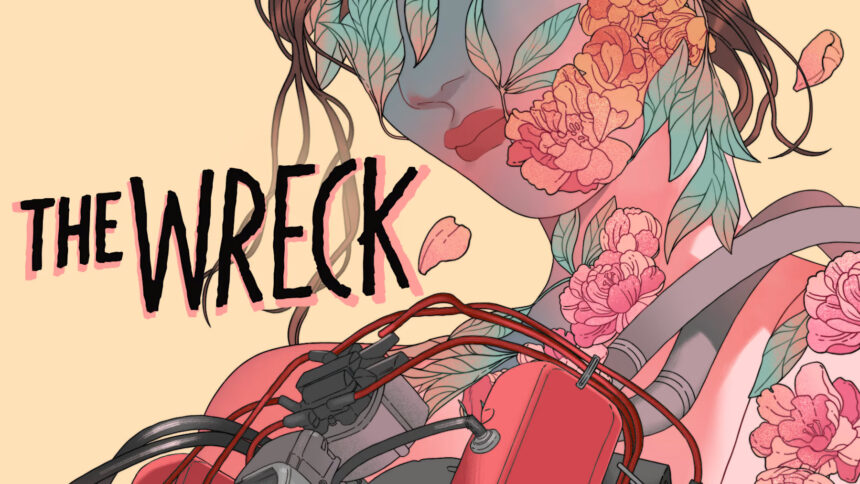
One thing you should know about this game is that the car crash becomes more familiar than the hospital. Junon reaches a point in a conversation she cannot emotionally survive, leaves, drives away, and ends up in the same wreck again. The sequence repeats often enough that I stopped reading it as a literal interruption and started seeing it as the physical shape of avoidance. She cannot deal with what is happening in the present, so her mind sends her somewhere catastrophic but familiar instead. The Wreck builds nearly everything around that cycle, turning a car accident into both a doorway to the past and a representation of how difficult it is for Junon to remain in the moment when the present asks too much of her.
Before any of that, the game asks me to name a document. Junon is a screenwriter, and the blank file inside her Screenplayer app looks almost comically ordinary compared with what the rest of her day will become. Her mother Marie has been rushed to the hospital in critical condition, and Junon discovers that she has been placed in the position of making decisions about her mother’s care. Worse, Marie arranged that responsibility without properly involving her. Junon’s signature was forged onto the relevant paperwork, leaving her with an enormous decision she never agreed to carry.
That violation matters because Junon and Marie are already carrying years of unresolved resentment into the hospital. The medical emergency does not magically flatten their relationship into sentimental concern for an ill parent. Junon can be frightened for her mother and furious with her at the same time. The Wreck is comfortable letting those feelings coexist, which makes the hospital conversations much more believable than if everyone immediately became forgiving because death had entered the room.
When those conversations become overwhelming, the crash interrupts them. Objects are thrown loose inside the wreck, and selecting one sends Junon into a memory associated with it. That makes the wreck function almost like a menu built from trauma. Instead of choosing a flashback from a neat chapter list, I sift through debris from an event Junon cannot stop reliving and use those objects to enter moments her mind has connected to the present crisis.
The memory sequences are where The Wreck becomes most mechanically distinctive. A scene initially unfolds on its own before becoming something I can scrub backward and forward. Left-clicking advances the memory while right-clicking rewinds it, with the camera travelling along a predetermined path through the scene. Words and fragments of Junon’s thoughts appear throughout the environment, and finding them allows her to examine the memory more closely until she understands enough to move forward.
I liked the concept much more than I always liked controlling it. Because the camera follows a fixed track, getting the exact moment or viewpoint I wanted could become awkward, especially when I already understood what a memory was showing me and simply needed to locate the remaining interactive fragment. The game generally requires the important pieces to be found before progression continues, so there were moments when reflection turned into searching.
The better memories justify that friction. Junon and Diane finding an injured bird as children reveals something about the sisters that would lose its texture if reduced to exposition. A later birthday memory adds another layer to that relationship from a completely different emotional angle. The first apartment Junon shared with Alex does similar work for a relationship that no longer exists in the same form. These scenes are effective because they rarely announce themselves as the definitive explanation for a character. They accumulate.
Diane especially benefits from that structure. She is not simply the sister who arrives whenever the screenplay needs someone to explain Junon’s childhood. Seeing the two of them at different ages allows affection, resentment, competition, and shared history to sit beside one another without needing one conversation in the hospital to summarize their entire relationship. Something that looks trivial in one memory can feel much heavier once another has changed the context around it.
Alex works similarly as Junon’s estranged husband. Memories involving him are not there simply to explain why their relationship failed. They show how the relationship existed before it became whatever Junon now thinks of it as, which is more valuable. The Wreck repeatedly uses hindsight this way. Junon already has conclusions about the people in her life, but revisiting the past forces her to confront the possibility that memory has compressed complicated relationships into easier stories.
Marie is harder to pin down, which feels appropriate. Junon remembers her not only as a mother but as an artist with her own ambitions, failures, selfishness, and emotional distance. That distinction prevents Marie from existing solely as the sick parent lying in a hospital bed. The woman Junon is being asked to make decisions for is also the person whose choices helped produce some of the anger Junon is carrying into that decision.
The five-chapter structure keeps the entire story attached to one pivotal day even while the memories stretch across years. Once the game has been completed, individual chapters can be revisited, but the first playthrough benefits from being forced forward with Junon. I could not simply jump backward whenever I wanted to inspect something again. Her past arrives when the present makes it unavoidable.
Thoughts also function as a lighter form of interaction outside those memories. Words appear around Junon’s internal monologue, and selecting them can push her thinking further or open additional responses in conversation. Most of those choices are less about rewriting the plot than helping Junon process what is happening. That fits a story where the player’s influence is largely interpretive. I am not creating a completely different Junon with every decision. I am helping her arrive at perspectives she might otherwise avoid.
That approach culminates in the final decision. The game eventually presents three possibilities, but even there it allows one last act of revision before Junon commits. The framing through Screenplayer makes that moment work because editing has been part of her identity from the beginning. She is a screenwriter trying to make sense of a day that refuses to behave like something she can neatly outline, and the final act of choosing becomes less about selecting a conventional ending than deciding what she will do with everything she has remembered.
The 3D presentation gives those memories a distinctive visual rhythm. Characters use cel-shaded models while the camera frequently sweeps, pans, and reframes scenes as Junon moves through them. The environments stay relatively grounded, with much of the present-day material concentrated around hospital rooms, corridors, the cafeteria, and a rooftop. That limited geography suits the story because the hospital increasingly feels like somewhere Junon cannot escape until she deals with what brought her there.
The character animation is less successful. Bodies can look stiff during scenes that need delicate physical performances, and there were times when the writing was communicating far more emotion than the models could visibly carry. That disconnect pulled me out of some otherwise strong conversations. The close camera work makes the problem more noticeable because the game often wants me watching small gestures that the animation is not always capable of selling.
The voice acting compensates for much of that stiffness. Sharlit Deyzac gives Junon enough weariness, sarcasm, anger, and vulnerability that the character feels far more alive in sound than the animation can always express visually. The wider cast handles the heavier material with similar restraint. Nobody needs to perform every painful conversation at maximum intensity for the stakes to register.
Adrien Larouzée and COLORSWAP divide the soundtrack between the present and Junon’s memories. The released score contains ten tracks running for about thirty-two minutes, with Larouzée contributing the hospital and present-day cues while COLORSWAP handles the more dreamlike memory material. I liked the difference because the past does not sound merely like another location. It feels slightly detached from the day Junon is currently trying to survive.
The contrast is especially useful when the game slips from a difficult conversation into a memory. The music helps separate emotional spaces without making the flashbacks feel disconnected from the same person experiencing them. There is sadness throughout the score, but it rarely becomes aggressively manipulative. The writing is already doing enough.
The Wreck’s central crash also has a real-world origin. The project’s initial idea grew from a car accident involving The Pixel Hunt founder Florent Maurin and his young daughter. Neither was seriously injured, but the experience of thoughts and memories rushing forward during the collision became the seed for the game’s repeated movement between an accident and fragments of a life. That origin explains why the wreck itself never feels like an arbitrary metaphor pasted onto a family drama. The connection between sudden danger and involuntary memory is built into the game’s foundation.
The Pixel Hunt had already made Bury Me, My Love and contributed to Inua: A Story in Ice and Time before releasing The Wreck in March 2023. The studio’s interest in what it calls reality-inspired games carries naturally into Junon’s story, where the dramatic premise remains grounded in recognizable family damage rather than depending on supernatural explanation. The game later expanded beyond its original PC and console release to mobile platforms as well.
That mobile version earned The Wreck the 2024 Apple Design Award for Social Impact and later the 2024 App Store Award for Cultural Impact. Those awards make sense in the context of what the game is trying to do, but the more important achievement for me is smaller. It takes a crisis that could easily become melodramatic and keeps narrowing it back down to one woman trying to survive a day while discovering that the memories she uses to explain herself may be incomplete.
The whole experience lasts roughly five hours, and I think that concentration helps it. The memory-search mechanic would probably become exhausting in a game twice as long, especially with the fixed camera and requirement to uncover every important thought. Here, the repetition has enough time to become meaningful without completely losing its effect.
Verdict
The Wreck turns avoidance into a mechanic, using the same crash to pull Junon through memories she would rather leave untouched. Its stiff animation and occasionally awkward memory camera hold back scenes that are otherwise beautifully written and performed, but the family relationships and final decision still land with considerable weight.