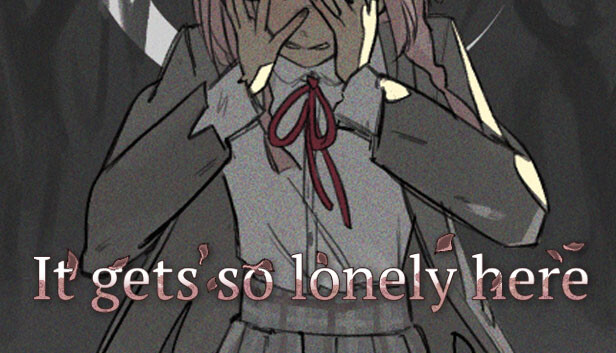
Reaching a fork in the road while being chased feels like salvation right up until every direction starts looking like another kind of trap. It gets so lonely here takes that simple fairy-tale image and turns it into the foundation for an entire yandere story, where choosing somewhere to hide also means choosing who gets the opportunity to love you far more intensely than you ever asked for.
The protagonist is running through a pitch-black forest with no map, plan, or destination beyond getting away from the mysterious presence pursuing her. Eventually, the path divides and gives her three possible destinations, each introducing a different woman: a mermaid, a gravedigger, or a princess. Those encounters form the game’s three main routes, gradually revealing that the danger waiting at the end of each path might be different in appearance but remarkably similar in intent.
That repetition is deliberate, and it’s where the title starts doing more work than I initially expected. Every woman I meet is lonely in her own way, and each relationship offers the protagonist an apparent escape from being alone. The problem is that affection here rarely understands where love should stop. Companionship becomes possession so easily that even initially inviting situations carry the uncomfortable sense that accepting someone’s kindness might eventually cost the protagonist her freedom.
The three heroines give that obsession different fairy-tale faces. The mermaid fits naturally into the story’s more ethereal side, the gravedigger brings the imagery somewhere earthier and more morbid, and the princess turns the familiar promise of sanctuary in a castle into something considerably less reassuring. I liked how immediately readable those archetypes are. Ebi-hime doesn’t need extensive worldbuilding to explain what kind of story I’m entering because the locations and characters already carry centuries of fairy-tale associations with them.
The downside is that the routes don’t always feel equally substantial as individual character studies. Their circumstances change, but they’re all serving variations on the same larger idea, so I occasionally wanted more time devoted to what made each woman psychologically distinct rather than another expression of obsessive affection. At roughly 50,000 words across the whole game, there simply isn’t enough space for three enormous romance arcs alongside the larger mystery.
What gives the structure more depth is the narrator. She isn’t a neutral voice describing what I see; she’s arch, amused, and unusually interested in the protagonist’s terrible decisions. That gives even basic narration personality and creates the uncomfortable impression that someone is always watching this escape attempt from somewhere just outside the frame. In a story already built around being pursued, having the narrative voice itself feel intrusive is particularly effective.
Choices matter more than my original impression of the game suggested. This isn’t a kinetic novel with three nearly cosmetic diversions, but a branching story with several decisions, three central routes, and multiple endings. Seeing everything takes more than simply picking one road and stopping there, and the larger structure gradually gives those apparently separate fairy tales a reason to belong together.
That made replaying feel purposeful rather than completionist. Once I understood the pattern behind one route, entering another wasn’t simply a matter of meeting a differently designed yandere and repeating the same romance. Similarities between the stories started becoming information in themselves. The more often the protagonist tries to escape loneliness through another person, the harder it becomes to ignore what the game is actually saying about the kind of affection she’s encountering.
Visually, the 800×600 presentation is an intentional choice meant to give the game an old-fashioned aesthetic, and it fits the fairy-tale framing surprisingly well. Mossinasi’s character artwork supplies the three heroines with distinct silhouettes and identities, while the backgrounds draw from Creative Commons photography and imagery rather than trying to imitate the character art. Elduator’s GUI helps bind those different visual sources together into something that feels deliberately storybook-like rather than mismatched.
Yuzuki’s custom soundtrack is another important part of that atmosphere and comes bundled separately with the visual novel. The music doesn’t need to make the story frightening on its own; the writing already provides enough unease. Instead, it helps distinguish the different fairy-tale spaces and gives the quieter stretches enough beauty that the protagonist’s temptation to stay with these women makes emotional sense rather than looking obviously foolish from the beginning.
For all the disturbing ideas underneath it, the presentation is notably restrained. Ebi-hime explicitly warns about drowning, being buried alive, cannibalism, bullying, and veiled references to homophobia, but also states that the visual novel contains no explicit textual or graphical depictions of blood or gore. The darkness comes primarily from implication and circumstance rather than graphic imagery. That restraint suits a story about loneliness better than excess would have. The disturbing part isn’t simply that dangerous women wait at the ends of three roads. It’s that every encounter offers something the protagonist genuinely wants before revealing what accepting that affection might require. The forest makes being alone frightening; the people she finds make companionship frightening too. Suddenly that fork in the road doesn’t look much like an escape at all.
Verdict
It gets so lonely here turns a simple fairy-tale choice between three roads into a compact exploration of loneliness, obsession, and affection that refuses to respect boundaries. Its mermaid, gravedigger, and princess don’t always receive enough individual development to escape the similarities between their routes, but that repetition also feeds the larger pattern the story is constructing. The intrusive narrator, branching structure, old-fashioned presentation, and custom soundtrack give the game considerably more personality than its short runtime suggests. At around two to three hours and completely free, it understands exactly how long its central idea can remain unsettling before the fairy tale needs to reveal what has really been chasing me through the woods.